
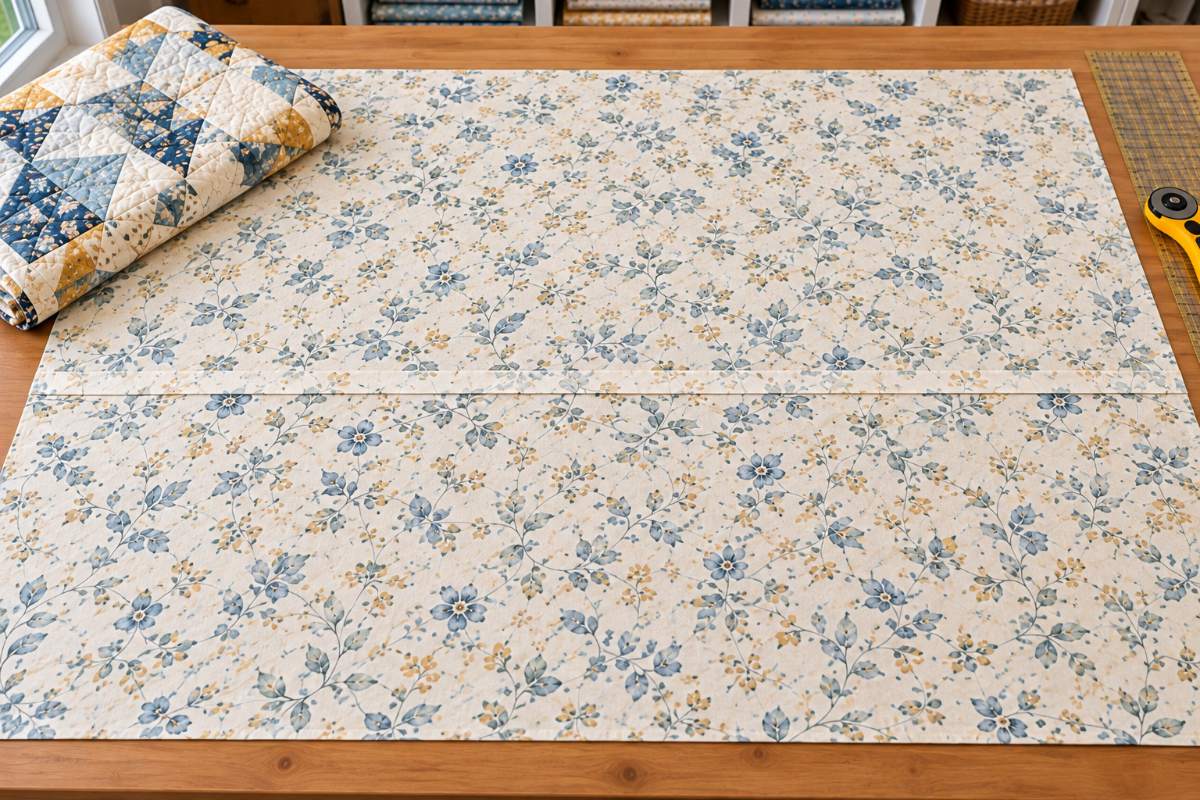
Quilt backing should be about 4 inches bigger than your quilt top on every side. That means the backing is 8 inches wider and 8 inches longer than the top. Regular quilting cotton is only 42 to 44 inches wide, so most quilts need two or three panels sewn together. A 108-inch-wide backing covers most quilts up to queen size in one piece.
QuiltGearHQ is a participant in the Amazon Services LLC Associates Program, an affiliate advertising program designed to provide a means for sites to earn advertising fees by advertising and linking to Amazon.com.
For example, a 60 by 70 inch throw needs a 68 by 78 inch backing. That is about 3 7/8 yards of regular quilting cotton with one seam, or 2 yards of 108-inch-wide backing with no seam. Enter your quilt size in the Quilt Backing Calculator below to see your yardage, cut plan, and the seam layout that uses the least fabric.
Table of Contents
Quilt Backing Calculator
Measure your finished quilt top across the middle in both directions, and use those numbers instead of the pattern size. The calculator adds the extra on each side, removes 1/2 inch for each seam, and rounds up to the next 1/8 yard. If you have not picked a quilt size yet, our quilt size chart lists the standard sizes for every bed.
Quilt Backing Calculator
Enter the size of your finished quilt top. The calculator compares regular quilting cotton with wide backing and shows the seam layout that uses the least fabric.
Quilt Backing Calculator by QuiltGearHQ.com. Free to use. Seams are figured at 1/2 inch. Results round up to the next 1/8 yard. Check with your longarm quilter before you buy.
The highlighted row shows the regular cotton layout that uses the least fabric. If you add prices, the calculator also tells you whether regular cotton or wide backing costs less for your quilt.
How Big Should Quilt Backing Be?
Make the backing at least 4 inches larger than the quilt top on all four sides. Maple Leaf Quilting Company puts it simply: add 8 inches to the quilt length and 8 inches to the quilt width. Others ask for a little more or a little less. Nebraska Quilt Company recommends at least 4 to 5 inches on every side. Christine Baker, writing for Quilt Social, says the backing should be 6 to 8 inches longer and wider than the top, with at least 3 inches on every side.
The extra fabric is not wasted. A longarm machine holds the backing on a frame with clamps and fabric strips called leaders, which take up some of the edge. Seasoned Homemaker, a quilting blog, adds the same 4 inches in its calculator to allow for quilting, loading, and basting. If you send your quilt to a longarm quilter, ask how much extra they need before you buy fabric. If you are new to longarm quilting, our guide to what longarm quilting is explains how the frame works.
Your quilt batting needs extra room around the top too, so plan for it when you buy backing.
Quilt Backing Yardage Chart
This chart uses the calculator settings: 4 inches extra on every side, 40 inches of usable width for regular quilting cotton, and 106 inches of usable width for 108-inch-wide backing. Quilt sizes vary by pattern, so the sizes below are examples. Use the calculator for your exact quilt.
| Quilt size (example) | Backing size | Regular cotton | Panels and seam direction | 108 in wide backing | 118 to 120 in wide backing |
|---|---|---|---|---|---|
| Baby, 40 x 50 in | 48 x 58 in | 2 3/4 yd | 2 panels, seam side to side | 1 3/8 yd | 1 3/8 yd |
| Throw, 60 x 70 in | 68 x 78 in | 3 7/8 yd | 2 panels, seam side to side | 2 yd | 2 yd |
| Twin, 70 x 90 in | 78 x 98 in | 5 1/2 yd | 2 panels, seam top to bottom | 2 1/4 yd | 2 1/4 yd |
| Full, 84 x 92 in | 92 x 100 in | 7 3/4 yd | 3 panels, seams side to side | 2 5/8 yd | 2 5/8 yd |
| Queen, 90 x 100 in | 98 x 108 in | 8 1/4 yd | 3 panels, seams side to side | 3 yd | 2 3/4 yd |
| King, 108 x 108 in | 116 x 116 in | 9 3/4 yd | 3 panels, seams either way | 6 1/2 yd (2 pieces, 1 seam) | 3 1/4 yd (almost no spare width) |
Two things stand out. Wide backing needs far less yardage for big quilts, and your seam direction can change how much regular cotton you buy by a yard or more.
Regular Quilting Cotton or Wide Backing?
Regular quilting cotton comes on a bolt that is about 42 to 44 inches wide. For example, Robert Kaufman lists its Kona Cotton solids at 44 inches wide. After you cut off the selvages (the woven edges on each side), you have about 40 to 42 inches to use. Wide backing is made for quilt backs. It is usually 106 to 108 inches wide, and some is 118 to 120 inches wide.
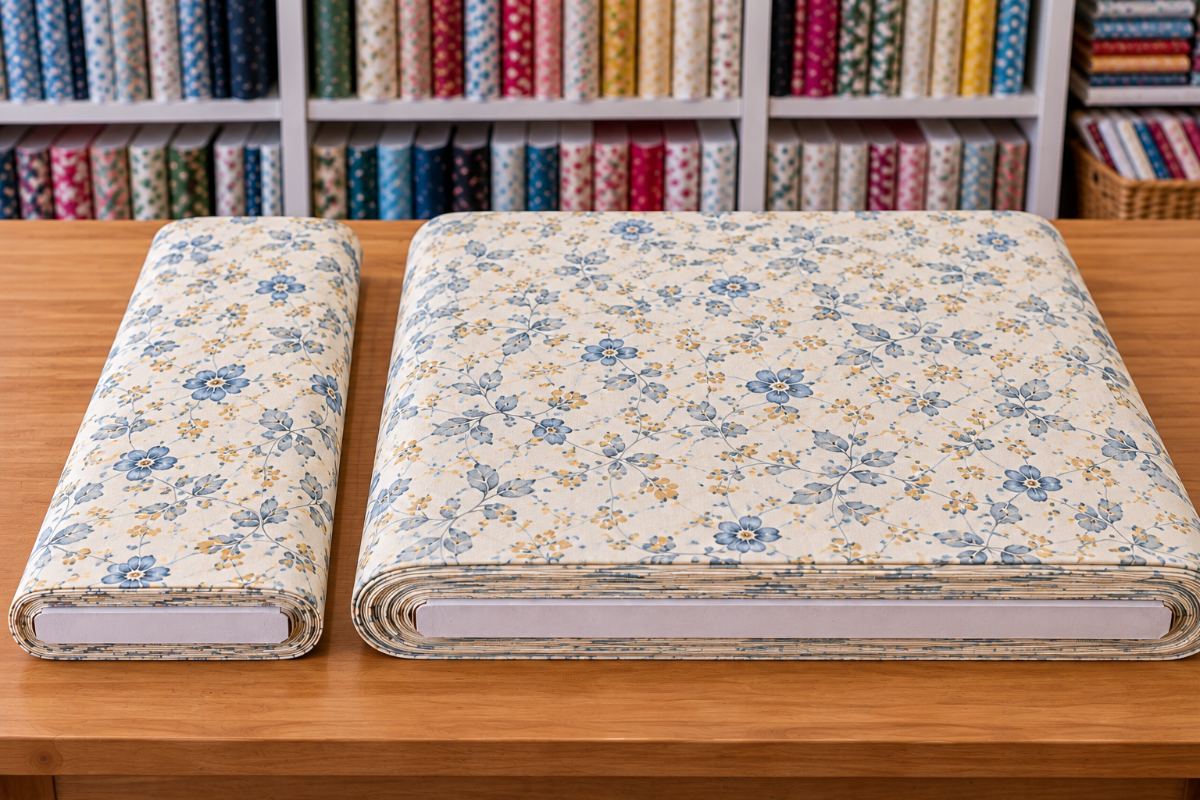
Choose wide backing when you want to skip seams and save time. It is the simplest choice for quilts larger than a throw, and it often needs less than half the yardage. It costs more per yard, so use the calculator's price boxes to compare.
Choose regular quilting cotton when you want a print that matches your quilt top, when you have fabric left over from the top, or when the quilt is small. Baby quilts and small throws often need only one seam.
Which Way Should the Backing Seams Run?
You can sew backing panels together so the seams run top to bottom or side to side. Both work. In most cases, choose the option that uses less fabric. The calculator shows both, so you can compare.
Christine Baker, writing for Quilt Social, gives this rule of thumb based on the finished quilt width:
- Quilts 60 inches wide or less: one seam that runs side to side.
- Quilts 61 to 80 inches wide: one seam that runs top to bottom.
- Quilts wider than 80 inches: three lengths of fabric with two seams that run top to bottom.
Nebraska Quilt Company says many longarm quilters prefer seams that run side to side, because those seams roll onto the frame more evenly. A seam that runs top to bottom can build up a small bump in the middle of the roller. If someone else is quilting your quilt, ask which seam direction they want before you sew.
How to Sew a Pieced Quilt Back
These steps follow the advice from the longarm quilters and quilt shops above.
- Measure the finished top. Measure through the middle, after you square up the quilt top. Add the extra for every side.
- Cut the panels. Cut each panel to the length the calculator shows. Cut straight across the fabric so the ends are square.
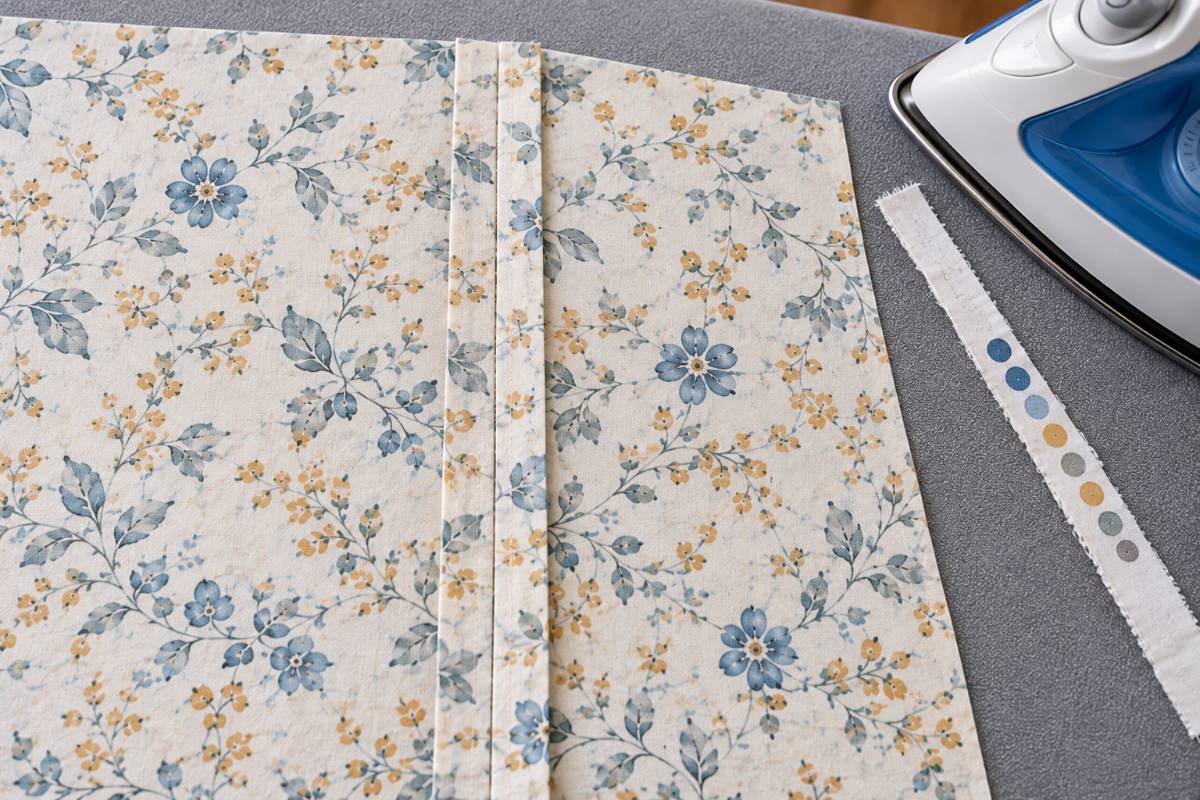
- Trim the selvages on the edges you will sew together. Selvages don't stretch like the rest of the fabric, so a seam with selvage in it can pull and pucker when you stretch the backing on a frame. You can leave the selvages on the outside edges.
- Sew with a 1/2 inch seam allowance. That is wider than the usual 1/4 inch quilting seam. Both Christine Baker and Nebraska Quilt Company use a 1/2-inch seam allowance for backing seams.
- Press the seams open. Pressing the seam open reduces bulk where the panels meet.
- Square and press the whole backing. Make sure the backing has no extra fullness or folds. Wide backing often has deep creases from the bolt, so press it well before you use it.
If your backing fabric has a print that points one way, cut the right selvage off one panel and the left selvage off the other. That keeps the print facing the same way on both sides of the seam. If you plan to baste the layers yourself, our guide to the best basting spray for quilting covers the spray method.
Our Picks for Wide Quilt Backing
These picks come from the product listings and maker details we checked. Prices change often, so check the current price before you buy.
Best Overall: Kona Cotton 108 Inch Wide
A 100 percent cotton solid backing from Robert Kaufman, sold by the yard.
- From the maker of Kona Cotton solids
- Covers most quilts up to queen size with no seam
- Costs more per yard than regular cotton
- Press out the bolt creases before use
The Kona Cotton 108-inch-wide quilt back is 100% cotton broadcloth from Robert Kaufman, the company that makes Kona Cotton solids. It comes in many solid colors, so you can match it to your quilt top. The listing says to machine-wash it cold and tumble-dry it on low.
Best Precut: Roc-lon 108 Inch Wide, 3 Yards
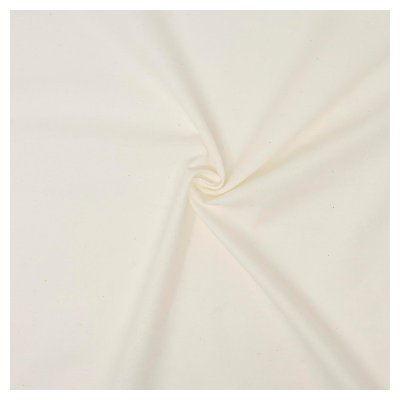
A preshrunk cotton backing sold as one 108 by 108 inch piece.
- One 3 yard piece covers most quilts up to queen size
- Preshrunk, so it stays close to its cut size
- Sold as a precut, so it may be more than a small quilt needs
- Listed as lightweight
The Roc-lon 108- inch wide quilt backing comes as one continuous piece, 3 yards long and 108 inches wide. The listing calls it preshrunk 100 percent cotton. Because it is already cut to 108 by 108 inches, it is an easy choice for a twin, full, or queen quilt.
Best for King Quilts: Roc-lon 118 to 120 Inch Wide
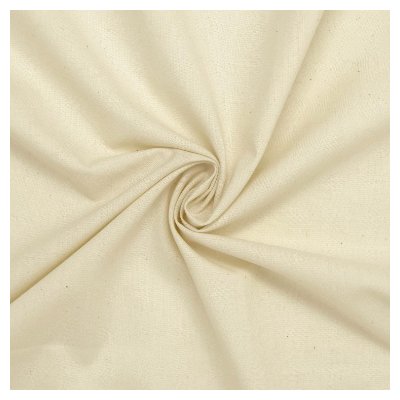
An extra wide unbleached cotton backing, cut by the yard.
- Wide enough to back a 108 inch king quilt in one piece
- Cut by the yard, so you buy only what you need
- This listing is unbleached white
- The listing says it can still shrink 3 to 5 percent
A 108-inch king quilt needs a backing about 116 inches wide, which is too wide for most 108-inch backing. The Roc-lon 118 to 120 inch wide backing solves that. It is 100 percent cotton with a crease-resistant finish, and the listing notes 3 to 5 percent shrinkage. A 116-inch backing uses almost all of that width, so measure the fabric before you cut, and prewash it if you want to remove the shrinkage first.
Common Quilt Backing Mistakes
Measuring the pattern instead of the quilt. Your finished top may not match the pattern size exactly. Measure your own top before you buy fabric.
Forgetting the extra on each side. A backing the same size as the top leaves no room for the longarm frame or basting. Our guide on how to baste a quilt covers that next step. Add at least 4 inches on every side unless your quilter asks for something else.
Leaving selvages in the seams. Trim them off the edges you sew together so the seam can stretch with the rest of the backing.
Not planning for shrinkage. Cotton can shrink in the first wash. Nebraska Quilt Company says most 100 percent cotton fabrics shrink 3 to 5 percent the first time they are washed, and it adds an extra 1/4 yard to its own backing estimates for shrinkage and squaring. The calculator has a box that adds that 1/4 yard for you.
After quilting, the last step is the binding. Our guide on how to bind a quilt includes a cut sheet that tells you how many binding strips to cut.
Quilt Backing: Common Questions
How much bigger should quilt backing be than the quilt top?
Most backing guides and longarm quilters recommend about 4 inches extra on each side. That makes the backing 8 inches wider and 8 inches longer than the quilt top. Some longarm quilters ask for 5 inches or more, so check with yours before you buy.
How much backing fabric do I need for a queen quilt?
For a 90 by 100 inch queen quilt with 4 inches extra on each side, you need about 8 1/4 yards of regular 42 to 44 inch quilting cotton, sewn in 3 panels. With 108-inch-wide backing, you need about 3 yards and no seams.
How many yards of 108-inch wide backing do I need for a king quilt?
A 108 by 108 inch king quilt needs a backing about 116 inches square. That is wider than most 108-inch-wide backing, so you would need two pieces and one seam, about 6 1/2 yards. A 118- to 120-inch-wide backing covers it in one piece, about 3 1/4 yards, with almost no spare width.
Should quilt backing seams go across or down?
Either works, so choose the layout that uses less fabric. Many longarm quilters prefer seams that run side to side, because they roll onto the frame more evenly. If someone else will quilt it, ask what they prefer.
What seam allowance should I use for quilt backing?
Use a 1/2-inch seam allowance for backing seams, and press the seams open. Cut the selvages off the edges you sew together because selvages don't stretch like the rest of the fabric and can cause puckering.
The Bottom Line
Make your quilt backing about 4 inches bigger than the quilt top on every side, or more if your longarm quilter asks for it. Regular quilting cotton works well for small quilts and lets you match your top. For anything larger than a throw, 108-inch-wide backing saves seams and yardage, and 118- to 120-inch-wide backing covers a king quilt in one piece. Use the Quilt Backing Calculator to get your exact yardage before you shop.
Want to learn more? Christine Baker explains how to get a quilt ready for a longarm quilter in this Quilt Social article.