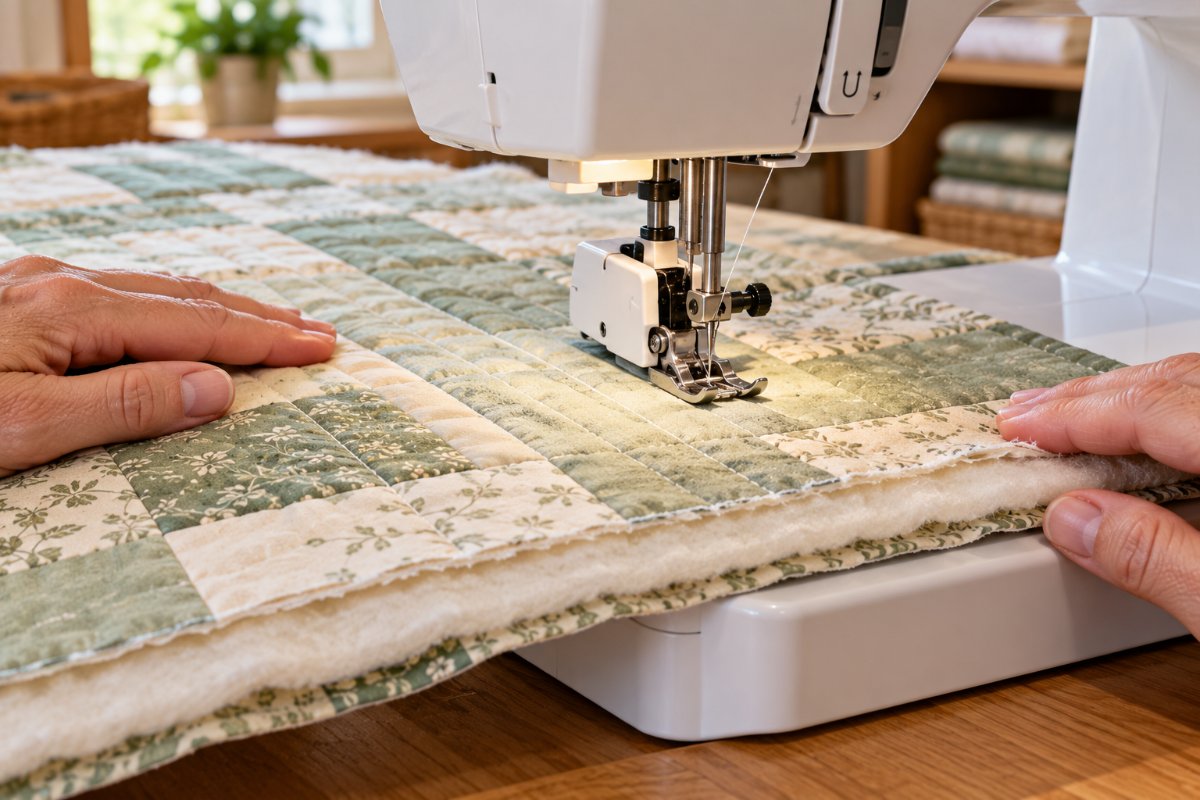
The best quilt batting for machine quilting is the one that matches how you quilt. A batting rated for stitching 10 inches apart forgives wide walking-foot lines, while one rated for 4 inches needs dense free-motion work to hold together in the wash. That one number, printed on every package, matters more than brand loyalty.
QuiltGearHQ is a participant in the Amazon Services LLC Associates Program, an affiliate advertising program designed to provide a means for sites to earn advertising fees by advertising and linking to Amazon.com.
Below are eight battings matched to three machine setups: straight lines with a walking foot, free motion on a home machine, and sit-down or longarm frames. Every stitching distance and shrinkage figure comes from the maker's own product page. We haven't quilted these side by side, so treat this as a spec-based shortlist and make a small sample before a big project. Batting packages are named for quilt sizes, so check our quilt size chart to see which package fits your quilt with room to spare.
Table of Contents
Quick picks: the best quilt batting by machine setup
Here is the short version for each setup. The distance column shows the widest spacing each maker allows between lines of quilting.
| Batting | Fiber | Widest stitching distance (maker) | Shrinkage (maker) | Best for |
|---|---|---|---|---|
| Warm & Natural | Cotton, needled to a thin scrim | 10 inches | About 3% in a cold wash, 5% in warm | Walking foot straight lines and wide grids |
| Warm 80/20 | 80% cotton, 20% poly, cotton scrim, no glue | 10 inches | 3% in the first cold wash | Wide spacing with a lighter feel |
| Hobbs Heirloom 80/20 | 80% cotton, 20% poly, light resin | 4 inches | 3 to 5% | Dense free motion on a home machine |
| Quilters Dream Blend 70/30 | 70% cotton, 30% poly microfiber, poly scrim | Not listed on the product page | Less than all cotton, per the maker | Machine quilting with less puckering |
| Quilters Dream Cotton Select | 100% cotton, no scrim or resin | 8 inches | Minimal | Soft drape for hand or machine |
| Quilters Dream Wool | Merino and domestic wool, thermally bonded | 8 inches | Processed to prevent shrinking and felting | Showing off free motion texture |
| Quilters Dream Poly Select | 100% fine polyester | 12 inches | None with prewashed fabric | Longarm edge-to-edge work |
| Hobbs Heirloom 80/20 Fusible | 80/20 blend, fusible on both sides | 4 inches | 3 to 5% | Skipping pins on a home machine |
How to choose batting for machine quilting
Three things decide how a batting behaves under a presser foot: how far apart you can stitch it, whether it has a scrim, and how much it shrinks.
Stitching distance sets your quilting plan
Every maker lists a maximum distance between quilting lines. Go wider than that, and the fibers can shift and clump inside the quilt after washing. Warm & Natural allows 10 inches, Quilters Dream Poly allows 12, and Hobbs Heirloom 80/20 stops at 4. If you plan loose meanders or a wide diagonal grid, pick a batting rated for the spacing you intend to use.
A scrim helps on the machine
A scrim is a thin web the fibers are needled through. The Warm Company says needle punching entangles the cotton with its scrim, which holds the batting together at wide spacing. Quilters Dream says the scrim in its 70/30 blend resists tugging and reduces puckering. The trade-off is a slightly firmer hand. Battings with no scrim, like Quilters Dream Cotton and Warm & Plush, drape more softly and rely on the fiber itself for strength.
Shrinkage changes the finished look
Cotton shrinks a little in the first wash, which gives that crinkly, vintage texture. Warm & Natural lists about 3% in cold water and 5% in warm. Polyester barely moves, and Quilters Dream says its poly shows no shrinkage when the fabrics were prewashed. For a flat, modern finish, lean toward poly or a blend. If you love crinkle, 100% cotton delivers it.
Match the batting to your machine
On a home machine with a walking foot, a scrim batting with a wide rating keeps the layers from creeping while you sew long straight lines. Our walking foot guide covers the foot itself. For free motion on a home machine, thin, low-loft batting is easier to push through a small throat, and dense quilting suits a 4-inch rating anyway. A machine built for free motion quilting helps too. On a sit-down or longarm frame, you are not wrestling the bulk, so lofty wool and poly load easily and show texture well.
The 8 best quilt batting picks for machine quilting
Each of these suits one kind of quilting, but none suits every quilt. Start with the setup you use most, then read the care notes before you buy.
1. Warm & Natural: best for walking foot straight lines
Warm & Natural is needle-punched (fibers locked together by barbed needles) cotton batting, and the maker says you can quilt it or tie it up to 10 inches apart. That wide rating makes it forgiving for straight line quilting, where rows often sit several inches apart. The Warm Company also says it won't distort when hanging, hooping, or loaded in a quilt frame.
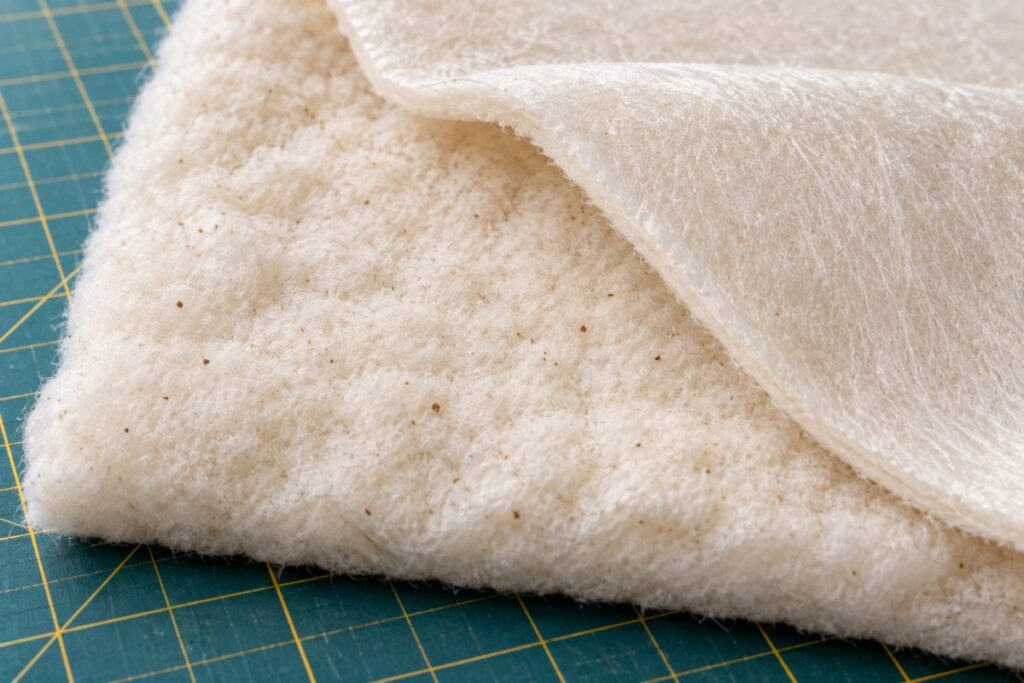
Put the cotton side, the one with tiny leaf and stem specks, toward the quilt top and the scrim side toward the backing. Expect about 3% shrinkage in a cold first wash. It is unbleached, so for white or pastel fabric the company makes Warm & White, which it lists at 0 to 1% shrinkage.
2. Warm 80/20: wide spacing with a lighter blend
Warm 80/20 is 80% cotton and 20% polyester needled into a 100% cotton scrim with no glue. It carries the same 10-inch rating as Warm & Natural and lists 3% shrinkage in the first cold wash. The maker says it clings to the fabric while you quilt, which helps the layers stay put under the foot.
3. Hobbs Heirloom 80/20: best for dense free motion on a home machine
Hobbs Heirloom Premium 80/20 is 80% cotton and 20% fine polyester, needle punched with a light resin bond. At about 1/8 inch loft, it slides easily through a domestic throat. Hobbs rates it excellent for machine quilting and caps the spacing at 4 inches, which lines up with the stipples and feathers most free motion quilters stitch anyway.
Hobbs lists 3 to 5% shrinkage and warns that unbleached cotton can slightly darken white or pastel fabric. The company also suggests making a sample to see how it needles and washes before you commit to a full quilt. That is sound advice for any batting on this list.
4. Quilters Dream Blend 70/30: built for machine quilting
Built for machine quilting from the start, the Quilters Dream Blend 70/30 is 70% cotton and 30% fine polyester microfiber on an ultralight polypropylene scrim, which the maker says adds tug resistance and reduces puckering. The polyester also helps it shrink less and dry faster than all cotton.
Treat that scrim gently. It melts at 250 degrees F, so dry the quilt on low heat, press with a low iron setting, and tell your dry cleaner. The product page doesn't list a maximum stitching distance, so check the package label before you plan wide spacing.
5. Quilters Dream Cotton Select: soft drape with no scrim
Quilters Dream Cotton is 100% cotton with no scrim, resin, or glue. The Select loft is the maker's most popular and works for both hand and machine quilting. You can quilt it as closely as you like or up to 8 inches apart. Shrinkage is minimal, and the company advises against prewashing.
It comes in four lofts. Request is the thinnest and aimed at hand quilters, Select is the midweight, and Deluxe and Supreme are heavier options for machine-quilted wall hangings, bags, and very warm quilts.
6. Quilters Dream Wool: best for showing off quilting texture
Wool is the pick when you want free motion work to stand out. Quilters Dream Wool has a thermally bonded loft of more than 1/3 inch, and the maker says it accentuates quilting and suits faux trapunto effects. No scrim or resin is used. You can stitch up to 8 inches apart, and the wool is processed to prevent shrinking and felting.
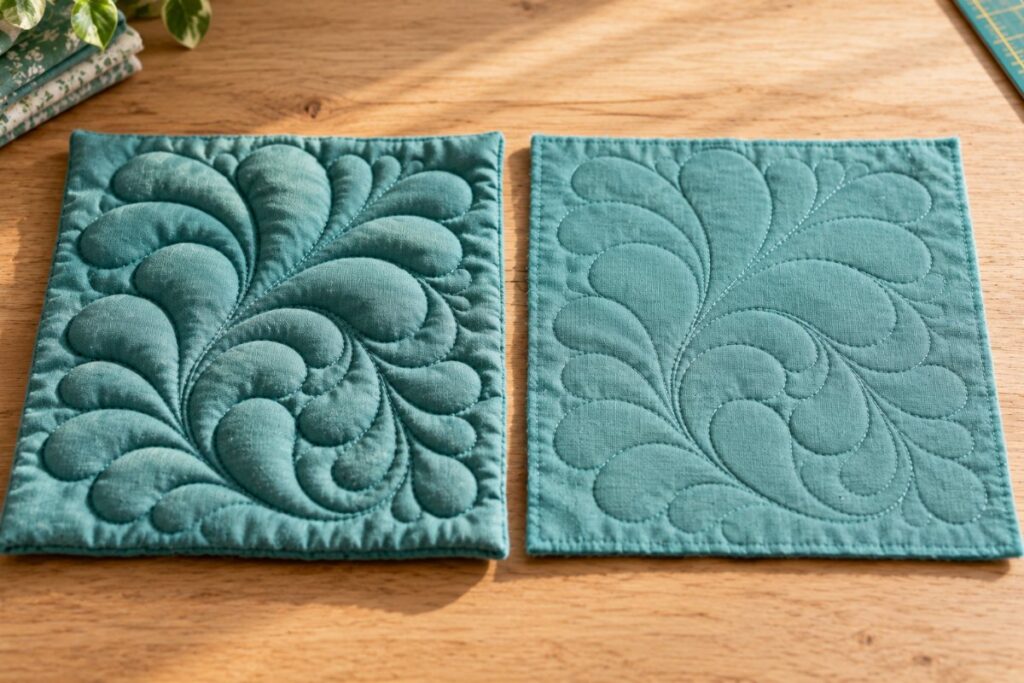
Care is the trade-off. Machine wash and dry on cold, and skip the iron, because heat flattens the loft. If creases appear, the company suggests a short tumble in a cool dryer with a damp cloth. Our guide to the types of quilt batting compares wool with cotton and bamboo in more detail.
7. Quilters Dream Poly Select: best for longarm edge to edge
Quilters Dream Poly is 100% fine denier polyester, and the maker says it is strong enough to stitch up to 12 inches apart, the widest rating on this list. That suits open edge-to-edge pantographs on a longarm (a large quilting machine that rides on a frame), where rows run far apart. It has no resin or scrim, resists bunching and creasing, and shows no shrinkage with prewashed fabric.
Select is the midweight loft for hand and machine work. It also comes in Midnight Black, which matches dark quilts better than white batting. If you are still choosing a frame, see our longarm buying guide.
8. Hobbs Heirloom 80/20 Fusible: best for skipping pins
Basting is the part of domestic machine quilting most people dread. Hobbs Heirloom 80/20 Fusible has a water-soluble fusing medium on both sides, so you press the top and backing to it instead of pinning. Use a dry iron with no steam, press each spot for 5 to 7 seconds working from the center out, and let it cool before tugging to test the bond.
The fusing medium washes out, leaving the batting as soft as the regular Heirloom 80/20. Everything else matches that version: about 1/8 inch loft, a 4-inch maximum, and 3 to 5% shrinkage. If you would rather keep regular batting, our basting spray guide covers the spray route.
Batting mistakes that show up under the needle
Any batting misbehaves when you handle it the wrong way. Most machine problems trace back to a handful of habits.
- Quilting wider than the rating. Lines farther apart than the maker allows can let fibers shift and clump after washing.
- Loading it upside down. On Warm & Natural, the scrim side faces the backing.
- Using steam on fusible batting. The Hobbs fusing medium is water soluble, so steam weakens the bond before you quilt.
- Ironing wool. Heat flattens the loft that makes wool worth using.
- Skipping the sample. Quilt and wash a small square first so shrinkage and loft don't surprise you.
- Blaming the batting for thread trouble. If your top thread keeps snapping, work through our thread breaking checklist before you swap batting.
Frequently asked questions
What is the best quilt batting for machine quilting beginners?
A scrim batting with a wide stitching rating is the most forgiving. Warm & Natural and Warm 80/20 both allow quilting up to 10 inches apart, so a simple straight line or grid quilt holds together even when your lines sit far apart.
Is 80/20 or 100% cotton batting better for machine quilting?
Both work well. An 80/20 blend such as Hobbs Heirloom gets a little extra loft and softness from the polyester, while 100% cotton gives a flatter finish that crinkles more after washing. Stitching distance varies more between brands than between fibers, so check that first.
Which side of the batting goes up?
For Warm & Natural, The Warm Company says the cotton side faces the quilt top and the scrim side faces the backing. On Warm & White, the scrim side is the shinier, smoother one, and it also goes toward the backing. Other brands differ, so read the label.
Do I need to prewash quilt batting?
Usually not. Warm & Natural, Hobbs, and Quilters Dream all say prewashing is not needed, and Hobbs recommends against it for its battings. Washing loose batting can pull the fibers apart, so if you want less shrinkage, choose a poly or a blend instead.
What batting is best for longarm quilting?
Poly and wool load easily and handle wide spacing. Quilters Dream Poly can be stitched up to 12 inches apart, and Quilters Dream Wool up to 8 inches, with extra loft that shows off custom quilting.
Which one to buy
Choose batting by your quilting plan first and the fiber second. For wide walking foot lines, Warm & Natural or Warm 80/20 give you 10 inches of room. For dense free motion on a home machine, Hobbs Heirloom 80/20 is thin and easy to move. Pick wool for texture and Quilters Dream Poly for open longarm pantographs. Whatever you choose, quilt and wash a small sample first. For more, see our picks for the best batting for baby quilts and the best thread for machine quilting.