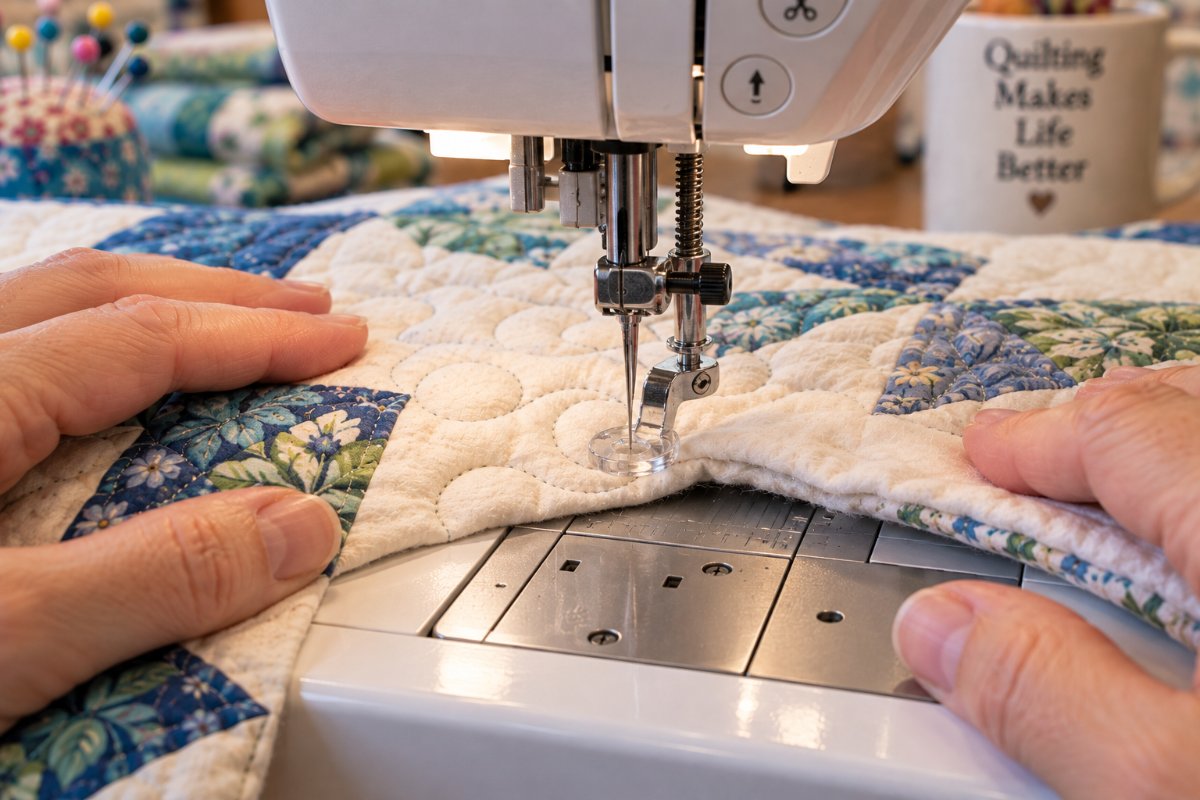
Choosing the best sewing machine for free motion quilting is different from choosing a general sewing machine. Free-motion quilting asks more of a machine than piecing does. You drop the feed dogs, guide the fabric by hand in every direction, and run the machine at a steady speed for long stretches, so a machine that is perfectly fine for piecing can feel frustrating the moment you switch to free motion.
The best sewing machine for free motion quilting comes down to a handful of specific features rather than the number of built-in stitches, and the five machines below cover that range from an affordable starter option to a dedicated high-speed workhorse.
Table of Contents
What Matters for Free-Motion Quilting
Skip the stitch count and focus on these instead. A machine with 200 decorative stitches and a shallow throat will fight you on a full-size quilt, while a straight-stitch-only machine built for speed and stability will often free-motion quilt better than a machine three times its price.
- True feed dog drop. A lever or dial that fully lowers the feed dogs, rather than just covering them with a plate, gives smoother fabric control.
- A darning or free-motion foot. Most machines include one, but check that it is a hopping foot with enough clearance for the batting thickness you use.
- Speed control independent of the foot pedal. A dial or slider that sets a maximum speed lets you keep the needle speed consistent while you control fabric movement by hand.
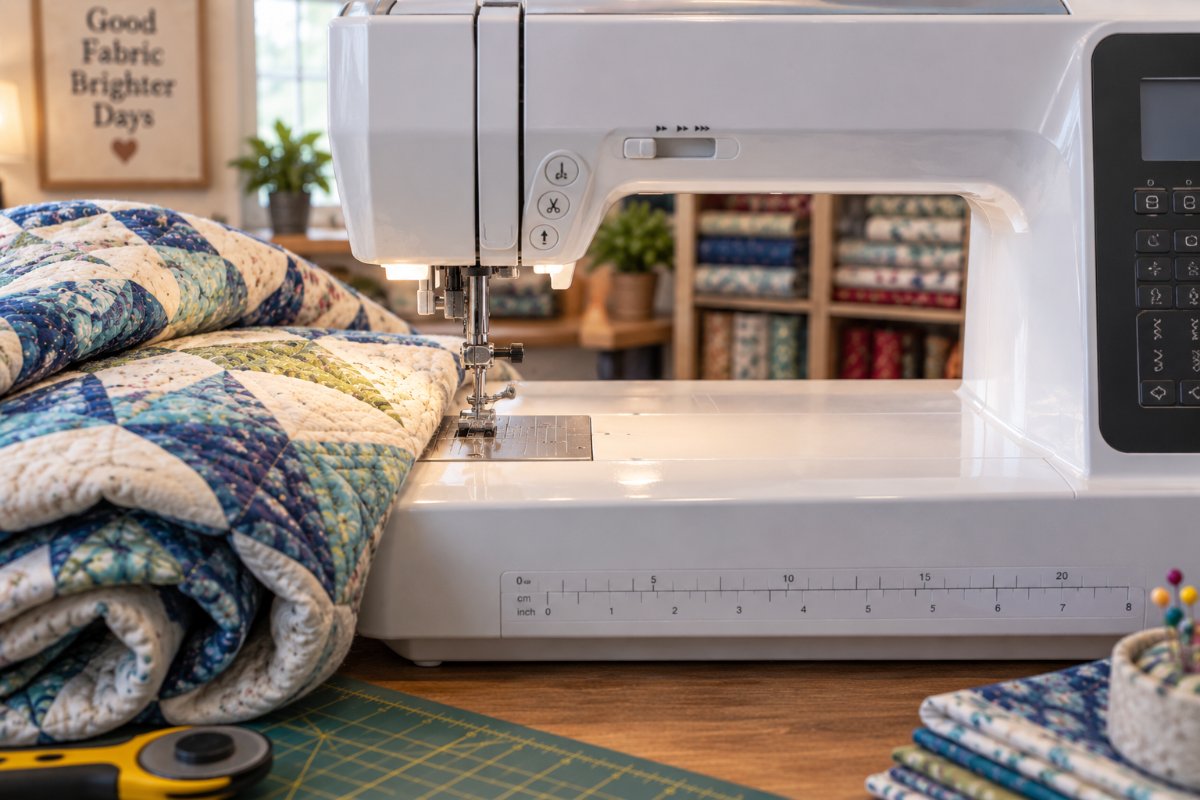
- Throat space. More space to the right of the needle means less bunching and re-rolling on a large quilt. 9 to 11 inches is comfortable for lap and twin quilts.
- A stable, heavier frame. A metal internal frame reduces vibration at sustained speed, which matters more in free-motion work than in normal sewing.
Best Sewing Machine for Free Motion Quilting: Top Picks
Best Budget Option: Janome HD3000 Black Edition
The Janome HD3000 Black Edition has a 4.4-star rating across 332 reviews as of this writing. It has a full metal frame, a true feed-dog drop, and a wide extension table included in the bundle, which gives it more support surface than most machines at this price. It is not a specialist free-motion machine like the options below, but for a quilter who wants to try free-motion quilting without a large upfront investment, the combination of a solid frame and a real feed-dog drop makes it a realistic starting point.
Best for Speed and Stability: Juki TL-2000Qi
The Juki TL-2000Qi has a 4.6-star rating across 913 reviews. It is a semi-industrial, straight-stitch-only machine, which sounds like a limitation until you are free-motion quilting: there are no decorative stitch settings to accidentally bump, the motor is built for sustained high speed without overheating, and the stitch quality stays consistent whether you are sewing slowly through a curve or running the machine flat out across an open area.
Most quilting forums and Facebook groups discussing this exact topic call this the best sewing machine for free motion quilting, and the live search results back that up. The Little Mushroom Cap independently lists it as a top recommendation for the same reasons.
Best Alternative to the Juki: Brother PQ1600S
The Brother PQ1600S has a 4.4-star rating across 47 reviews. It occupies the same high-speed, straight-stitch-only category as the Juki above and is worth cross-shopping if you prefer Brother's bobbin system and accessory ecosystem, or if you find one in stock when the other isn't. Reviews with fewer than 50 ratings should be weighed with that in mind, but the feature set and price point are directly comparable to the Juki TL-2000Qi.
Best for Larger Projects: Janome Memory Craft 6650
The Janome Memory Craft 6650 has a 4.6-star rating across 311 reviews. Unlike the straight-stitch machines above, this is a fully computerized sewing and quilting machine with a wide throat built specifically for machine quilting, plus a large stitch library for quilters who also want decorative and piecing stitches on the same machine.
The higher price reflects the wider throat and computerized features rather than better free-motion mechanics on their own, so this is the pick for a quilter who wants one machine that does everything well rather than a dedicated free-motion workhorse. Quilters shopping for the best sewing machine for free-motion quilting at this price point are usually also comparing throat space and stitch libraries, not just free-motion performance.
Setting Up Any Machine for Free-Motion Quilting
Whichever machine you choose, the setup steps are the same. Drop the feed dogs fully, attach a darning or free-motion foot, and set your top tension slightly looser than your normal piecing tension, then test on a scrap sandwich made from the same fabric, batting, and thread as your actual project. If you run into skipped stitches once you start quilting, see our guide to how to fix skipped stitches when free motion quilting for the most common causes.
If you also want to add embroidered blocks or labels, our guide to the best sewing machine for quilting and embroidery compares combo machines.
Frequently Asked Questions
Do you need a special sewing machine for free motion quilting?
You don't need a specialized machine, but the best sewing machine for free motion quilting for your situation does need a true feed-dog drop and a darning or free-motion foot. Many domestic machines already sold for general sewing and quilting can free-motion quilt smaller projects. The machines above are worth the upgrade mainly for larger quilts and sustained sessions, where speed control and throat space start to matter.
Can I do free motion quilting on a regular sewing machine?
Yes, as long as the machine's feed dogs can be dropped or covered and it accepts a darning or free-motion foot. Smaller projects like table runners, placemats, and baby quilts are realistic on most regular machines. Full-size quilts get harder to manage on a machine with a shallow throat, which is where a machine built for free-motion quilting starts to earn its price.
What sewing machine do most quilters use for free-motion quilting?
Among quilters who free-motion quilt regularly and post about their setups online, straight-stitch, high-speed machines like the Juki TL-2000Qi and Brother PQ1600S come up most often, specifically because they are built for the sustained speed and simplicity that free-motion work rewards. Quilters who also want a single machine for piecing and decorative stitching tend to choose a full-featured computerized machine instead.
Is a stitch regulator worth it for free motion quilting?
A stitch regulator senses how fast you move the fabric and adjusts the needle speed to keep stitch length even, which is genuinely useful for quilters who struggle with consistent stitch length on the best sewing machine for free motion quilting they already own. This feature is found mainly on higher-end and longarm machines rather than the domestic machines above, and it adds significantly to the price, so it is worth considering once you have some free-motion experience and know stitch-length consistency is your specific struggle, rather than a starting requirement.
Bottom Line
The best sewing machine for free motion quilting depends more on feed-dog drop, throat space, and speed stability than on stitch count or price alone. The Janome HD3000 is a reasonable place to start without a large investment. The Juki TL-2000Qi and Brother PQ1600S are the two most commonly recommended dedicated options for serious free-motion work, and the Janome MC6650 suits a quilter who wants one computerized machine that handles piecing, decorative stitching, and free-motion quilting all in one. For beginners still deciding on a first machine more broadly, see our guide to the best sewing machine for quilting beginners.
2 thoughts on “Best Sewing Machine for Free Motion Quilting in 2026”