Nothing derails a good free-motion quilting session like a needle that stops catching thread. One second you are moving smoothly across the quilt top, and the next you are staring at a row of loose, unlooped stitches that pull apart the moment you touch them. Learning how to fix skipped stitches when free motion quilting usually comes down to one of a handful of common causes, and most of them take a few minutes to rule out.
A skipped stitch happens when the machine's hook misses the loop of top thread as the needle rises, so no stitch forms at all. It is a timing problem between the needle and the hook, and almost everything below is really a different way that timing gets thrown off. Working through these causes in order is the fastest way to stop skipped stitches when free motion quilting for good.
Table of Contents
Why Skipped Stitches Happen During Free-Motion Quilting
Skipped stitches when free motion quilting are rarely a sign of a broken machine. Most quilters trace the problem back to the needle, the thread path, or the tension settings rather than anything mechanical inside the machine itself. The five causes below account for the large majority of cases quilters report in forums and Facebook groups, and they are worth checking in this order because the first two are the fastest to rule out.
- A dull, bent, or wrong-type needle. A needle does not have to look damaged to be the problem. Universal needles struggle with the constant direction changes of free-motion work, and a needle that has quilted even one full-size top can be dull enough to cause skipping.
- The needle is not fully seated. If the needle was not pushed all the way up into the clamp and tightened, it sits at the wrong height for the hook to catch the thread loop reliably.
- Top tension set too tight. This is one of the most commonly missed causes because a skipped stitch looks like a bobbin problem. Tight top tension can pull the loop back before the hook has a chance to catch it.
- Thread that does not match the needle or fabric. A needle sized for piecing thread will struggle with a thicker quilting thread, and glue from fusible web or heavily starched fabric can add drag that throws off the loop.
- Lint or a burr in the bobbin case or hook race. Compressed lint changes how smoothly the hook spins, and a nicked or scratched bobbin can catch the thread at the wrong moment.
Step-by-Step: How to Fix Skipped Stitches When Free-Motion Quilting
1. Put in a Fresh, Correct-Type Needle
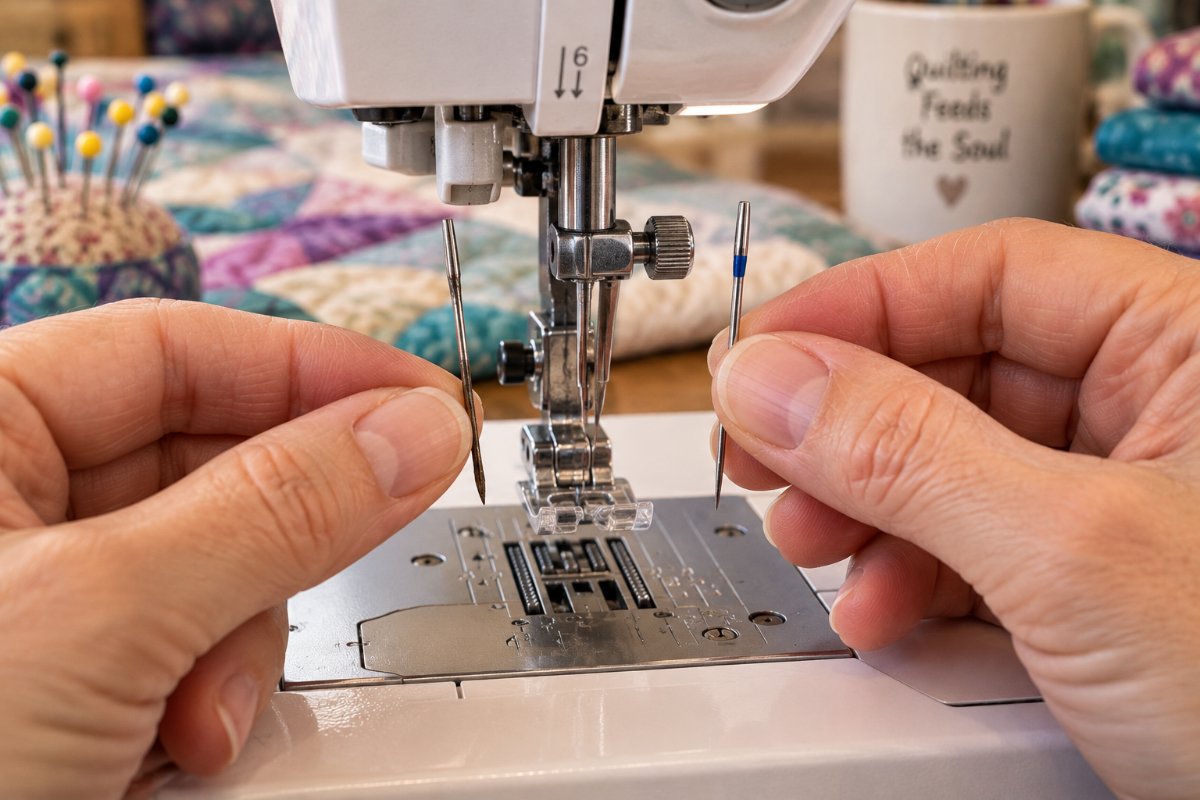
Start here every time, since it fixes the largest share of skipped-stitch problems on its own. Use a quilting or topstitch needle in a size that matches your thread weight, typically 80/12 to 90/14 for standard cotton quilting thread. Make sure the needle is pushed all the way up into the clamp with the flat side facing the correct direction for your machine, then tighten the clamp screw fully. If you are quilting through fusible web or a heavily fused applique, a jeans or Microtex needle sheds the extra glue better than a standard quilting needle and needs changing more often than usual.
2. Check and Adjust Your Top Tension
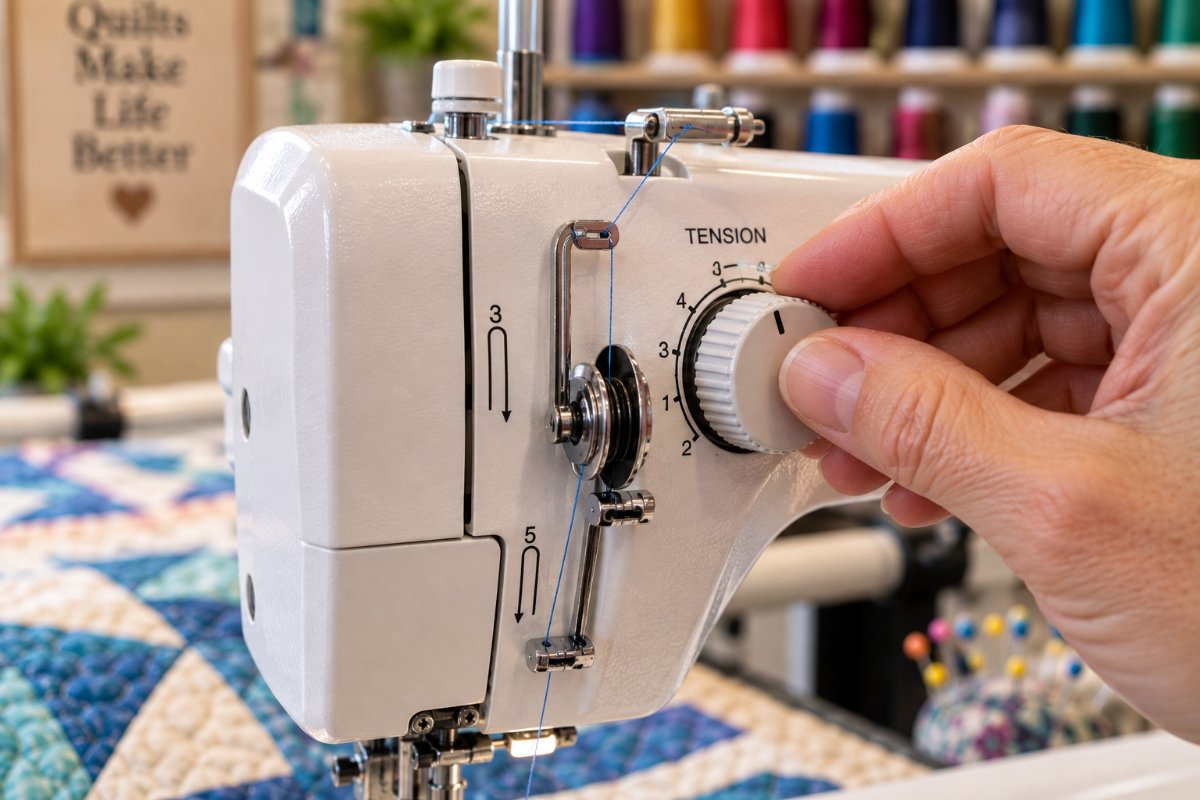
Loosen the top tension slightly and test on a scrap sandwich made from the same fabric, batting, and thread as your project. Skipped stitches when free motion quilting often disappear the moment top tension comes down even a small amount, because the loop the hook needs to catch has more slack to form. Adjust gradually and test after each small change rather than making one large adjustment.
3. Clean Out the Bobbin Area
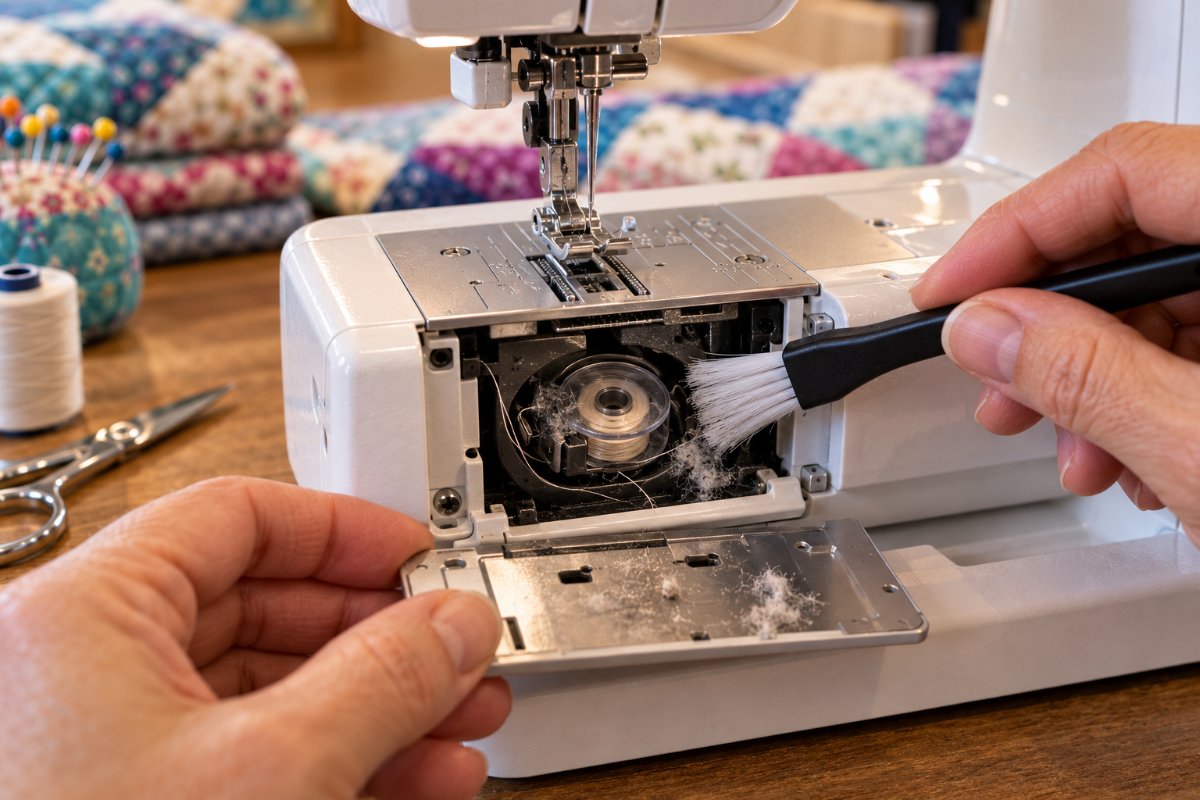
Remove the bobbin case and brush or blow out any lint that has built up in the hook race. Inspect the bobbin case itself for a burr or scratch, since a damaged case can catch thread unevenly even when it looks fine at a glance. If your machine has a removable shuttle, check that it is seated and tightened correctly, since a loose shuttle is a documented cause of skipped stitches on longarm and domestic machines alike.
4. Match Your Thread and Needle to the Fabric
Use quality, consistent thread rather than old or cheap spools that shed lint and vary in thickness along the same length. Using the same thread in the top and bobbin, rather than mixing two different weights, gives more even tension and fewer skips. If the quilt top contains fusible web, glue, or heavy starch, wipe the needle with a bit of rubbing alcohol partway through the project to keep residue from building up and adding drag. Geta's Quilting Studio has a good rundown of needle choices specifically for quilting through fusible web, if that is the fabric giving you trouble.
5. Keep Your Motion Steady
Sudden speed changes and jerky direction changes can throw off the timing between the needle and hook even on a machine in good working order. Aim for smooth, even movement and a consistent machine speed, and slow down through tight curves and sharp direction changes rather than stopping and starting abruptly. Quilters who see skipped stitches when free motion quilting mainly on tight curves often find this step alone solves the problem.
Common Mistakes That Cause Skipped Stitches to Come Back
Quilters who keep seeing skipped stitches when free motion quilting after trying one fix usually have more than one cause at play. The habits below are the most common reasons the problem returns even after the first fix seemed to work.
- Reusing a needle across multiple projects. A needle that quilted one top is already duller than a fresh one. Swap it before starting the next project rather than waiting for visible skipping.
- Assuming it is always a bobbin problem. A skipped stitch looks the same whether the cause is the top tension, the needle, or the bobbin, so ruling out the needle and top tension first saves time before ever touching the bobbin case.
- Skipping the test-scrap step. Testing tension and needle changes on the actual quilt instead of a scrap sandwich means any mistake shows up on the real project instead of a throwaway sample.
- Ignoring lint buildup until stitches skip. Lint in the bobbin area causes tension and timing problems well before it becomes visible skipping, so clearing it on a regular schedule prevents the problem rather than just fixing it after the fact.
Thread is a common cause of skipped stitches. Our guide to the best thread for machine quilting explains which weights suit free-motion work.
Frequently Asked Questions
Why is my free motion quilting skipping stitches all of a sudden?
A sudden change usually points to something that changed recently rather than a developing mechanical issue: a new spool of thread, a needle that has now quilted several projects, a fabric with fusible web or heavy starch, or lint that has built up since the last cleaning. Working through the needle, tension, and bobbin-area checks above in order will usually find whichever one changed.
What is the most common cause of skipped stitches?
A dull, bent, or wrong-type needle is the single most common cause reported by quilters dealing with skipped stitches when free motion quilting, followed closely by top tension set too tight. Both are also the fastest checks to make, which is why they are the recommended starting point before touching the bobbin case or timing.
What is dirty quilting?
"Dirty quilting" is not a technical term with one fixed meaning, but quilters commonly use it to describe stitching affected by lint, glue residue from fusible web, or built-up thread debris in the tension discs and bobbin area. This buildup is one of the quieter causes of skipped stitches when free motion quilting, since it develops gradually rather than all at once. Regular cleaning of the bobbin area and needle prevents most of it.
Do I need a special needle for free-motion quilting?
A quilting or topstitch needle in a size matched to your thread weight works for the large majority of free-motion projects. If you are working through fusible web or fused applique, a jeans or Microtex needle handles the extra stiffness and glue better, and if you are unsure which project needs which needle, see our guide to choosing a quilting machine and setup for how needle choice fits into the bigger picture.
Bottom Line
Fixing skipped stitches when free motion quilting almost always comes down to checking the needle first, adjusting top tension second, and cleaning the bobbin area third, in that order, before assuming anything is mechanically wrong with the machine. Most quilters solve the problem within one or two of these steps. If skipping continues after working through the full list, a visit to a qualified sewing machine technician can rule out a timing issue that needs professional adjustment. For the maintenance habits that help prevent skipped stitches and other tension problems before they start, see our guide to how to clean and oil a longarm quilting machine.
4 thoughts on “How to Fix Skipped Stitches When Free-Motion Quilting”