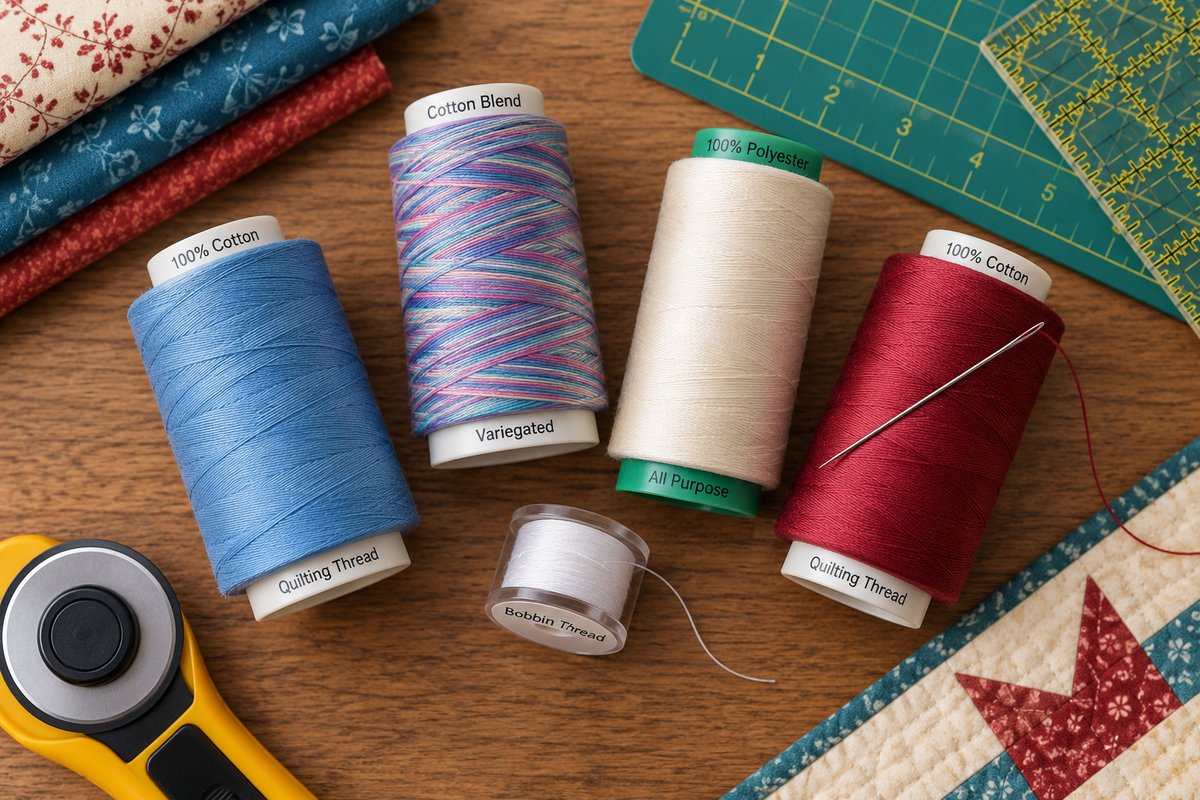
The best thread for machine quilting isn't a single spool. It is a small kit built around what you are doing: piecing your blocks, quilting the top, or filling the bobbin. A quilt that skips stitches, breaks thread constantly, or comes out stiff after washing usually traces back to a mismatched thread-and-needle combination rather than a machine problem.
This guide covers what changes machine quilting thread performance, fiber, weight, and ply, then names specific spools worth buying for piecing, for visible machine quilting, and for your bobbin, plus a comparison table to see the whole lineup at a glance.
Table of Contents
What Makes the Best Thread for Machine Quilting
Three things determine the best thread for machine quilting on any given project: fiber, weight, and ply. Fiber is cotton or polyester (or a poly-wrapped-poly variant). Cotton is the traditional choice for piecing and quilting because it presses flat and has a matte finish, but it sheds more lint and needs more frequent machine cleaning. Polyester is stronger for its thickness, sheds less lint, and is the standard pick for bobbin thread because it holds up under tension without adding bulk.
Weight is a number like 40wt or 50wt, and it works backward from what most people expect: the higher the number, the thinner the thread. A 50wt thread is thinner than a 40wt thread. Ply is how many strands are twisted together, 2-ply or 3-ply, and more plies generally means a stronger, slightly thicker thread. Getting these three right, and matching your needle size to the thread weight, prevents skipped stitches and thread breaks far more than brand loyalty does.
Best Overall: Superior Threads King Tut 40wt 3-Ply Cotton
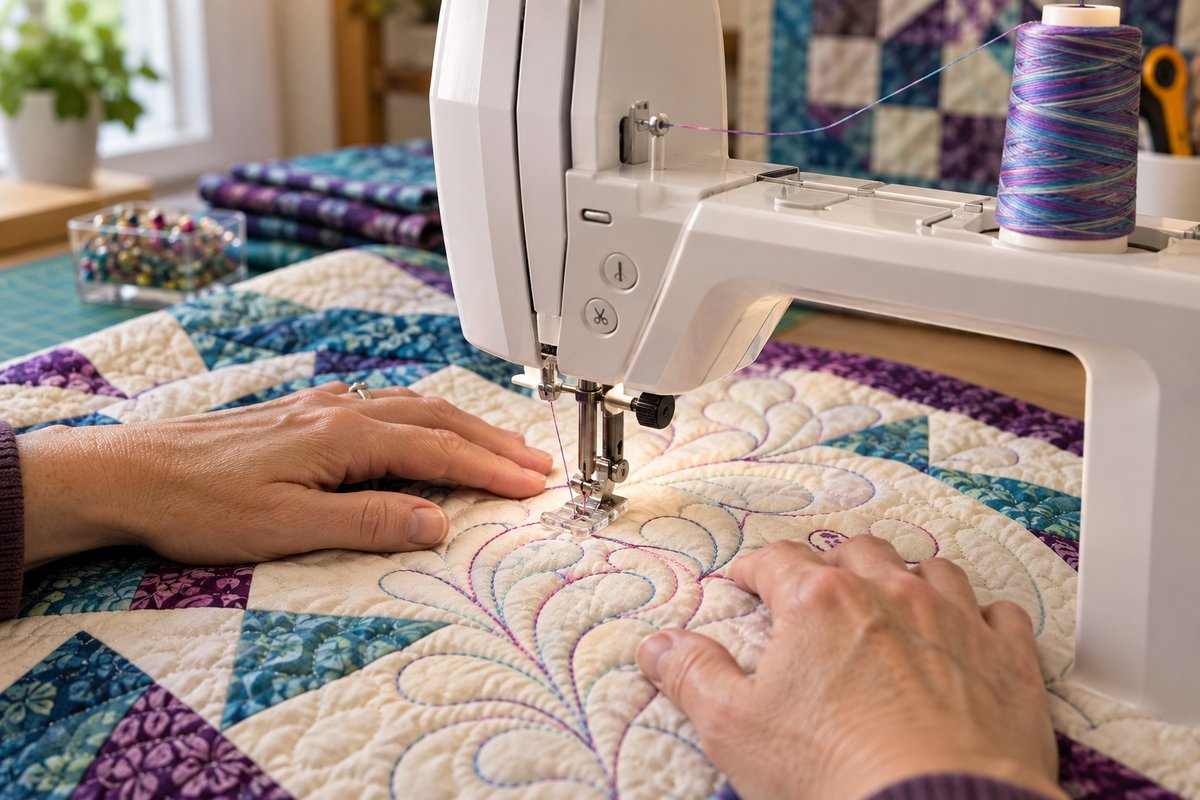
For many quilters, Superior Threads King Tut is simply the best thread for machine quilting when the goal is visible stitching. This 40wt, 3-ply, 100% Egyptian-grown extra-long-staple cotton thread is built specifically for machine quilting, not piecing. The heavier 40wt weight and 3-ply construction give it enough body to show up as visible stitching on the quilt top, which is the point when you are free-motion quilting a design you want people to see. It comes on a 2000-yard cone in dozens of solid and variegated colorways, and the Ebony colorway alone carries a 4.8-star rating across 454 verified ratings on Amazon.
Superior recommends a size 90/14 needle for home machines and a #18 needle on a longarm (see Superior's own King Tut product line for the full color range). The company built its reputation specifically on low-lint cotton, which matters more on this thread than almost any other because a 40wt 3-ply cotton is exactly the kind of thread that clogs a bobbin case if it is not low-lint.
Best for Piecing: Aurifil Mako 50wt Cotton Thread
Aurifil Mako 50wt is a 2-ply, long-staple Egyptian cotton thread, and it is the most commonly recommended piecing thread in quilting circles for a simple reason: the thinner 50wt weight means seam allowances stay flat instead of getting bulky where multiple seams cross. It comes on a large 1422-yard spool, which is enough for a full quilt top without needing a mid-project color change.
Pricing varies by colorway, and a handful of specialty colors cost more. Ratings range from 4.6 to 4.8 stars, with several popular colors carrying well over 1,000 verified ratings on Amazon. This is not the best thread for machine quilting with visible stitching. It is thin by design, but it is close to the standard answer for "what should I piece with."
Best All-Purpose Budget Pick: Gutermann Sew-All Polyester Thread
Gutermann Sew-All is a 100% polyester all-purpose thread, and most quilters already have it lying around from other sewing projects. It isn't spun specifically for quilting, but it is strong, consistent, and inexpensive, making it a reasonable choice for straightforward straight-line quilting or piecing on a budget. A 3-pack of 547-yard spools holds a 4.8-star rating across 560 verified ratings. It will not give you the low-lint cotton feel of a dedicated quilting thread, and it will not disappear into a bobbin the way a true bobbin-weight thread does, but as a budget do-everything thread for machine quilting and general sewing, it earns its place in a sewing room.
Best Bobbin Thread: Superior Threads Bottom Line 60wt Polyester
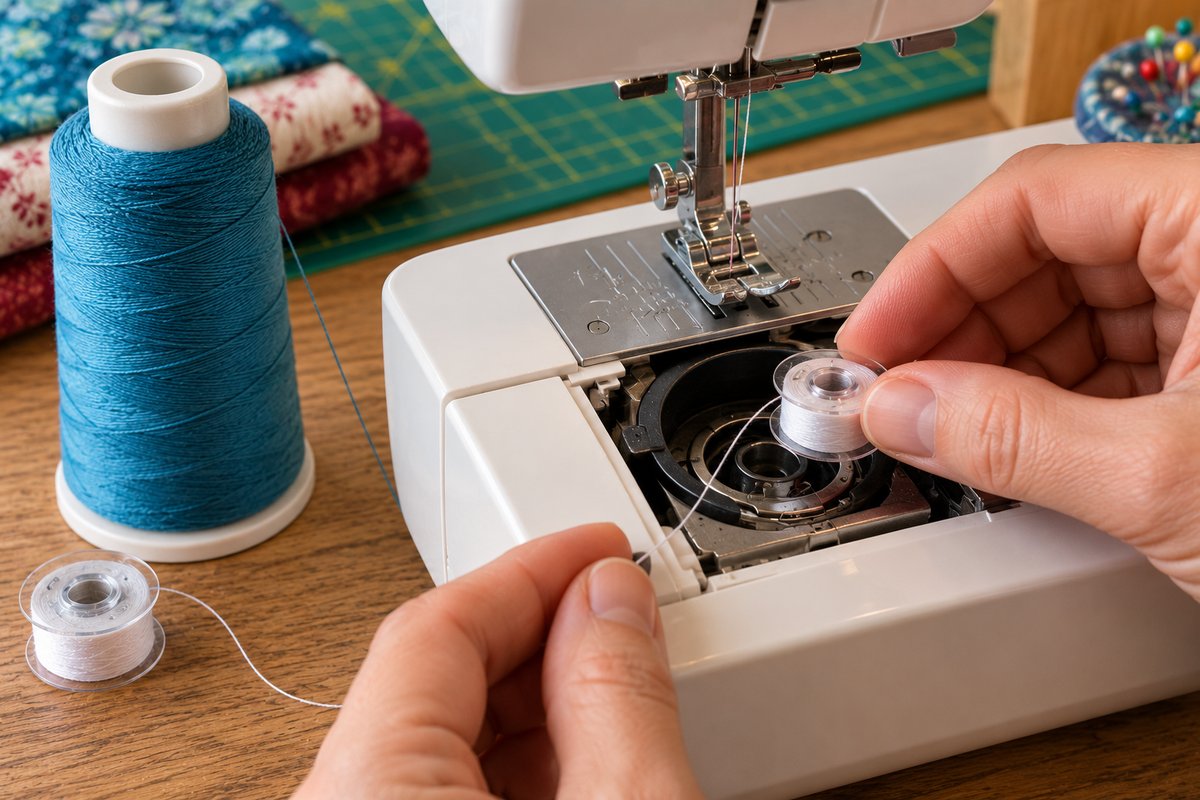
Superior Threads Bottom Line is a 60wt, 2-ply, 100% polyester thread purpose-built for bobbins. The thinner 60wt weight means a single bobbin holds noticeably more thread than it would with a 40wt or 50wt cotton, which means fewer bobbin changes in the middle of quilting a large project. It is also lint-free, which keeps the bobbin case cleaner for longer. It comes on a 3000-yard cone and carries a 4.8-star rating across 1,223 verified ratings on Amazon, with reviewers specifically calling out how well it blends into the back of a quilt without showing through. Many longarm quilters run this in the bobbin regardless of what thread is on top.
Also Worth Considering: Superior Threads So Fine 50wt Polyester
Superior Threads So Fine is a 50wt, 3-ply trilobal polyester thread with a slight sheen closer to silk than to standard polyester. It is a real alternative to cotton for both piecing and quilting if you want polyester's strength and lower lint without cotton's flat, matte look. A 3280-yard cone holds a 4.8-star rating across 791 verified ratings on Amazon.
It is not the first thread most quilters reach for, but it is a legitimate second opinion if a cotton thread keeps shredding on a particular machine. If you are also choosing batting for the same project, see our guide to the best batting for baby quilts for how fiber choice affects the whole quilt, not just the thread.
A Note on Thread Weight and Needle Size
Thread weight numbers work backward from what feels intuitive: a 60wt thread is thinner than a 50wt thread, which is thinner than a 40wt thread. Needle size needs to scale with thread weight, not the other way around. A needle too small for the thread will fray or shred it as it passes through the eye repeatedly. A needle too large will leave visibly larger holes in the fabric and can affect stitch quality.
As a rough starting point, a 50wt cotton pairs well with a size 80/12 universal or quilting needle, while a heavier 40wt cotton like King Tut typically wants a 90/14. When in doubt, check the thread manufacturer's needle recommendation before assuming your usual needle will work, since a needle-and-thread weight mismatch is one of the most common causes of skipped stitches, regardless of whether you use the best thread for machine quilting or the cheapest.
Machine Quilting Thread Comparison
| Thread | Fiber / Weight | Yardage | Best For | Needle | Rating |
|---|---|---|---|---|---|
| Superior King Tut ★ TOP PICK | Cotton, 40wt 3-ply | 2000 yd cone | Visible machine quilting | 90/14 (home), #18 (longarm) | 4.8★ (454 ratings) |
| Aurifil Mako | Cotton, 50wt 2-ply | 1422 yd spool | Piecing | 80/12 universal/quilting | 4.6 to 4.8★ (1,000+ ratings) |
| Gutermann Sew-All | Polyester, all-purpose | 547 yd × 3-pack | General sewing, budget | 80/12 universal (fabric-dependent) | 4.8★ (560 ratings) |
| Superior Bottom Line | Polyester, 60wt 2-ply | 3000 yd cone | Bobbin | N/A, bobbin only | 4.8★ (1,223 ratings) |
| Superior So Fine | Polyester, 50wt 3-ply | 3280 yd cone | Alternative all-purpose | 80/12 universal | 4.8★ (791 ratings) |
Thread choice and tension go together. If stitches look loose or loopy after you switch threads, see our guide on how to fix tension on a sewing machine. Our guide to skipped stitches when free-motion quilting also covers how to pair thread with the right needle.
Frequently Asked Questions
What is the best thread for machine quilting?
For visible machine quilting on top of the quilt, a 40wt 3-ply cotton like Superior King Tut is the most common recommendation because it has enough body to show as real stitching. For piecing, a thinner 50wt cotton like Aurifil Mako is the standard choice instead, since it keeps seams flat.
What weight thread is best for machine quilting?
40wt is the most common weight for visible machine quilting, since it is thick enough to show up as a defined stitch line. 50wt and 60wt threads are thinner and better suited to piecing and bobbins, where you do not want the thread to be the focal point.
Should I use cotton or polyester thread for quilting?
Both work. Cotton is the traditional choice and presses flatter with a matte finish, but sheds more lint and needs more frequent machine cleaning. Polyester is stronger for its thickness, sheds less lint, and is the standard choice for bobbin thread. Many quilters use cotton on top and a fine polyester like Superior Bottom Line in the bobbin.
What thread should I use in my bobbin?
A thin, lint-free polyester like Superior Threads Bottom Line (60wt) is the most common bobbin thread among longarm and machine quilters, regardless of what thread is loaded on top. Its thinness means a single bobbin holds more thread and needs changing less often during a large project.
Bottom Line
There is no single best thread for machine quilting, only the right thread for the machine quilting step you are on at that moment. Piece with a thin 50wt cotton like Aurifil Mako, switch to a heavier 40wt cotton like Superior King Tut when you want your quilting stitches to show, and load a fine polyester like Superior Bottom Line in the bobbin so it holds more thread and stays invisible on the back. Match your needle size to the weight you load, and most skipped-stitch and thread-break problems blamed on the machine tend to disappear.
1 thought on “Best Thread for Machine Quilting in 2026”