Quilting statistics get passed around quilt guilds, blogs, and shop newsletters, often years after the survey behind them was taken. Some are fifteen years old, and some count every kind of sewing, not just quilting. This page collects the quilting numbers that trace back to a primary source, with the year each one covers.
Every figure below links to its source: the industry's Quilting Trends Survey, the older Quilting in America study, the National Endowment for the Arts' national arts survey, and the public record on Joann's closing. After that come four things people say about quilting that the data doesn't support.
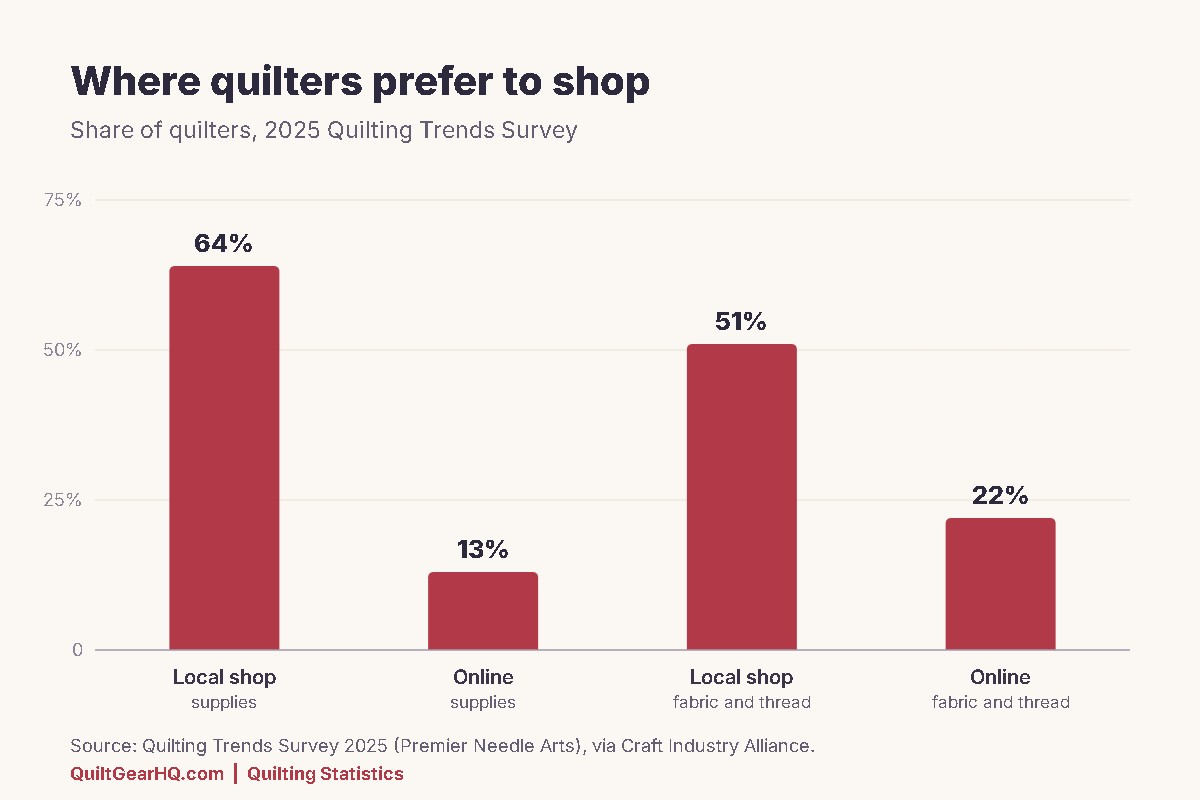
Quick take: the North American quilting market was about $4.5 billion in the 2025 survey, with 9 to 11 million active quilters, a number that's held steady for a decade. In 2025, 18% of quilters surveyed were new to the craft. In 2022, 11.7% of U.S. adults did some kind of textile craft. And 64% of quilters would rather buy supplies at a local shop than anywhere else.
Table of Contents
Quilting statistics at a glance
Each row is explained further down, including who was surveyed and what year the numbers cover.
How many people quilt
The most-cited current quilting statistics come from the Quilting Trends Survey, run by Premier Needle Arts with other industry partners and summarized each year by the Craft Industry Alliance. The 2025 edition was emailed to more than 1.8 million quilters in February 2025 and got over 30,000 responses. It estimates 9 to 11 million active quilting consumers in the U.S. and Canada, a number it says has stayed consistent for ten years.
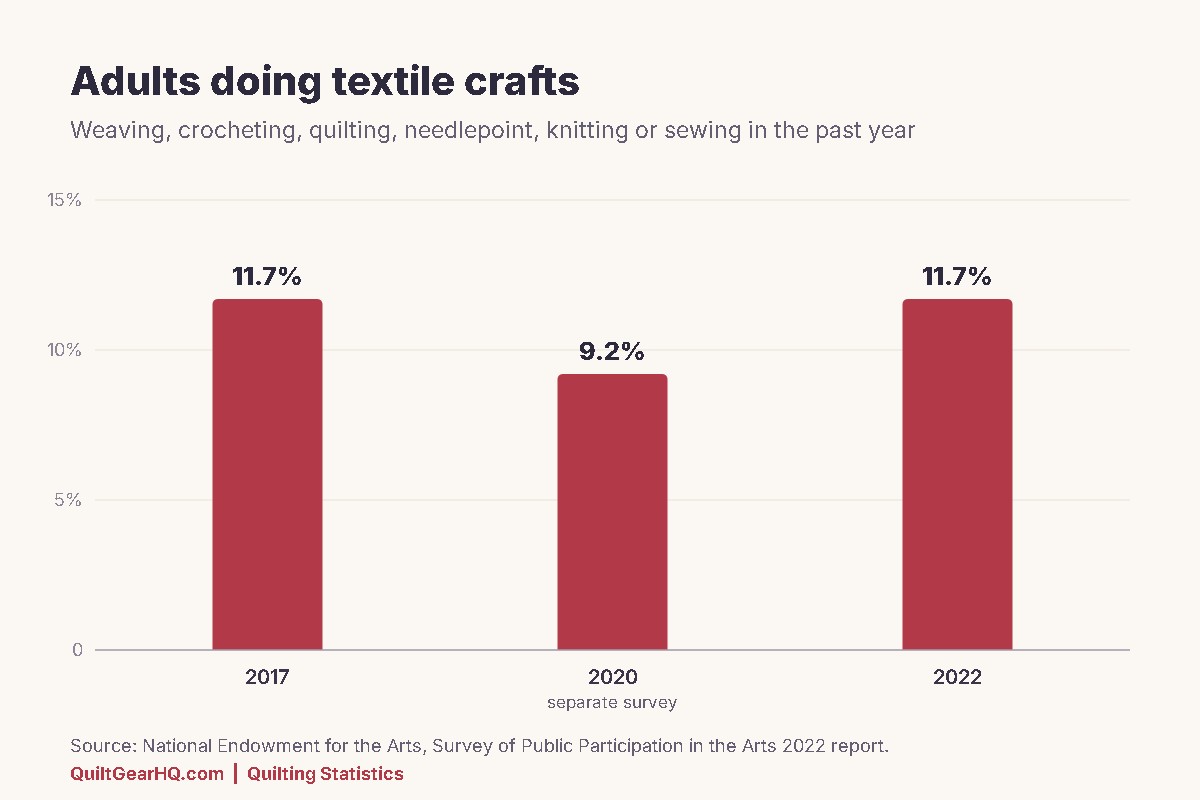
That survey reaches quilters on brand and publisher email lists, so it leans toward people already engaged with the hobby. For a broader view, the National Endowment for the Arts asks a large national sample about arts activities. In its 2022 survey, run with the Census Bureau, 11.7% of U.S. adults said they had done weaving, crocheting, quilting, needlepoint, knitting, or sewing in the past year. That's the same share as in 2017, after a dip to 9.2% in a separate 2020 survey. It covers all textile crafts, not quilting alone.
The pipeline of new quilters looks healthy. In the 2025 Quilting Trends Survey, 18% of respondents said they were new to quilting, up from 11% the year before. If you're one of them, our guide to the best sewing machine for quilting beginners is a good place to start.
Who quilts
The typical quilter in these surveys is a woman in her 60s. The 2024 Quilting Trends Survey found 98% of respondents were women and 70% were retired, and the 2025 edition describes the average quilter as female, in her 60s, and retired.
She's also busy. The average quilter in the 2025 survey spends six hours a week on quilts, starts 11 projects a year and finishes 9, and owns four different sewing machines.
Older quilting statistics are often quoted as if they were current. The last Quilting in America study, from 2017, put the average age of its dedicated quilters, those spending $500 or more a year, at 63. That group accounted for 72.2% of all quilting spending.
How big is the quilting industry
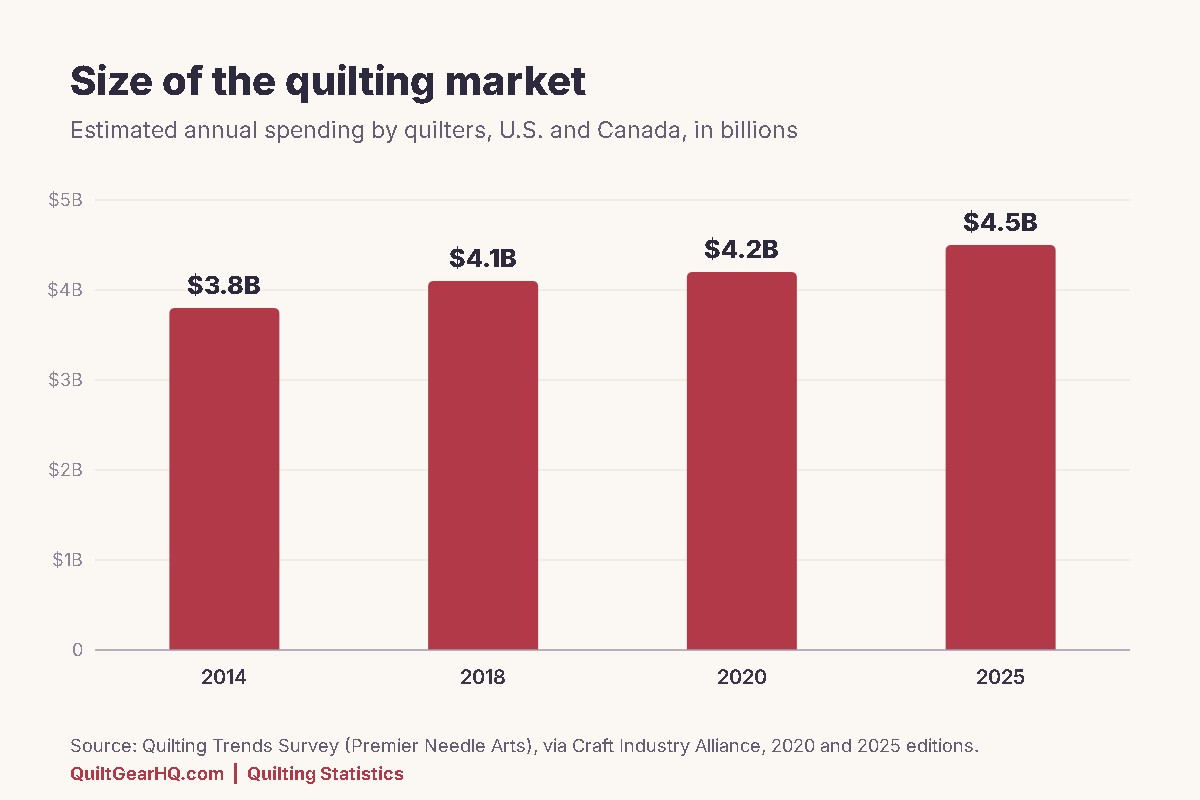
In the 2025 Quilting Trends Survey, the quilting market came to about $4.5 billion. That was below the $4.958 billion the previous year's survey had projected for 2025. The 2020 edition put the market at $4.2 billion, up from $4.1 billion in 2018 and $3.8 billion in 2014.
These surveys estimate spending from what respondents report, and the underlying data is proprietary, so treat them as industry estimates rather than audited sales. They're still the only consistent series available. The separate Quilting in America study, which used a national household panel, estimated the U.S. market at $3.7 billion in 2017 and hasn't been repeated since.
Where quilters shop
Local quilt shops still win. In the 2025 survey, 64% of quilters said they prefer to buy quilting supplies at their local shop, up 3 points from the year before, while 13% prefer to buy online. For fabric and thread, 51% prefer to shop locally and 22% online.
The biggest retail change in years was Joann's closure. The fabric and craft chain filed for Chapter 11 bankruptcy for the second time on January 15, 2025, with more than 800 stores in 49 states. The company's assets went to GA Group and its lenders at auction, and NPR reported that 255 stores would close by the end of April 2025, with the remaining 535 closing in May. Quilters who relied on Joann for batting, notions or a quick rotary cutter replacement have had to shift to independent shops and online sellers.
Four quilting myths the data doesn't support
These quilting statistics and claims turn up in guild newsletters, blog posts, and shop talk. Here's what the sources actually say.
Myth 1: There are 21 million quilters in America
That number comes from the Quilting in America study of 2010, more than fifteen years ago. The 2017 edition of the same study estimated 7 to 10 million U.S. quilters, and the 2025 Quilting Trends Survey estimates 9 to 11 million active quilting consumers across the U.S. and Canada combined. The surveys use different methods, so the drop isn't a clean trend line, but 21 million isn't a current figure.
Myth 2: Quilting is dying out
The data points the other way. The NEA's share of adults doing textile crafts was 11.7% in both 2017 and 2022. The Quilting Trends Survey says its 9 to 11 million active consumer estimate has held for ten years, and 18% of its 2025 respondents were new to quilting.
Myth 3: Quilting is a $4 billion industry
In 2020, the Quilting Trends Survey put it at $4.2 billion. The 2025 survey puts it at about $4.5 billion. The $4 billion figure is five years old.
Myth 4: Joann closing means quilters lost their shops
Joann was a national chain, not a quilt shop, and most quilters already preferred local independent shops. In the 2025 survey, 64% said they prefer to buy supplies at their local shop, up 3 points from the year before. We couldn't find any credible count of independent quilt shops, so no one can say for sure whether their numbers are rising or falling.
How we checked these quilting statistics
For each figure, we went to the most direct source available: the Craft Industry Alliance's published summaries of the Quilting Trends Survey, the Quilting in America 2017 summary, the NEA's 2022 survey report, and Joann's own bankruptcy announcement. We note the year each number covers and who was surveyed, and we flag where the underlying data is industry-run or proprietary. We left out numbers we couldn't trace to a source, including counts of quilt shops and injury rates for rotary cutters.
Last checked: September 28, 2026. We'll update this page when the next Quilting Trends Survey results are published.
Using these statistics
You're welcome to use any figure or chart on this page in an article, report or guild newsletter. Please link to the primary source for the number and to this page as the place you found it. Suggested citation: QuiltGearHQ, "Quilting Statistics: 15 Verified Numbers and 4 Myths," quiltgearhq.com/quilting-statistics/, September 2026.
Quilting statistics FAQ
How many quilters are there?
The 2025 Quilting Trends Survey estimates 9 to 11 million active quilting consumers in the U.S. and Canada.
How big is the quilting industry?
About $4.5 billion, according to the 2025 Quilting Trends Survey, up from $4.2 billion in 2020.
What is the average age of a quilter?
The 2025 survey describes the average quilter as a woman in her 60s, and 70% of 2024 respondents were retired. The older Quilting in America study put the average age of dedicated quilters at 63 in 2017.
Is quilting growing or declining?
Holding steady. Participation in textile crafts was 11.7% of U.S. adults in both 2017 and 2022, and 18% of 2025 survey respondents were new to quilting.
How many sewing machines does a quilter own?
Four, on average, according to the 2025 Quilting Trends Survey.