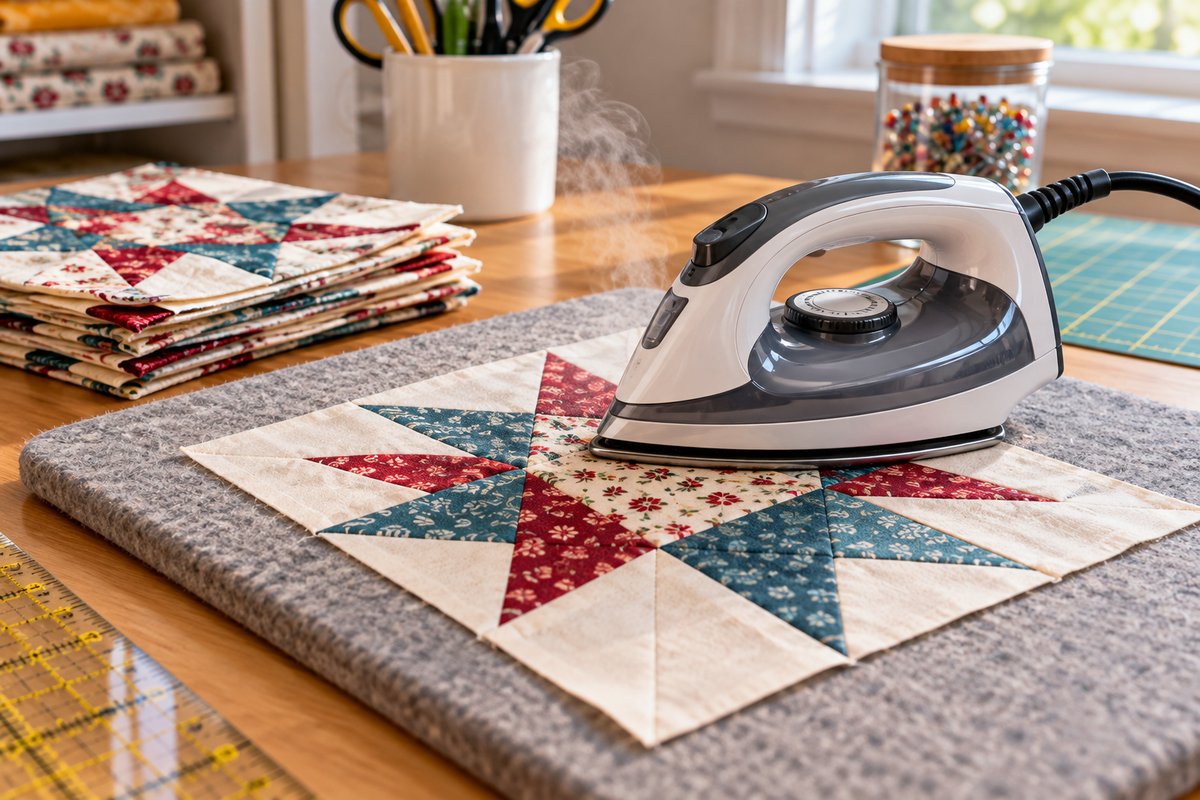
A full-size iron is not always the right tool at the sewing table. If you piece blocks on a lap desk, work at a retreat, or only have a corner of a small room, a mini iron does the same pressing job in a fraction of the space. The best mini iron for quilting heats up fast, holds enough steam to set a seam, and won't tip over the second you look away.
QuiltGearHQ is a participant in the Amazon Services LLC Associates Program, an affiliate advertising program designed to provide a means for sites to earn advertising fees by advertising and linking to Amazon.com.
This guide compares four mini irons by weight, heat-up time, soleplate material (the flat metal or ceramic plate that touches the fabric), and price, based on specs pulled from the manufacturers themselves. Three of the four are sold specifically for sewing and quilting. The fourth is a low-cost iron that many quilters keep as a spare.
Table of Contents
What to look for in a mini iron for quilting
Not every small iron makes a good quilting iron. Quilters press seams open or to one side dozens of times per block, so they need a different iron than someone touching up a wrinkled shirt once a trip. A few things matter more here than size alone.
- Heat-up time. A 45-second iron keeps you working. One that takes several minutes to reach temperature breaks your rhythm every time you set it down and pick it back up.
- Soleplate material. Ceramic soleplates glide over cotton without dragging and resist the sticky residue that fusible products leave behind. A plain non-stick coating works fine for basic pressing but wears faster.
- Dual voltage. If you travel abroad with your iron, dual voltage (120V and 240V) means it works without a separate converter. Within the United States, it does not matter.
- A heat-safe rest. Scorching happens when you set a hot iron flat on a table between seams. A silicone pad or trivet made for the iron lets you set it down face-down safely.
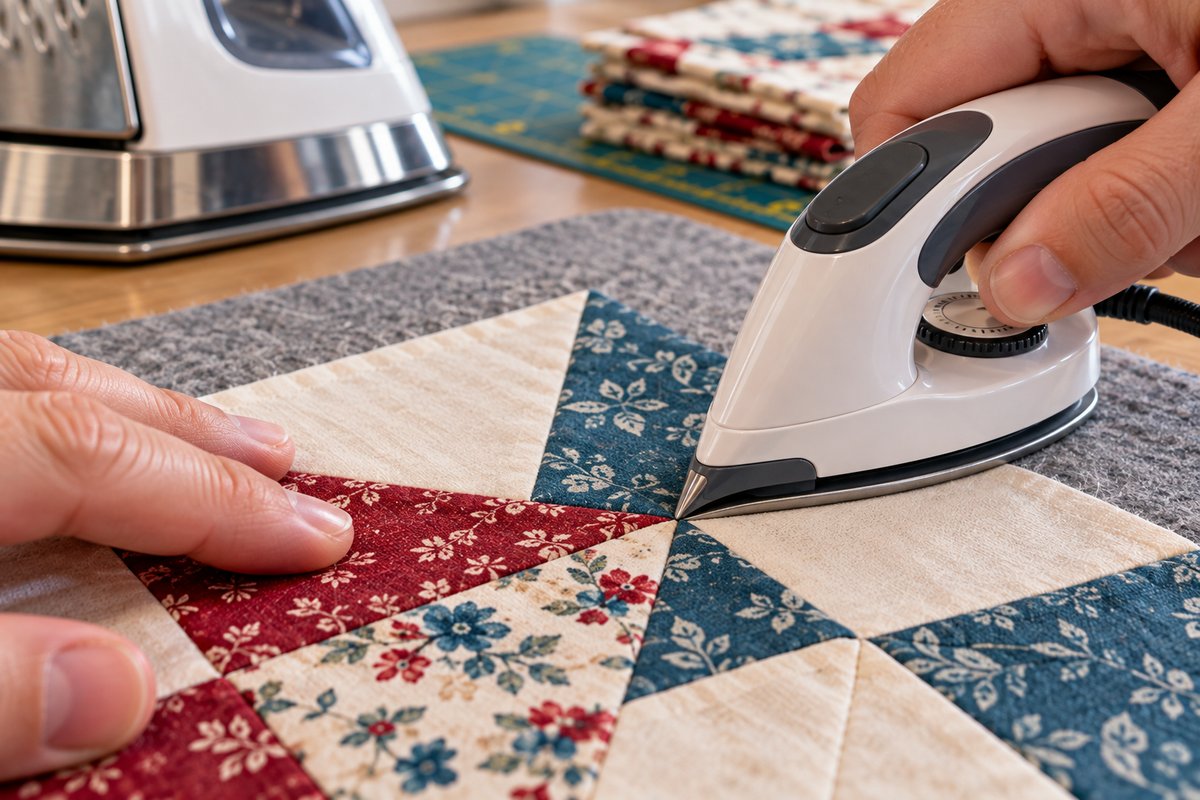
- A narrow or pointed tip. Mini irons already have small soleplates, but a tapered tip reaches into corners, points, and tight seam allowances that a full-size iron glides right past.
- Weight. Anything under two pounds is comfortable to hold for a long pressing session and easy to pack in a tote without adding much bulk.
The 4 best mini irons for quilting
These four come up often when quilters compare mini irons, and each one suits a different need. The specs below come from each brand.
| Iron | Best for | Wattage | Soleplate | Weight |
|---|---|---|---|---|
| Oliso M3Pro Project Iron | Overall pick | 1000W | Diamond ceramic-flow | 2.0 lbs |
| Oliso M2Pro Mini Project Iron | Best value | 1000W | Diamond ceramic-flow | 1.6 lbs |
| Dritz Mighty Travel Iron | Best for retreats | Not listed | Non-stick | Not listed |
| Steamfast SF-710 | Best budget | 800W | Non-stick | Not listed |
Oliso M3Pro Project Iron: best overall
The M3Pro is the larger of Oliso's two mini irons, and it includes features a full-size iron usually keeps to itself. It runs two independent steam zones, so you can send a burst of steam through just the tip for a tight corner while the rest of the soleplate stays dry. The two-inch detailer tip handles points and seam allowances that would otherwise require forcing a wider iron into a space it doesn't fit. For quilters deciding between the two Oliso sizes, this is the one to get if budget is not the deciding factor.
At 1000 watts and about two pounds, it heats quickly without feeling flimsy in your hand. The included Solemate silicone pad lets you rest it face-down between presses, which matters more than people expect once you are moving through a stack of blocks. It runs on universal voltage, so it switches automatically between 110 to 120V and 220 to 240V, no manual setting required.
The higher price is the main tradeoff. For quilters who press constantly and want the closest thing to a full-size iron's control in a smaller body, it is worth the cost. For occasional travel use, the M2Pro below does most of the same job for less.
Oliso M2Pro Mini Project Iron: best value
The M2Pro is Oliso's smaller, lighter sibling to the M3Pro, and it covers the basics most quilters need. It heats up in 45 seconds, has the same style of precision detailer tip for seams and collars, and comes with its own Solemate rest pad. At 1.6 pounds, it is noticeably lighter in the hand than the M3Pro, which adds up over a long pressing session.
Compared to the M3Pro, it gives up dual-zone steam control. The M2Pro has one-touch steam with horizontal and vertical burst modes, which covers most quilting needs, but it doesn't isolate steam to just the tip. For most buyers, that difference will not matter. It also runs on universal dual voltage and includes an 8-foot cord with a swiveling base, so it does not fight you for desk space.
This is the pick for quilters who want a sewing-specific iron rather than a stripped-down travel iron, without paying for the M3Pro's extra steam control.
Dritz Mighty Travel Iron: best for retreats
Dritz makes notions, not appliances, which shows in how specifically this iron is built for sewing. It is marketed directly for quilting, appliqué, bias tape, and craft work rather than general travel use. It comes with a storage bag and a small measuring cup for filling the water tank, both useful at a retreat where counter space is limited.
It runs on dual voltage and heats across a wide temperature range, from 140 to 428 degrees Fahrenheit, which covers delicate synthetics through heavier cotton. The soleplate has a basic non-stick coating rather than ceramic, so it will not glide as smoothly as Oliso irons and won't hold up to fusible adhesives as well over time.
For quilters packing a retreat bag who want something built for sewing rather than a generic drugstore travel iron, this is a sensible, specific choice.
Steamfast SF-710: best budget
The SF-710 is not marketed as a quilting iron specifically, but it shows up in a lot of sewing rooms anyway because it does the basic job for very little money. It runs on 800 watts, heats in 45 seconds, and has a non-stick soleplate with four steam vents. The handle folds flat for storage, which is a small detail that matters if you are tucking it into a sewing kit rather than leaving it out on a shelf.
There are tradeoffs. It isn't dual voltage, so it isn't the right choice for international travel. The water tank holds only one ounce, which means you'll refill it more often during a long pressing session. And without a dedicated detailer tip, it is less precise on fussy corners than the Oliso irons.
It is the iron to buy if you want a backup for the sewing room, a first mini iron to try before committing to something pricier, or a low-stakes option for a kid learning to sew. It is not the right iron if you press seams all day, but it works well as a spare.
How a mini iron fits into your quilting routine
A mini iron is not a replacement for a full-size iron for quilting. It is a second tool for situations where a full-size iron is too much. Examples include pressing a block at a design wall across the room, working a seam flat without walking back to the main ironing station, or packing for a weekend retreat where table space is tight. Many quilters use both: a full-size iron at the main pressing station and a mini iron wherever the work happens.
Pair either mini iron with a wool pressing mat instead of a standard cotton ironing board cover. Wool holds and reflects heat back into the fabric, so a smaller, lower-wattage iron still presses a seam flat on the first pass instead of needing a second press to finish the job.
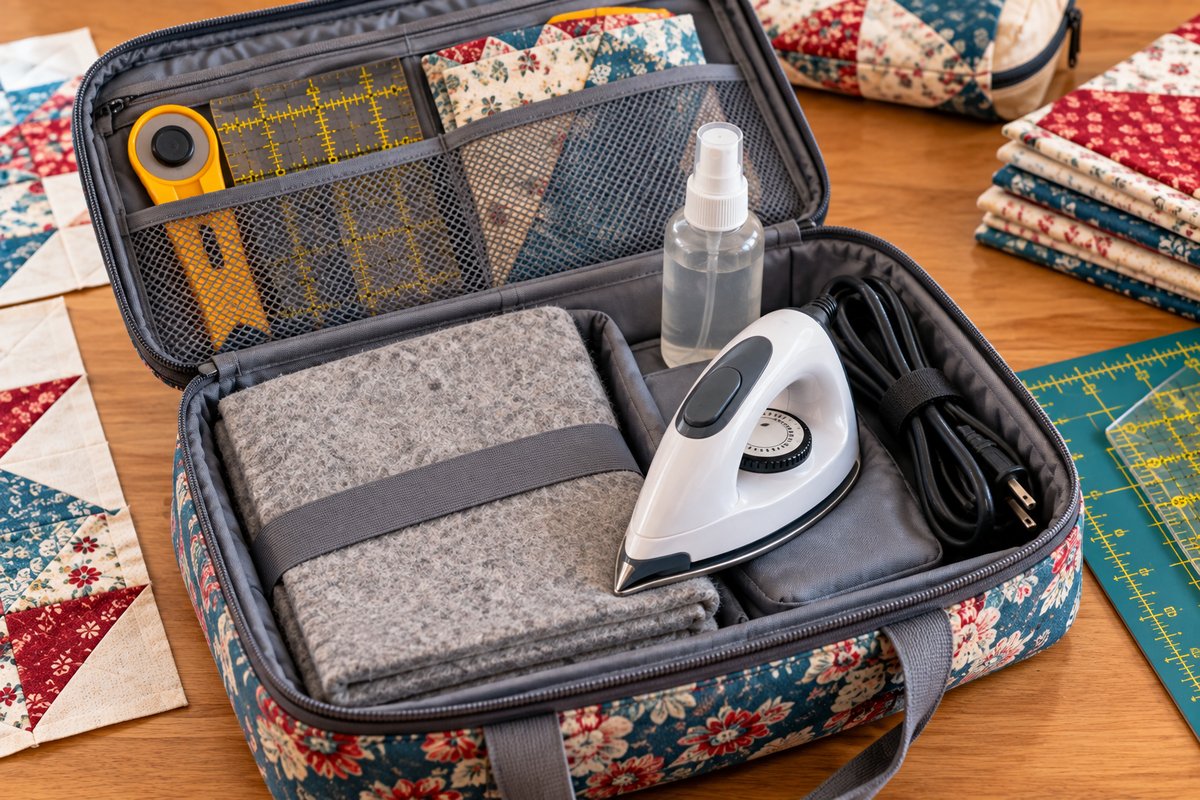
If you are building a travel pressing kit, keep it simple: the iron, its rest pad or trivet, a small spray bottle for water, and a folded wool mat or pressing cloth. That is enough to press blocks anywhere you set up, without hauling your whole sewing room along.
Frequently asked questions
Is a mini iron hot enough for quilting cotton?
Yes. Most mini irons, including every one in this guide, reach the same temperature range as a full-size iron. The difference is soleplate size and steam capacity, not maximum heat.
Can I use a mini iron instead of a full-size iron all the time?
You can, but it will take more passes to press a large quilt top or a wide seam. A mini iron is best alongside a full-size iron, not as a full replacement, unless your space does not allow for a larger one.
Do mini irons need distilled water?
Check the manual for your specific model. Several mini irons, including the Oliso irons in this guide, can handle regular tap water, but hard water can still cause mineral buildup over time in any iron. If your tap water is especially hard, distilled water will extend the life of your mini iron.
Why does my mini iron take longer to reheat than it did when it was new?
This usually means mineral buildup inside the water tank or steam vents. Most manufacturers recommend an occasional cleaning cycle, often with a vinegar-and-water solution, to clear it. Check your model's manual for the exact method, since steam irons vary.
Is dual voltage worth paying for if I never travel internationally?
Not really. Dual voltage only matters if you plan to use the iron outside North America. For retreats and travel within the United States, a single-voltage iron like the Steamfast SF-710 works fine and costs less.
Summary
The right mini iron depends on how often you will reach for it. If you press constantly and want the closest thing to full-size control, the Oliso M3Pro is worth the higher price. If you want most of that same quality for less, the Oliso M2Pro is the better value. Quilters packing for a retreat will appreciate how specifically the Dritz Mighty Travel Iron is built for sewing, and anyone who just wants a cheap, reliable backup will get good use out of the Steamfast SF-710. Whichever one you pick, use it alongside a wool pressing mat and a full-size iron, not instead of them.