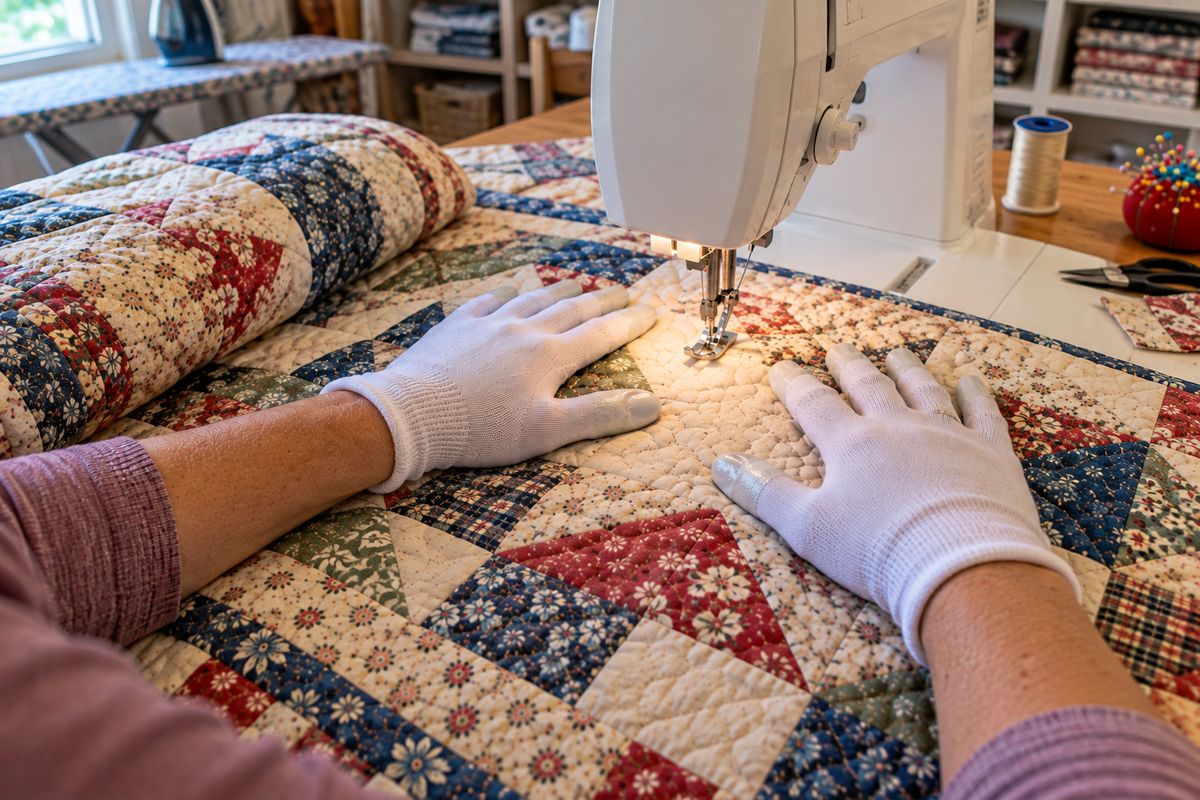
Free motion quilting gloves give your fingertips extra grip on the quilt. Feed dogs are the small teeth under the needle that normally pull the fabric along. In free motion quilting, you lower them and move the quilt by hand under the needle. That means your hands do all the steering. Bare hands slide on cotton, so many people press down hard to keep control. Gloves add grip, so you can guide the quilt with a lighter touch.
QuiltGearHQ is a participant in the Amazon Services LLC Associates Program, an affiliate advertising program designed to provide a means for sites to earn advertising fees by advertising and linking to Amazon.com.
This guide explains what the gloves do, who needs them, and how to pick a pair. It also compares 5 gloves sold on Amazon. We picked them from the makers' listings and owner reviews. We have not tested them by hand.
Table of Contents
What free motion quilting gloves do
Quilting gloves are thin, stretchy gloves with a grippy coating or rubber dots. The grip sits on the fingertips, the palm, or both. When you rest your hands on the quilt, the coating holds the fabric so it moves with your hands.
Grip matters because of how we hold things. Scientists have found that people squeeze slippery things harder than sticky ones. A 2024 study on grip and friction describes this well-known effect. A quilt is large, heavy, and smooth. Without grip, your fingers have to press and pinch to hold it. With grip, you get the same control with less force.
Less force can mean less fatigue in your hands, arms, and shoulders at the end of a long session. Some quilters also say their stitch lines look smoother because the quilt moves with their hands and doesn't slip.
Do you need quilting gloves?
No. Free motion quilting gloves are helpful, not required. Some skilled quilters work bare-handed. Lori Kennedy teaches free motion quilting on Bernina's WeAllSew blog. She says she often quilts with no grip aid. She reaches for one when her hands are tired, or the quilt is very large.
Gloves tend to help most if:
- You are new to free motion quilting and the quilt keeps sliding away from you.
- You quilt large or heavy quilts, like a queen-size quilt on a home machine.
- Your hands get sore, tired, or sweaty during long sessions.
You may not need them if you only quilt small pieces, like mug rugs and table runners. You may also skip them if you already use a quilting hoop or grip discs.
A note on health claims
Some glove listings say they help prevent back and neck pain. Some sellers also link gloves to carpal tunnel syndrome. We couldn't find any study that tested quilting gloves for these problems, so treat those claims as marketing.
There is a real link between force and hand problems, though. Canada's Institute for Work and Health shared a large US study of workers. It found that hard gripping and pinching were bigger risk factors for carpal tunnel. Light, repeated hand motion mattered less. Gloves that let you use less force make sense for that reason. But they are not a treatment. If you have numbness, tingling, or weakness in your hands, talk to a doctor.
The three main types of quilting gloves
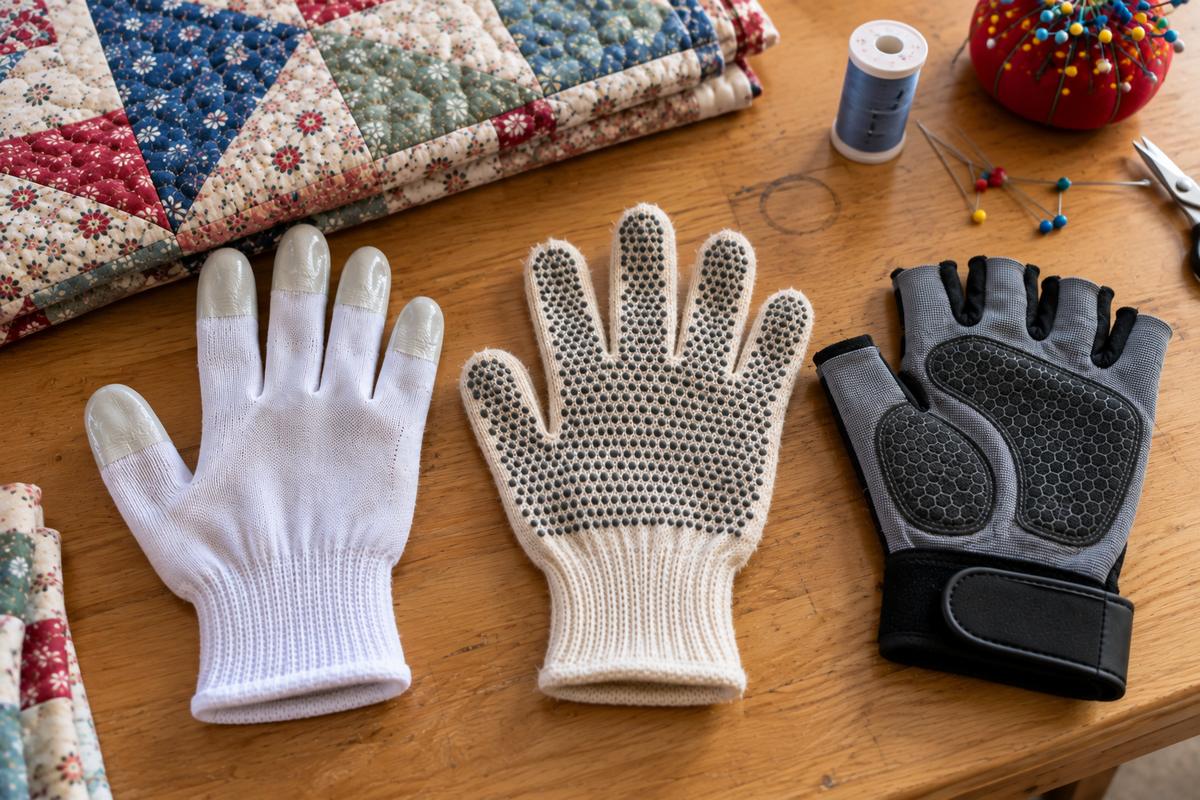
Most free motion quilting gloves fall into one of three styles. The right one depends on how you like to hold the quilt.
Full gloves with coated fingertips
These are thin nylon gloves with a smooth, grippy coating on each fingertip. The palm is usually bare fabric, so your hands stay cooler. This is a common style. Quilter's Touch, which makes Machingers, says you can keep its gloves on to thread a needle or add and remove pins.
Gloves with grip dots
These have small rubber or PVC dots on the fingers, and sometimes on the palm too. Palm dots help if you like to move the quilt with flat hands. Some styles have dots on both sides of the fingers, so you can wear them either way.
Fingerless gloves with palm pads
These cover the palm with a grip pad and leave your fingers free. The pair we list closes with a wrist strap. They are made for steering with your palms. They also let you thread needles and snip threads without taking anything off.
How to choose a pair
- Where the grip is. If you steer with your fingertips, choose coated fingertips. If you steer with flat hands, choose a glove with palm dots or a palm pad.
- Fit. Quilting gloves should feel snug with no loose fabric. Loose fingertips bunch up and lose grip. Check each listing's size chart before you buy. Some brands come in several sizes, while others are one size.
- How warm they feel. Thin nylon with a bare palm is the coolest. Cotton breathes well too. Thicker gloves and full-palm coatings can feel warm during a long session.
- Fingertip feel. Full fingertip coverage gives the most grip. Fingerless styles give the best feel for small jobs like threading the needle.
- Washing. Some gloves are hand wash only, and some can go in the washer. Check the label.
- Allergies. If you have a latex allergy, check what the grip is made of. Some listings don't say. Ask the seller before you buy if you are not sure.
5 free motion quilting gloves to consider
We chose these free motion quilting gloves from Amazon listings with a strong rating. We checked ratings and counts on Amazon on October 11, 2026, and they change over time. We have not used these gloves ourselves, so the notes below come from each listing.
| Glove | Style | Material | Sizes | Washing |
|---|---|---|---|---|
| Machingers Quilting Gloves | Coated fingertips | Nylon knit | XS to XL | Hand wash |
| Dritz Machine Quilting Grip Gloves | Dots on fingertips and palm | Cotton knit | Medium (this listing) | Machine wash cold, air dry |
| Gypsy Quilter Hold Steady Machine Gloves | Dots, wear either side | Nylon with PVC dots | One size | Not stated |
| Marcia Baraldi Quilting Grip Gloves | Fingerless, palm pads, wrist strap | Rubber grip pads (body not stated) | Adjustable | Not stated |
| Geyoga Quilting Gloves, 6 pairs | Coated fingertips | Nylon | Medium | Not stated |
Machingers Quilting Gloves: best overall
Machingers are made by Quilter's Touch. The Machingers Quilting Support Gloves are nylon knit with soft, flexible fingertip grips and added wrist support. The listing says they are for quilting, thread painting, free-form embroidery, and appliqué.
They come in several sizes, from extra small to extra large, making a snug fit easier to find. Medium/large is sold as a separate listing. The Amazon listing says they are hand wash only. They are the most popular of the five gloves here.
Good for: most quilters who steer with their fingertips and want one pair to start with.
Dritz Machine Quilting Grip Gloves: best for steering with flat hands
The Dritz Machine Quilting Grip Gloves are cotton knit with non-slip dots on both the fingertips and the palms. That lets you switch between fingertip and flat-hand control without changing gloves. Dritz says they also keep hand oils and sweat off the fabric.
They can go in the washer on cold, then air dry. This listing is for size medium.
Good for: quilters who like palm grip and want gloves they can machine wash.
Gypsy Quilter Hold Steady Machine Gloves: two grips in one glove
The Hold Steady Machine Gloves from Gypsy Quilter are nylon with PVC grip dots. Wear them one way for dots on the fingertips. Flip them around, and you get dots all over the palm and fingers for more control.
They are one size, so they may feel loose on small hands or tight on large ones.
Good for: quilters who want to try both fingertip and palm grip before choosing a style.
Marcia Baraldi Quilting Grip Gloves: best fingerless pick
The Marcia Baraldi Quilting Grip Gloves leave your fingers bare and put rubber grip pads under your palm. A hook-and-loop strap adjusts the fit, so one design covers small to large hands. You can cut thread or change a needle without taking them off.
The listing says the design puts the pressure on your palms and helps prevent back and neck pain. We could not find proof of that. The listing does not say whether the rubber contains latex, so check with the seller if that matters to you.
Good for: quilters who dislike covered fingers or who stop often to thread, snip, and pin.
Geyoga Quilting Gloves, 6 pairs: best multipack
The Geyoga 6 Pairs Quilting Gloves are a value pack of thin nylon gloves in size medium. The fingertips are coated, and the palms are bare. With six pairs, you can keep a spare pair by each machine or share with a quilting friend.
This listing only comes in medium, so they may not fit very small or very large hands.
Good for: quilters who want spare pairs or wear out glove fingertips fast.
How to use quilting gloves
Free motion quilting gloves work best with good hand position. These steps come from common free motion quilting advice, including Lori Kennedy's lessons on WeAllSew.
- Make a frame with your hands. Put your hands flat on the quilt on each side of the needle, with your thumbs 1 to 2 inches apart. This area gives you the most control.
- Press lightly. Let the gloves do the gripping. You should not need to pinch or claw at the fabric.
- Stitch only inside your frame. When you reach the edge of it, stop with the needle down. Then move your hands to a new spot and start again.
- Support the weight of the quilt. A quilt that hangs off the table drags against you, and no glove can fix that. A large flat surface helps. See our guide to the best sewing table for quilting.
- Help the quilt slide. Grip on top is not enough. The quilt also needs to glide on the machine bed. Some quilters starch the backing fabric so it slides more easily. Our spray starch guide covers the options.
Gloves also work best with the right presser foot (the part that holds fabric flat under the needle). If you are still choosing one, see our guide to the best free motion quilting foot. If your stitches start skipping, our guide to skipped stitches when free motion quilting can help.
How to wash quilting gloves
Follow the care label first. For example, Machingers are hand wash only, while the Dritz gloves can go in the washer on cold and should air dry.
Simply Quilting, a quilting magazine website, suggests a simple way to hand wash. Put the gloves on and wash your hands in warm water with dish soap, rubbing the fingertips together.
After washing, rinse the gloves well and let them air dry. Don't use a dryer unless the label says it is safe.
When your free motion quilting gloves stop gripping well, it's time to replace them.
Other ways to get a better grip
If gloves feel strange, other tools can do the same job.
- Quilting hoops or gripper rings. These sit on top of the quilt and have a grippy underside. You hold the hoop and move the quilt with it. Pick one with an opening, so you can lift it off without cutting your thread.
- Grip discs and paddles. These pads have a non-slip base you hold in your palm.
- Rubber fingertips. Office-supply finger cones add grip to the fingers you use most.
- Non-slip shelf liner. A small piece under your palm works as a cheap test.
- Clean dish gloves or thin gardening gloves. These can work in a pinch. Many dish gloves are made of latex, so skip them if you have a latex allergy. The Mayo Clinic explains that latex allergies can cause reactions ranging from mild to serious.
Free motion quilting gloves FAQ
Do quilting gloves help with free motion quilting?
For many quilters, yes. The grip lets you move the quilt with a light touch instead of pressing and pinching. That can mean smoother stitch lines and less tired hands. Some experienced quilters still work bare-handed, so try a pair and see how they feel.
Can I use gardening gloves for quilting?
Thin gardening gloves with coated fingertips can work. Thick or heavy gardening gloves make it hard to feel the fabric and can feel bulky. If the gloves have a latex coating and you're allergic to latex, don't use them.
What size quilting gloves should I buy?
Buy a size that fits snugly with no loose fabric at the fingertips. Each brand uses its own sizes, so check the size chart on the listing. If you are between sizes, an adjustable glove, like the Marcia Baraldi gloves, can be easier to fit.
Can quilting gloves prevent carpal tunnel syndrome?
We could not find any study that shows quilting gloves prevent carpal tunnel syndrome. They may help you use less force, which is good for your hands. If you have numbness, tingling, or weakness in your hands, see a doctor.
Are cut-resistant gloves the same as quilting gloves?
No. Cut-resistant gloves protect your hand when you use a rotary cutter. Quilting gloves add grip for moving the quilt under the needle. An Amazon search for free motion quilting gloves can also show cut-resistant gloves, so read the listing before you buy.
Can I wear quilting gloves with a walking foot?
Yes. Gloves help whenever you need to guide a large quilt, including straight-line quilting with a walking foot. The grip helps you keep the quilt flat and moving at an even pace.
Which pair to buy
For most quilters, Machingers are the safest first pair. They have the most ratings, come in several sizes, and grip at the fingertips. If you like to move the quilt with flat hands, choose the Dritz gloves or the Hold Steady gloves for their palm dots. If covered fingers bother you, try the fingerless Marcia Baraldi gloves. If you want spare pairs by each machine, choose the Geyoga six-pack.