
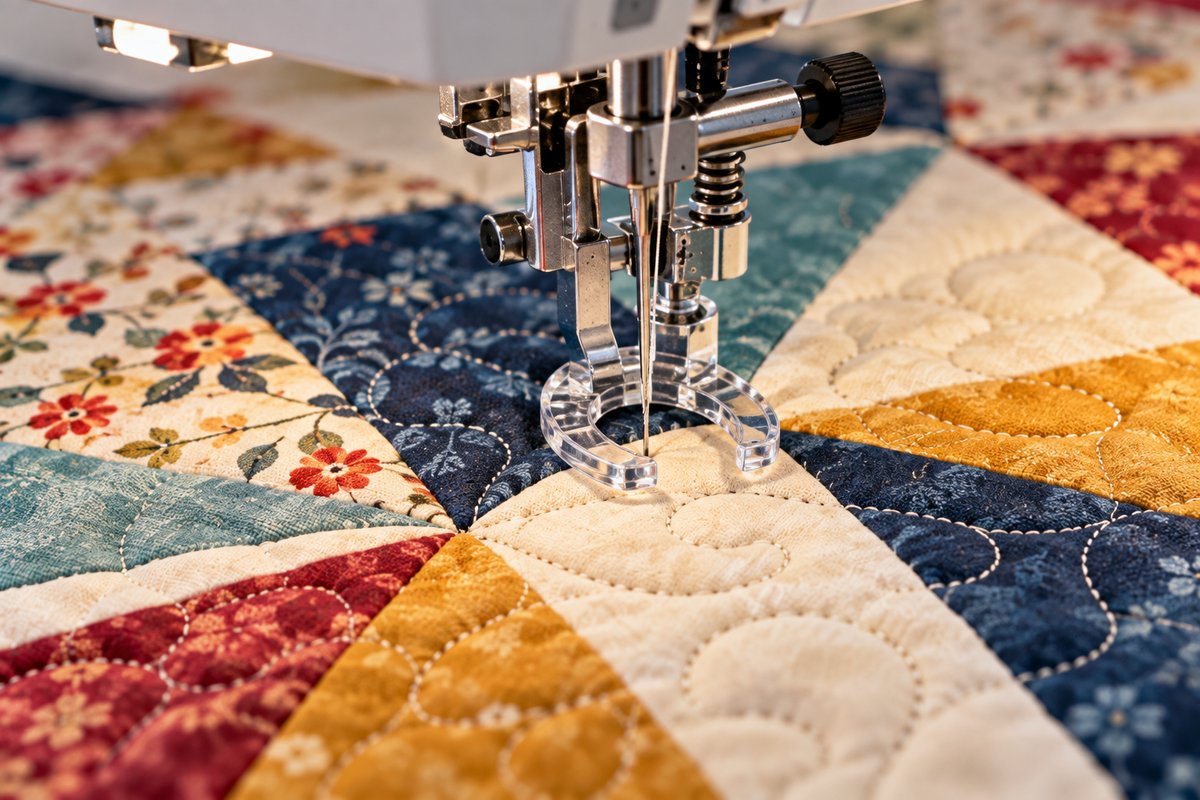
Pull a generic darning foot out of its package, and you will probably find a problem nobody mentioned in the listing. Leah Day, who has sold free motion quilting feet for years, says on her own product page: her basic low shank darning foot ships with a solid oval base you can barely see your needle through. She walks buyers through cutting it with nail clippers and sanding the edges before it is usable. Many sites still recommend that foot as a top pick.
The bigger issue is that a "free motion quilting foot" isn't one product. It is a category that splits by shank height, by brand, by whether you want to see your needle or guide a ruler against the foot's edge, and by whether you are doing simple stippling (a meandering, all-over quilting pattern) or ruler work with templates. Buy the wrong one and it either will not clamp onto your machine at all. Or it clamps on fine and then skips stitches every few inches because the foot cannot track your fabric the way your machine needs it to.
This list reflects what is selling well right now, not just what shows up first in a generic Amazon search, and each pick is matched to the situation it solves. Below you will find six feet. There is one true all-around pick, a dedicated option for Bernina owners (whose machines reject most "universal" feet outright), one for Juki's popular TL series, a ruler foot, a four-piece value set. There is also a premium convertible system if you want to stop buying replacement feet every time your project changes.
Table of Contents
Why your presser foot choice changes how your stitches look
Free motion quilting means you drop or cover your machine's feed dogs (the small metal teeth under the needle that pull the fabric along) and move the fabric yourself, in any direction, while the needle keeps moving up and down. A standard straight-stitch foot cannot work this way. It sits flat against the fabric the entire time, and once you start pushing fabric around under it by hand, it catches, puckers, or just refuses to let the fabric move at all.
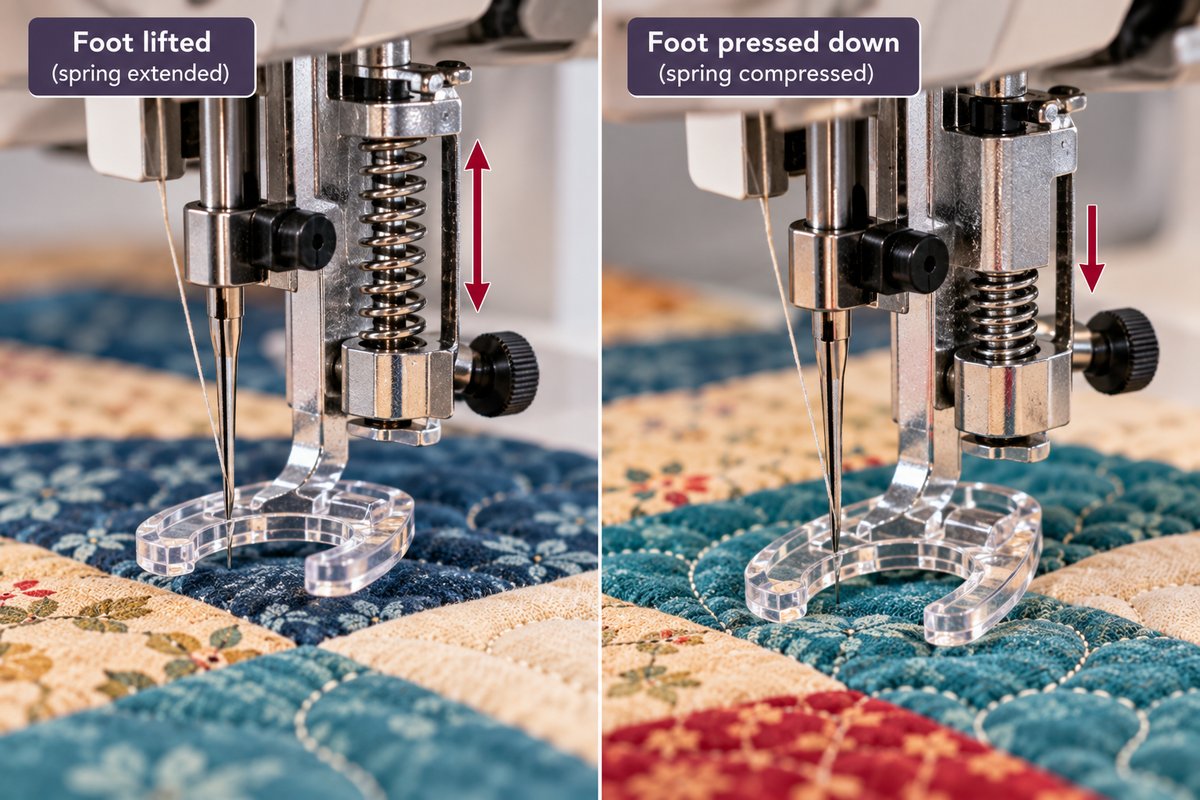
A dedicated free motion quilting foot solves this with one of two mechanisms. A hopping foot has a spring built into the shank. It lifts slightly between stitches, letting the fabric move briefly, then comes back down to hold it steady while the needle penetrates.
A floating foot skips the spring and instead rides just above the fabric surface, controlled by bar height rather than spring action. Both approaches work. Hopping feet tend to be cheaper and more common on entry-level machines. Floating feet, sometimes sold as "glide" or "hover" feet, are smoother at high speed and show up more on quilting-specific machines and newer Berninas.
Either way, three things determine whether a foot performs: how much of the needle area you can see through it, how it is held onto the machine (screw-on shank versus snap-on), and whether it is built for your shank height. Get any one of those wrong, and you will blame your tension or your thread when the real problem is sitting right under the needle.
Check your shank height before you buy anything
This is the step most buying guides skip, and it is the reason so many one-star reviews on generic darning feet say "didn't fit my machine" when the foot itself was perfectly fine.
Shank height is the distance from the needle clamp screw down to the bottom of the presser foot bar. Low shank machines (most home machines from Brother, Singer, Janome, Kenmore, and older Babylock models) measure around 1/2 inch. High shank machines measure closer to 7/8 inch to 1 inch, and you will find this on some Juki home models, industrial-adjacent machines, and certain longarm-style setups. A low-shank foot physically won't reach the fabric on a high-shank machine, and a high-shank foot will hang too low and jam on a low-shank one.
The fastest way to check without a ruler: look at what shipped with your machine. If your standard feet snap on and off with a lever at the back (no screwdriver needed), you likely have a low shank or a snap-on low shank machine, which is the most common setup in North America. If your dealer manual lists a "shank height" spec directly, trust that over any guesswork.
When in doubt, search your machine's exact model number plus "shank height" rather than relying on "universal, fits all machines" marketing copy, because that phrase almost never means Bernina or Janome Horizon machines. Both brands use proprietary foot-attachment systems that reject most generic low-shank feet sold for Brother and Singer machines, which is why a dedicated Bernina-specific free-motion quilting foot exists as its own product category below.
Open toe or closed toe
Open toe (sometimes called "spring" or "darning" foot with an open front) feet have no plastic or metal in front of the needle, so you get a full, unobstructed view of exactly where your needle is landing. This matters most for anyone doing detailed free motion work, like stippling tight curves, following a marked pattern, or quilting feathers, where a half-inch of blocked visibility can make you drift off your line.
Closed-toe feet have a solid loop in front of the needle. You lose some visibility directly in front of the needle, but you gain stability because the closed loop holds the fabric flatter and more evenly on both sides. Quilters who do a lot of straight-line or gentle-curve work, or who find open toe feet "bouncy," often prefer closed toe for exactly that reason. A few of the sets below include both, which is a reasonable way to find out which one suits your stitching style without buying two separate feet.
Ruler feet and stitch regulators
Two upgrades sit outside the basic open toe versus closed toe decision for a free motion quilting foot, and conflating them with a regular foot is where many buying guides get confusing.
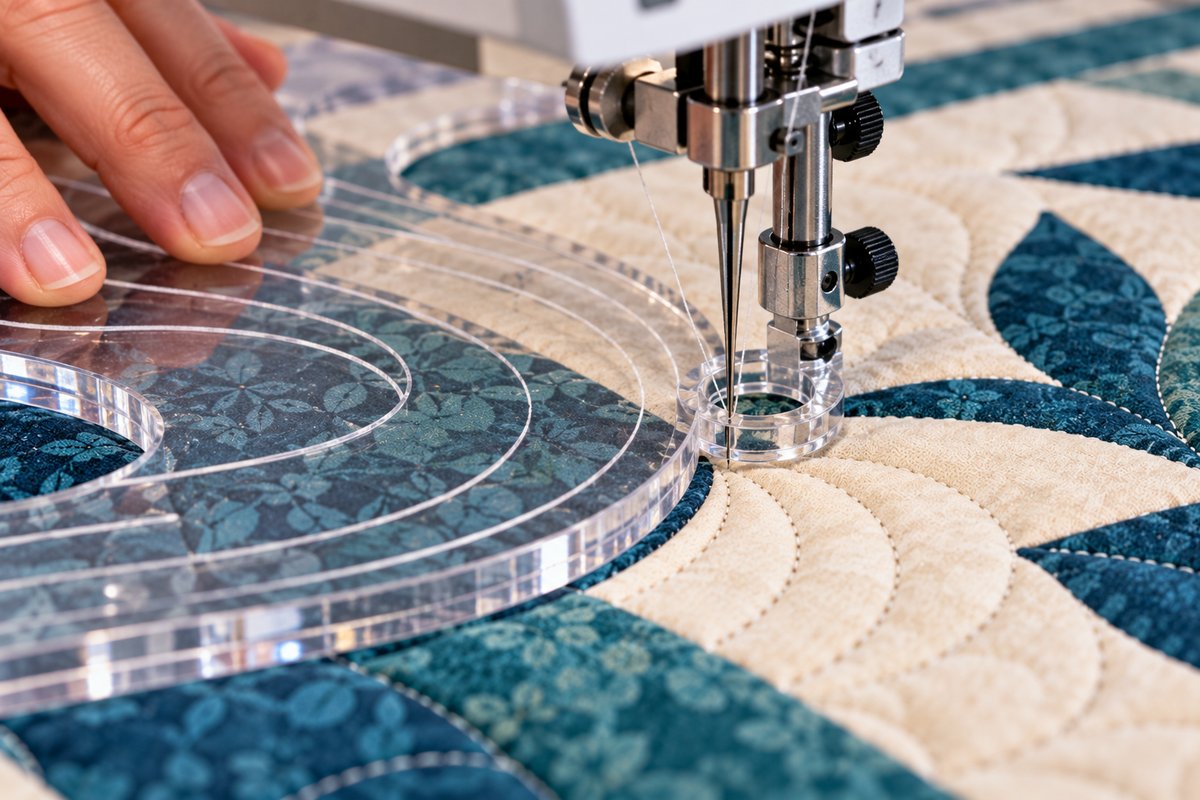
A ruler foot has a taller, usually clear plastic or acrylic collar around the needle. That extra height is not cosmetic. It lets you rest an acrylic quilting template (sold separately) flush against the foot's edge and guide the fabric along it, which produces clean, repeatable curves and straight lines that freehand motion cannot match. If you want template-guided quilting, you need a ruler foot. A standard open toe darning foot is too short, and the template will hit the needle bar.
A stitch regulator is a different category of product entirely. It is not a presser foot you buy for eight dollars. It is a sensor-equipped system that reads how fast you are moving the fabric and adjusts the needle's speed in real time to keep stitch length consistent. Bernina's BSR (Bernina Stitch Regulator) foot is the best-known example, and a few aftermarket add-ons exist for other brands. No amount of practice with a plain darning foot will give you that.
It is worth knowing this exists before you assume a basic foot should produce machine-perfect, even stitches on its own. It will not. Stitch regulators cost considerably more than a standard foot and are typically model-specific. If even stitch length matters more to you than price, that is a separate part to research for your exact machine rather than something to expect from any foot on this list.
Compare all six at a glance
| Product | Best For | Shank | Rating |
|---|---|---|---|
| AMZTKDIY Metal Open Toe Darning Foot | Best overall | Low shank, universal | 4.4 (302) |
| HONEYSEW 4-Piece Darning Foot Set | Best value set | Low shank, universal | 4.5 (66) |
| SEW-LINK Foot for Bernina #24 | Best for Bernina | Bernina proprietary | 4.4 (123) |
| Front Open Toe Foot #40171422 | Best for Juki TL series | Juki TL-98Q / TL-2010 / TL-2200QVP Mini | 5.0 (6) |
| Low Shank Ruler Foot, High Visibility Frame | Best ruler foot | Low shank, universal | 4.3 (238) |
| Janome Convertible Quilting Foot Set | Best splurge/quick-change | Low shank (Janome system) | 4.6 (283) |
The 6 best free motion quilting foot picks
1. AMZTKDIY Metal Open Toe Free Motion Quilting Darning Presser Foot: Best overall
Low shank, fits Brother, Singer, Babylock, Janome, New Home and most other low shank machines
For a first-time buyer, this is the foot to try first. It is metal rather than the thin stamped plastic some budget feet use, the open toe design gives a clear sightline to the needle. It has also sold over 1,000 units in the past month alone, which for a small accessory like this suggests few returns. At eight dollars, there is very little financial risk in trying it, and if your machine is one of the common low shank brands, it will likely clamp on without trouble.
It won't fit Bernina or Janome Horizon machines, or match a high-shank setup, so confirm your shank height first using the method above before you order.
2. HONEYSEW 4-Piece Large Metal Darning/Free Motion Presser Foot Set: Best value set
Low shank, fits Singer, Brother, Janome, Juki and more
For about two dollars more than a single free motion quilting foot, this set gives you a closed toe, an open toe, a dedicated quilting foot, and an embroidery foot. If you are still deciding whether you prefer an open or closed toe for your stitching style, this is the cheapest way to test both without committing to one. It is also a sensible pick if you share a machine with someone else who quilts differently than you do.
3. SEW-LINK Free Motion Quilting Darning Embroidery Foot for Bernina #24: Best for Bernina
Bernina proprietary attachment system
Bernina owners get left out of almost every generic "best free motion quilting foot" list because the brand's proprietary foot attachment does not accept the low shank feet everyone else is buying. This foot is built specifically to Bernina's #24 specification rather than adapted from a low-shank universal mold, which is the difference between a foot that clicks into place correctly and one that does not fit properly. It has a solid track record among Bernina owners, a much smaller buying pool than the Brother/Singer market, so the fit claims are easier to trust.
4. Front Open Toe Quilting Foot #40171422 for Juki TL-98Q, TL-2010, TL-2200QVP Mini: Best for Juki
Juki TL series specific
Juki's TL series machines (popular with quilters for their straight-stitch speed and simplicity) need their own free-motion quilting foot rather than a generic one, and this part number matches that system directly rather than a generic foot someone claims is "compatible." The rating pool here is small, which is normal for a part this specific to one machine line, but the fit is exact rather than approximate. If you own a TL-98Q, TL-2010, or TL-2200QVP Mini, this saves you the trial and error of adapting a low shank foot that was never designed for your machine.
5. Low Shank Ruler Foot with High Visibility Metal Frame: Best ruler foot
Low shank, universal
This free motion quilting foot is the one to buy once you are ready to move from freehand stippling into template-guided ruler work. The taller metal frame holds an acrylic ruler template flush against the fabric while keeping the needle clear, which a standard open toe darning foot cannot do safely. At under nine dollars, it is one of the cheaper ways into ruler work, though you will still need to buy acrylic templates separately, since none are included.
6. Janome Convertible Free Motion Quilting Foot Set for Low Shank Models: Best splurge
Low shank, Janome quick-change system
This is the pick for anyone tired of buying a new cheap foot every time a project calls for a different stitch style. It is a convertible base system: one shank stays mounted on the machine, and you swap foot heads for open toe, closed toe, or other quilting tasks without unscrewing anything each time. It has a solid track record, and the quick-change design is worth the premium if you quilt often enough that the time saved adds up.
Mistakes that cost people money
The most common mistake when buying a free motion quilting foot is choosing one labeled "universal" or "fits all machines" without checking shank height first, then being surprised when it does not clamp onto a Bernina or a Janome Horizon. Those two brands are the most common exceptions to "universal" claims, and it is worth checking your manual before you order rather than after your foot arrives and will not click into place.
The second mistake is expecting a basic darning foot to deliver stitch-regulator results. An eight-dollar foot will let you quilt free motion. It will not read your fabric speed and adjust needle timing to keep every stitch the same length. That is a feature of dedicated stitch regulator systems, not something foot design alone can deliver, so set your expectations around what the foot does before you blame your technique for uneven stitches.
The third mistake with a ruler-style free motion quilting foot is assuming templates are included. They almost never are. Budget for templates separately once you decide you want to pursue ruler work.
Frequently asked questions
Do I need a special foot for free motion quilting, or can I use my regular machine?
You need a dedicated free motion or darning foot. A standard straight-stitch foot sits flat against the fabric the whole time, which fights against the hand-guided motion free motion quilting requires. Any machine that can lower or cover its feed dogs can do free motion quilting once the correct foot is attached.
What is the difference between a hopping foot and a floating foot?
A hopping foot uses a spring in the shank to lift slightly between stitches, releasing the fabric briefly before coming back down. A floating foot has no spring and instead hovers just above the fabric at a fixed height, which tends to feel smoother at higher sewing speeds. Both are valid approaches to free motion quilting, and which one feels better is mostly personal preference.
Can I use a low shank foot on a high shank machine?
No. The foot will not reach the fabric, because the distance from the needle clamp to the foot is built for a shorter shank measurement. Check your machine's shank height before buying, either in your manual's specifications or by searching your exact model number.
Why won't a "universal" free motion foot fit my Bernina?
Bernina (and Janome's Horizon line) use proprietary foot attachment systems rather than the low shank clamp used by Brother, Singer, and most other brands. Generic feet marketed as fitting "all machines" are almost always built around the low shank standard and will not click onto a Bernina or Horizon shank. Look for a foot built to your brand's specific attachment system instead.
Do I need a ruler foot if I only do freehand stippling?
No. A ruler foot's taller frame exists to hold an acrylic template flush against the fabric for guided curves and straight lines. If you are doing freehand motion without templates, a standard open toe or closed toe darning foot is the right tool, and a ruler foot offers no advantage for that style of quilting.
Which one to buy
Picking the right free motion quilting foot starts with your shank height, not the star rating. Once you know whether you need a low shank, high shank, Bernina, or Juki-specific foot, the AMZTKDIY open toe foot is the safest default for most low shank machines. The HONEYSEW free motion quilting foot set is the best way to test open versus closed toe cheaply. The ruler foot is worth adding once you are ready for template work.
If your machine already handles free motion quilting well and you are deciding what to quilt on it next, our guide to the best sewing machine for free motion quilting and our fix for skipped stitches when free motion quilting cover the two problems that come up right after the foot question. Once the foot is on, a pair of free motion quilting gloves helps you guide the quilt with less force.