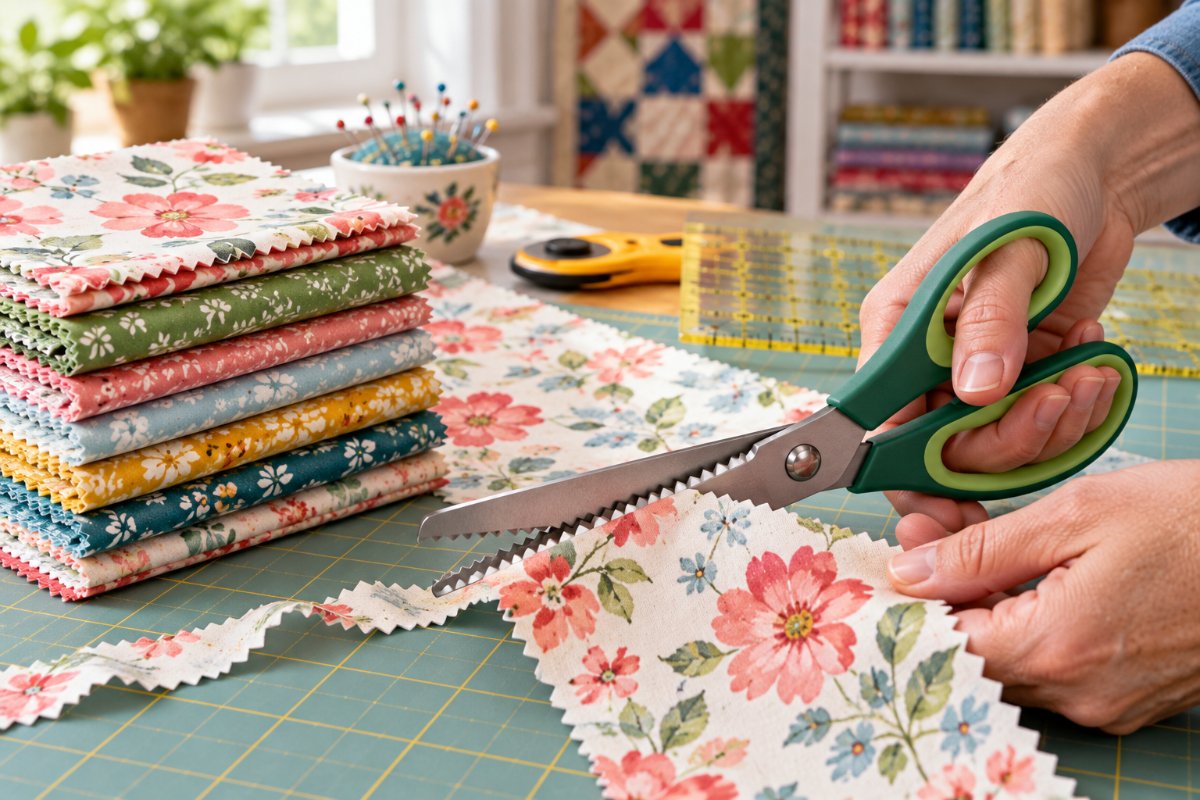
Most quilters need light, sharp 8- to 9.5-inch pinking shears with a soft grip, and they don't need to be expensive. The JISTL 9.5-inch shears are inexpensive and very popular. The SINGER 9-inch pair is the comfortable middle choice, and the KAI 8-inch is the one to buy if your hands get tired.
Before you buy, though, it helps to know where pinking shears are useful in a quilting room and where they aren't. Pieced quilt seams are enclosed, so you won't pink them. Pinking matters for prewashed yardage, stored fabric, quilted bags, and the edges of precuts, and that last one has a measuring trap that catches many quilters.
Table of Contents
Do quilters need pinking shears?
Not for every project. Inside a finished quilt, batting (the soft middle layer of a quilt) and backing cover the seams, so fraying there doesn't matter. Where pinking shears are worth using:
- Before prewashing. Pinking the cut ends of yardage keeps a long tangle of threads from forming in the washer.
- Fabric you're storing. Fat quarters (precut fabric pieces about 18 by 22 inches) and cut pieces that sit in a bin for months fray less with pinked edges.
- Quilted bags, pillows, and clothing. Any project where a seam is visible inside or gets handled a lot.
- Trimming curves. Pinking a curved seam allowance notches it at the same time, so it lies flat when turned.
- Decorative edges. Felt, fleece, paper labels and gift tags.
If you only piece quilt tops, pinking shears are optional. If you prewash, make bags or sew garments too, you'll reach for them often.
How pinking stops fraying (and where it doesn't)
A straight cut along the grain lets threads pull loose along the whole edge. Pinking turns that edge into a row of tiny triangles, each cut on the bias, and bias edges fray much less. Diary of a Quilter puts it well: pinking won't stop fraying entirely, but it keeps it from spreading across your project. For a seam that will see heavy washing, pinking plus a line of straight stitching just inside the zigzag holds up better than pinking alone.
What to look for in the best pinking shears
| Feature | What it means | What to choose |
|---|---|---|
| Blade length | Longer blades cut farther per stroke but weigh more | 8 to 9 inches for most quilters |
| Weight | Pinking blades are thick, so these shears are heavier than regular scissors | Lighter pairs if you cut a lot or have sore hands |
| Handle | Soft grips and ergonomic shapes cut hand fatigue | Cushioned or contoured handles |
| Blade steel | Stainless steel resists rust and holds an edge | Hardened stainless steel |
| Warranty | Pinking blades are hard to sharpen at home | A long or lifetime warranty is a plus |
A note on weight: almost every pinking shear is heavier and stiffer than a fabric scissor, because the blades are thick and the teeth have to mesh. Expect that, and pick a comfortable handle rather than chasing the lightest pair.
Best pinking shears for quilting: 5 picks
All five are widely reviewed pairs, with prices as of this writing. Ratings shift over time, so check before you buy.
JISTL 9.5-Inch Pinking Shears: best value
The green JISTL pinking shears have tens of thousands of reviews and cost about ten dollars, which makes them the default recommendation for most quilters. They have stainless steel blades and soft grips, and Diary of a Quilter recommends them too. The listing says they're a little big and heavy and that the pivot screw can't be adjusted.
- Good: Very low cost, huge review record, long 9.5-inch blades.
- Watch for: On the heavy side, and the screw can't be tightened later.
SINGER 9-Inch Pinking Shears: best soft grip
SINGER's 9-inch pinking shears add a cushioned white handle to stainless steel sawtooth blades for about sixteen dollars. They have thousands of strong reviews, and the softer grip helps when you're pinking a whole stack of fat quarters before prewashing.
- Good: Comfortable soft-grip handle, well reviewed, still inexpensive.
- Watch for: 9-inch blades are long for small hands.
KAI N5350 8-Inch Pinking Shears: best for tired hands
KAI is a Japanese scissor maker with a strong following among quilters, and the N5350 pinking shears focus on comfort. They're built to be lightweight, with an ergonomic handle and stainless steel blades that cut through several layers. At about thirty-three dollars, they cost more, but they're the pair to buy if hand strain is the problem.
- Good: Light, ergonomic, cuts multiple layers cleanly.
- Watch for: Higher price, and an 8-inch blade means more strokes on long edges.
Fiskars 8-Inch Pinking Shears: best warranty
The orange-handled Fiskars pair has stainless steel blades, an ergonomic handle, and an extended lower blade that helps you keep cutting in one smooth line. It's backed by a full lifetime warranty, which matters because pinking blades are hard to sharpen at home. It costs about twenty-one dollars.
- Good: Lifetime warranty, familiar Fiskars handle, steady continuous cuts.
- Watch for: Fewer reviews than the JISTL and SINGER pairs.
Gingher 7.5-Inch Pinking Shears: the classic, with a catch
Gingher is the name many quilters grew up with, and its 7.5-inch pinking shears are all metal with stainless steel blades. They're also the most expensive pair here at about fifty-five dollars, and their average rating trails the cheaper options. Buy them if you want the traditional all-metal feel, not because the price guarantees a better cut.
- Good: Classic all-metal build, compact 7.5-inch size.
- Watch for: High price, lower average rating than budget pairs.
Side by side:
| Pinking shears | Blade length | Handle | Best for |
|---|---|---|---|
| JISTL | 9.5 in | Soft grip | Best value |
| SINGER | 9 in | Cushioned soft grip | Comfort on a budget |
| KAI N5350 | 8 in | Ergonomic, lightweight | Tired or sore hands |
| Fiskars | 8 in | Ergonomic | Lifetime warranty |
| Gingher | 7.5 in | All metal | Traditional feel |
Pinking shears vs a pinking rotary blade
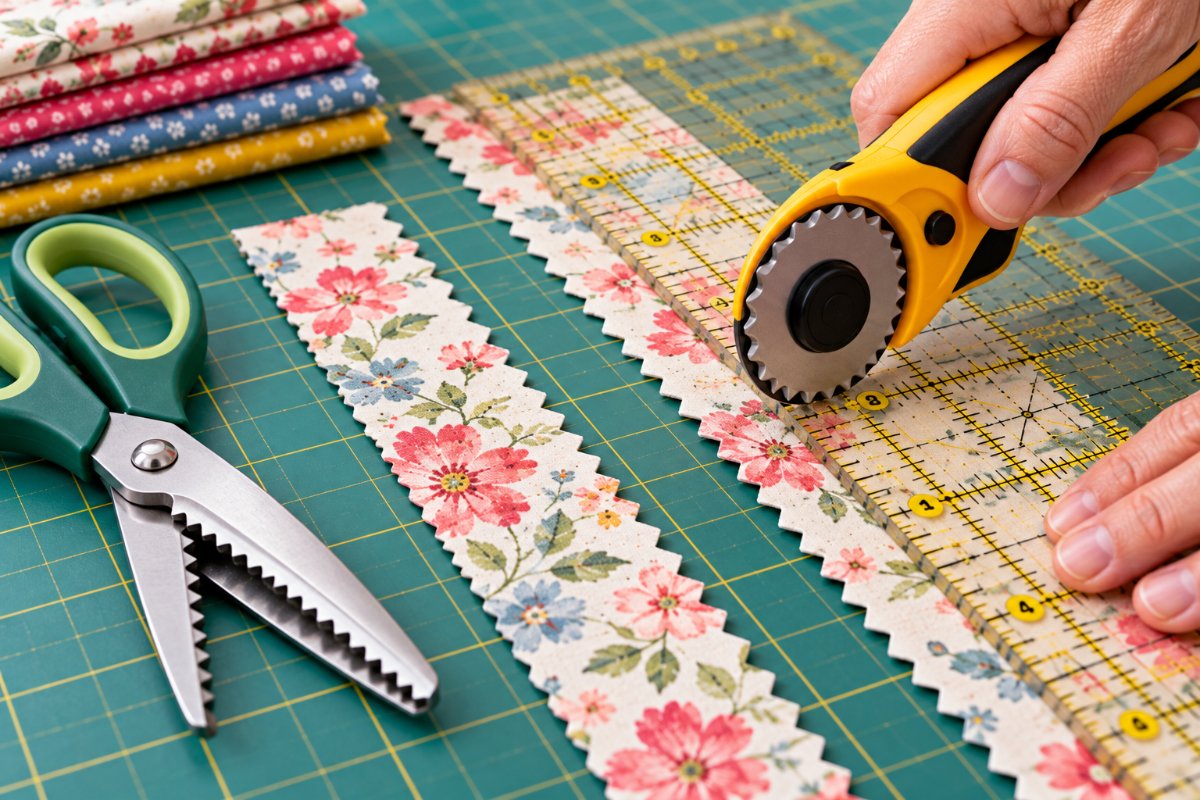
If you already own a 45mm rotary cutter, a pinking blade may suit you better than shears for long, straight edges. The OLFA 45mm Rotary Pinking Blade (PIB45-1) fits most 45mm cutters and costs about seventeen dollars. It's easier on arthritic hands and cuts several layers at once against a ruler. Shears are still better for small pieces you need to hold, curves, and quick trims without a mat.
| Pinking shears | Pinking rotary blade | |
|---|---|---|
| Long straight edges | Slower, many strokes | Fast with a ruler |
| Curves and small pieces | Better control | Awkward |
| Hands and wrists | Squeezing can tire hands | Easier for arthritis |
| Extra gear | None | Cutting mat and ruler |
| Pattern | Sharp zigzag | Softer, shallower zigzag |
One warning: generic multi-pack pinking blades are cheap, but many owners report poor results with them. The OLFA blade is the safer buy. Our guides to the best rotary cutter for quilting and the best self-healing cutting mat cover the rest of that setup.
Pinked precuts: where to measure your 1/4-inch seam
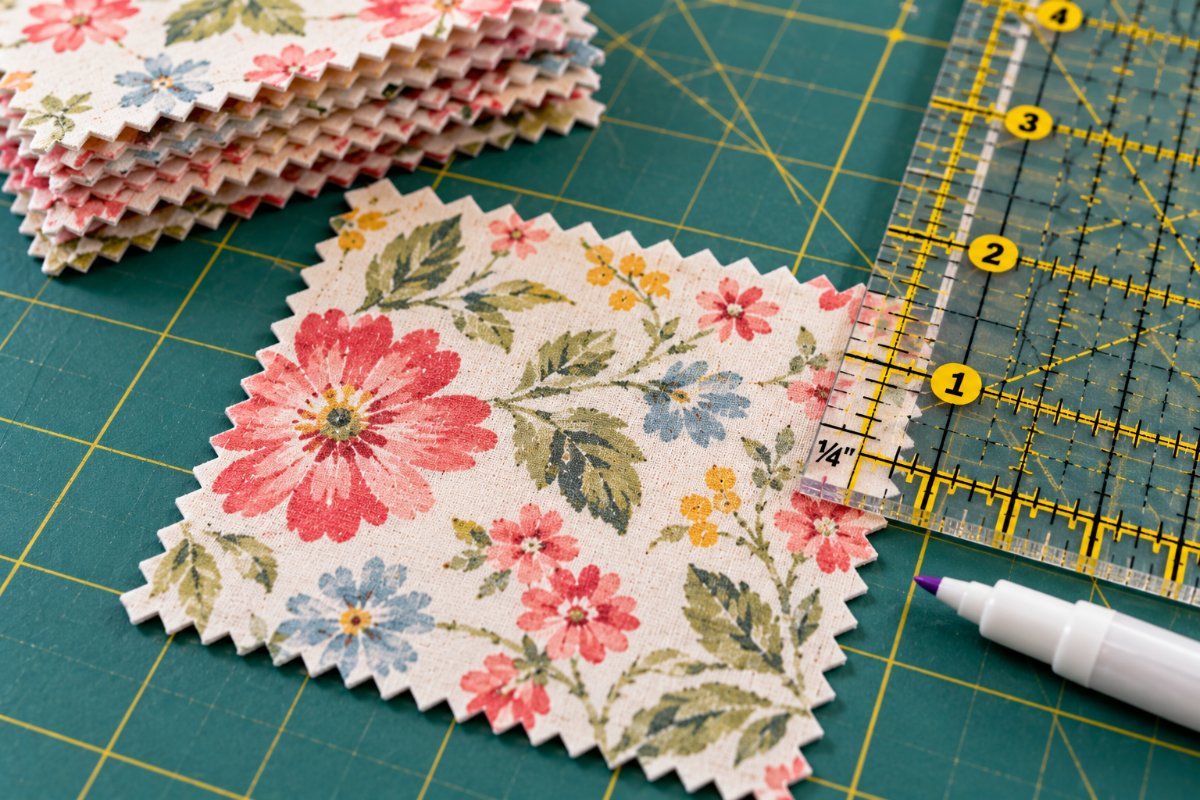
Charm packs, layer cakes, and jelly rolls come with pinked edges so they don't fray in the package. That raises a question: do you measure your seam from the points of the zigzag or the valleys?
It depends on the fabric company. In a Quilting Daily test of pinked precuts, measuring from the outer points of a deep pinked edge added as much as a quarter inch, while measuring from the inner edge could lose as much. Windham's deep pinking added a full quarter inch, Maywood Studio's shallow pinking measured almost exactly true, and Moda's 2.5-inch strips had a negligible pinked edge.
The fix is simple. Measure a few pieces from the pack before you start. If they're oversized, trim them to size. If they're true, pick one edge (points or valleys) and sew from it every time, since consistency matters more than which edge you choose.
How to use pinking shears
- Cut with fabric flat on the table, using the lower blade as a guide along the surface.
- Open the blades fully and cut with their whole length, not just the tips.
- Before each new stroke, line up the teeth with the end of the last zigzag so the pattern stays continuous.
- Don't snap the blades fully closed at the end of a stroke. Stopping just short keeps the pattern clean.
- For seams that will be washed often, stitch a straight line about 1/4 inch from the pinked edge.
Care and sharpening
Pinking shears are hard to sharpen at home because of the teeth. Use them only on fabric, wipe off lint and any adhesive, and put a drop of sewing machine oil on the pivot screw now and then. When they start to chew instead of cut, take them to a professional sharpener who works on pinking blades. Diary of a Quilter notes that only the flat underside of each blade should be sharpened, which is why a pro is worth it. A lifetime warranty, like Fiskars offers, can be the cheaper route.
Pinking shears vs fabric scissors
Pinking shears don't replace a good pair of fabric scissors or a rotary cutter. Never cut patchwork pieces with pinking shears. The zigzag edge makes an accurate 1/4-inch seam almost impossible, and the shapes won't line up when you piece them. Pinking shears are a finishing tool: you cut accurately first, then pink the edges you want to protect.
Keep both tools for fabric only. Paper dulls any blade quickly, and a dull pinking blade chews and snags instead of cutting cleanly. If you also need a precise straight cut, see our guide to the best quilting rulers for beginners, which pairs with a rotary cutter for accurate pieces.
Other ways to stop fraying
Pinking is the quickest fix, but it isn't the only one. Depending on the project, one of these may suit you better:
- Zigzag stitch. Any sewing machine can run a zigzag along a raw edge. It's slower than pinking but holds up better in the wash.
- Serger or overlock stitch. The most durable seam finish for garments and bags, if you own a serger.
- Liquid fray stopper. A thin line of a product like Dritz Fray Check seals a small edge or a clipped corner. It can stiffen the fabric, so test it on a scrap first.
- A quick straight stitch. Stay-stitching about 1/4 inch from a raw edge before prewashing keeps long threads from unraveling.
For most quilters, a pair of pinking shears plus an occasional zigzag stitch covers almost every situation.
Frequently asked questions
What are the best pinking shears for quilting?
The best pinking shears for most quilters are a light 8- to 9.5-inch pair with a soft grip. The JISTL 9.5-inch shears are the best value, the SINGER 9-inch pair adds a cushioned handle, and the KAI N5350 is the most comfortable for tired hands.
Do pinking shears stop fabric from fraying?
They reduce fraying but do not stop it completely. Pinking turns the edge into small bias-cut triangles that fray much less than a straight-grain edge. For heavily washed seams, add a line of straight stitching inside the pinked edge.
Do quilters need pinking shears?
Not for pieced quilt tops, because the seams are enclosed. They are useful for pinking yardage before prewashing, storing cut fabric, and sewing bags, pillows, and garments where seams show.
Where do you measure a 1/4-inch seam on pinked precuts?
It depends on the manufacturer. Deep pinking can add up to a quarter inch if you measure from the points. Measure a few pieces first, trim them if they are oversized, and otherwise sew consistently from the same edge.
Can you sharpen pinking shears?
Yes, but it is best done by a professional sharpener, because only the flat underside of each blade should be sharpened to keep the teeth meshing. Keep them for fabric only, and oil the pivot to make them last longer.
Which one to buy
The best pinking shears don't have to cost much. The JISTL 9.5-inch pair is the best value, the SINGER 9-inch pair is the comfortable budget pick, and the KAI N5350 is worth the extra money if your hands get sore. For long straight edges, add an OLFA pinking blade to the rotary cutter you already own. And when you sew with pinked precuts, measure first so your blocks come out the size the pattern expects.