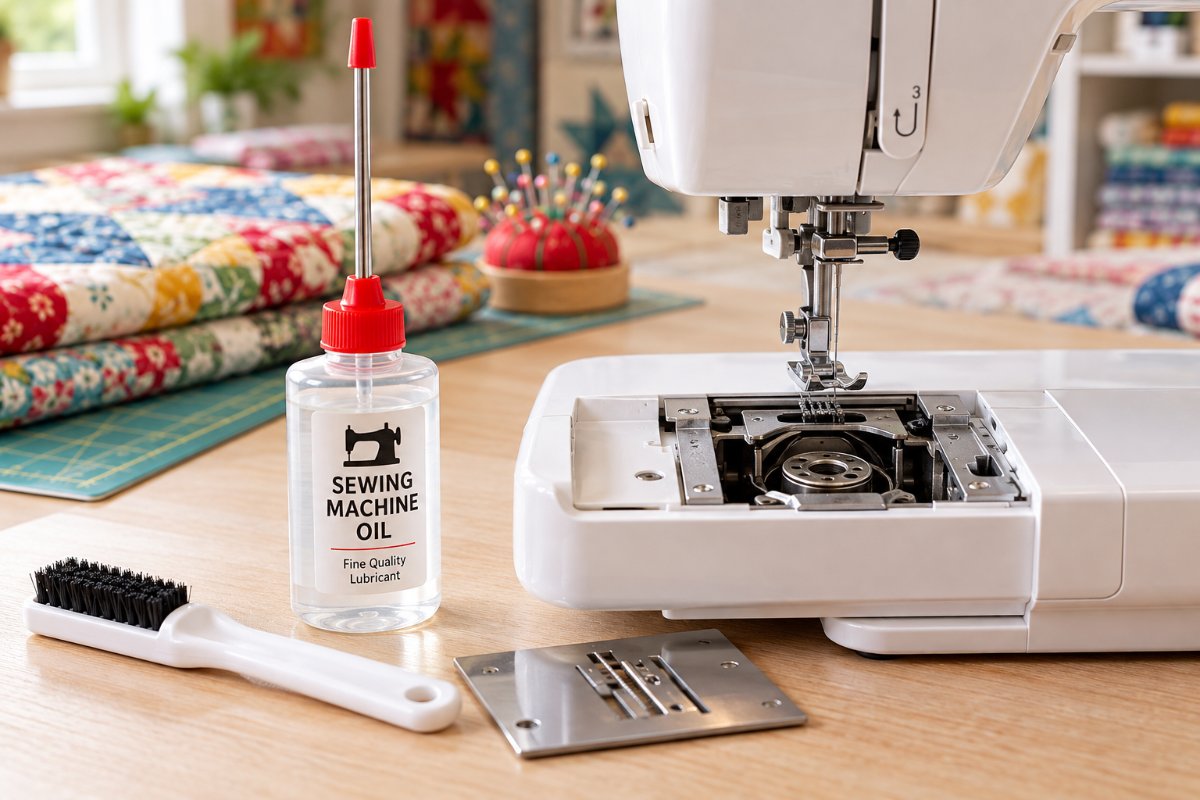
A few drops of sewing machine oil are the cheapest insurance a quilter can buy. Quilting is hard on a machine. Long seams, thick layers, and batting lint add friction, and friction wears metal parts, loosens stitches, and makes a machine clatter. The right oil in the right spots keeps it quiet, smooth, and sewing evenly for years.
This guide explains what sewing machine oil is, which oils to avoid, how to tell whether your machine needs oil, and how to oil it in six easy steps.
Table of contents
- What sewing machine oil is
- What to use and what to avoid
- Sewing machine oil options worth knowing
- Does your machine need oil?
- How to oil a sewing machine in 6 steps
- How often to oil
- Oiling mistakes to avoid
- Frequently asked questions
- Bottom line
What sewing machine oil is
Sewing machine oil is a light, clear lubricant made for the small, fast-moving metal parts inside a sewing machine. Most brands are a highly refined, non-detergent mineral oil. Some are synthetic. Either way, the oil is thin enough to reach tight spaces, it stays fluid instead of turning gummy, and it is clear so a stray drop is far less likely to stain fabric.
That last point matters for quilters. A drop of dark or heavy oil near the needle can leave a mark on a light quilt top that is hard to remove. Clear sewing machine oil is made to avoid that problem.
What to use and what to avoid
Use only oil that is labeled for sewing machines. Your machine brand may sell its own, and general sewing machine oils in small bottles with a long, thin spout come in many names. Look for oil described as clear, stainless, or non-staining. A clear sewing machine oil is the only kind that belongs inside your machine.
Skip these, even if they are already in your garage or kitchen:
- WD-40. It's more of a cleaner and water displacer than a long-lasting lubricant, and it can leave a sticky film behind as it dries.
- Household 3-in-1 multipurpose oil. It is heavier and contains additives that can gum up over time. Some brands make a separate oil labeled for sewing machines, which is fine. Read the label.
- Cooking oil. Vegetable and olive oils turn sticky and can go rancid inside the machine.
- Motor oil or gun oil. These are too heavy for small sewing machine parts and often too dark as well.
- Canned air. It is not an oil, but it is worth mentioning here. It blows lint deeper into the machine, where it mixes with oil and turns to sludge. Brush lint out instead.
Sewing machine oil options worth knowing
You do not need a special brand. These are the kinds of sewing machine oil quilters use most:
- Zoom spout oilers. Small bottles of clear, stainless sewing machine oil with a telescoping spout that reaches deep into the bobbin area. Several companies sell this style, often labeled Lily White or Zoom Spout.
- Your machine brand's own oil. Singer, Juki, Bernina, and other brands sell oil for their machines. It is a safe choice if your manual names it.
- Synthetic oil with PTFE. A thicker synthetic oil some sewists use before long storage. Check that it is labeled safe for sewing machines before you use it.
Whichever sewing machine oil you choose, a small bottle lasts a long time because you use only a drop or two at each spot.
Does your machine need oil?
Not every machine wants sewing machine oil, so check your manual before you start. Older mechanical machines and semi-industrial straight-stitch machines, like the ones in our Juki TL-2000Qi review, have several oil points and need oil often. Many newer computerized home machines are partly sealed, and the manual may ask you to oil only the hook race in the bobbin area, or not at all.
The manual usually shows each oil point with a small diagram, and some machines mark them with red dots. If your manual says not to oil, follow it and have the machine serviced on the schedule it recommends instead. Brother, for example, keeps model-specific oiling steps on its official support page.
How to oil a sewing machine in 6 steps
These steps work for most machines that take sewing machine oil. Always follow your own manual where it differs.
- Unplug the machine. Never oil a machine that is plugged in.
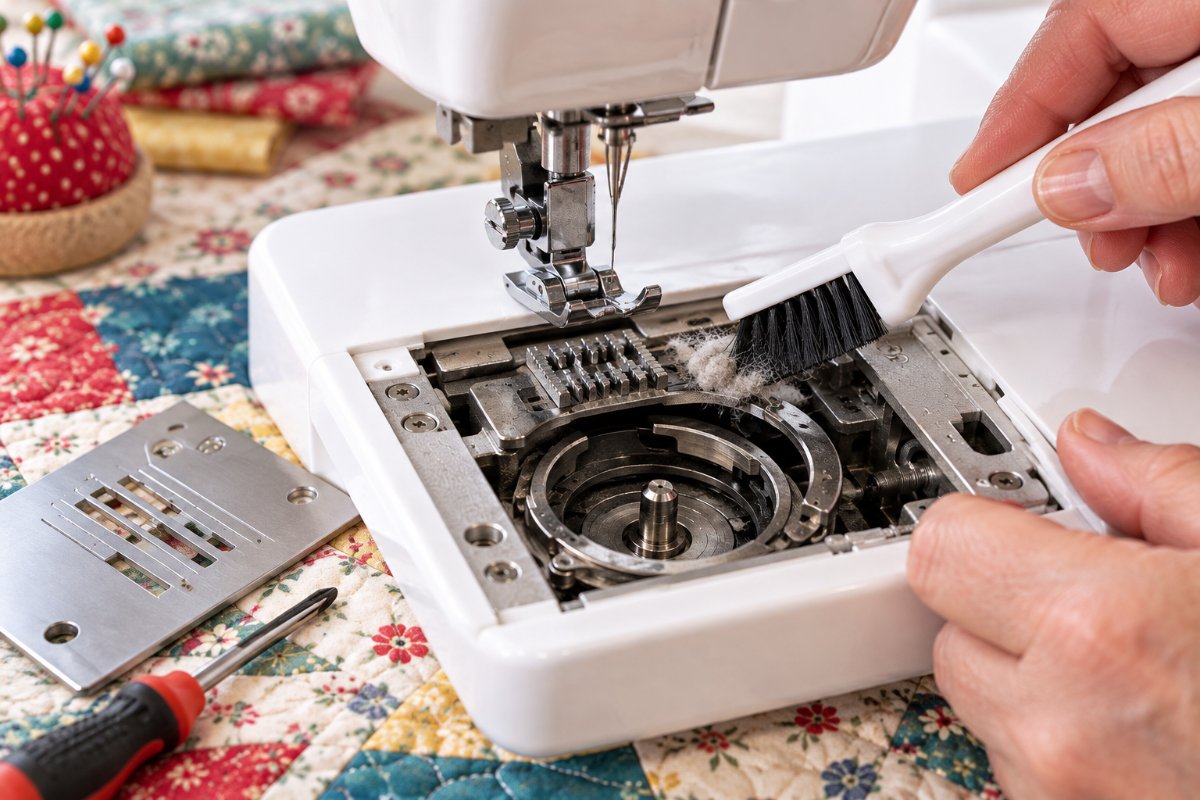
- Open up the bobbin area. Remove the needle, presser foot, throat plate, bobbin, and bobbin case if your manual allows it.
- Clean out the lint first. Use a small brush to sweep lint from the feed dogs, hook race, and bobbin case. Oil on top of lint makes a paste that traps dirt.
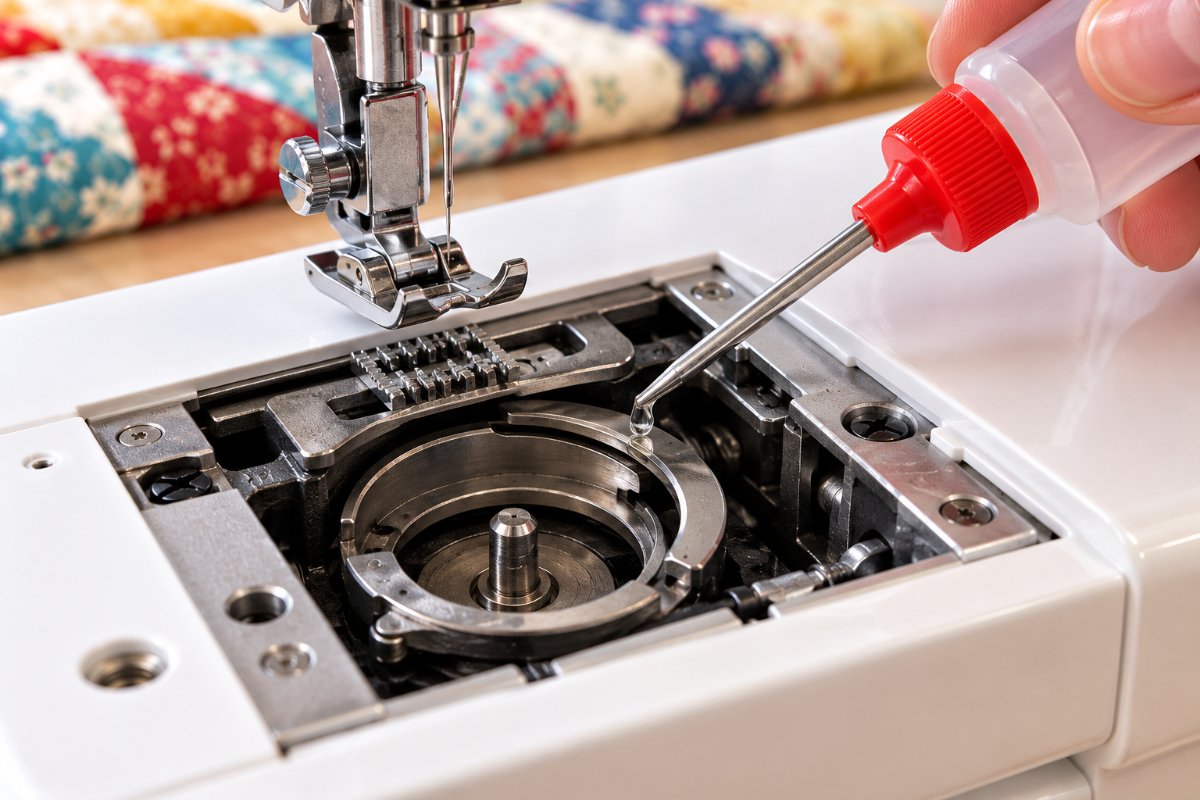
- Add one drop at each oil point. Put a single drop of sewing machine oil on each spot your manual shows, starting with the hook race. More is not better.
- Turn the handwheel. Rotate it toward you a few times by hand so the oil spreads through the moving parts.
- Wipe and test. Reassemble the machine, wipe away any extra oil, and sew a few rows on scrap fabric before you go back to your quilt.
Sewing on scrap first is the step people skip, and it is the one that saves quilts. Any extra oil ends up on the scrap instead of your quilt top.
How often to oil
How often you add sewing machine oil depends on the machine and how much you sew. A few general rules:
- Follow your manual first. Its schedule beats any general rule.
- Home machines: many quilters add a drop to the hook race after each bobbin change or after each large project.
- Semi-industrial and longarm machines: these run faster and longer, so they usually need oil much more often, sometimes every day of heavy use. Our guide to how to clean a longarm quilting machine covers that routine.
- Before storage and after a long break: oil before you put a machine away, and check it again before you use it after weeks of sitting.
Listen to the machine too. A machine that suddenly sounds louder, clicks, or feels sluggish is often asking for cleaning and a drop of sewing machine oil.
Oiling mistakes to avoid
- Oiling without cleaning. Always brush out lint first.
- Using too much. Extra oil drips onto fabric and attracts more lint.
- Oiling spots the manual does not list. Some parts are sealed or not meant to be oiled.
- Skipping the scrap test. Always sew on scrap fabric after oiling.
- Using the wrong oil. Stick to sewing machine oil, not household oils.
If the machine still skips or loops thread after cleaning and oiling, the problem is usually elsewhere. See our guides on how to fix tension on a sewing machine and skipped stitches when free-motion quilting.
Frequently asked questions
What kind of oil is sewing machine oil?
Most sewing machine oil is a light, clear, highly refined mineral oil with no detergents. Some brands use a synthetic oil instead. It is thin enough to reach small parts and clear, so it is less likely to stain fabric.
Can I use WD-40 on a sewing machine?
No. WD-40 is mainly a cleaner and water displacer, not a lasting lubricant for sewing machines, and it can leave a sticky film. Use oil labeled for sewing machines instead.
How often should I oil my sewing machine?
Follow your manual first. Many quilters oil the hook race after each bobbin change or after each large project. Semi-industrial and longarm machines usually need oil more often, sometimes daily during heavy use.
Can I use mineral oil instead of sewing machine oil?
Some sewists use pure, clear mineral oil in a pinch because most sewing machine oil is a refined mineral oil. Scented or baby oil versions have additives, so skip those. Oil labeled for sewing machines is inexpensive and the safest choice.
Does sewing machine oil go bad?
Sewing machine oil keeps well in a capped bottle. If it looks cloudy, darker, or thicker than when you bought it, replace it.
Bottom line
Sewing machine oil is simple. Use clear oil labeled for sewing machines, never WD-40 or household oil, and only where your manual says. Clean out lint first, add one drop at each point, turn the handwheel, and sew on scrap before your quilt. Do that on a regular schedule, and your machine will stay quiet and smooth through many quilts.
1 thought on “Sewing Machine Oil: What to Use and How to Oil Your Machine”