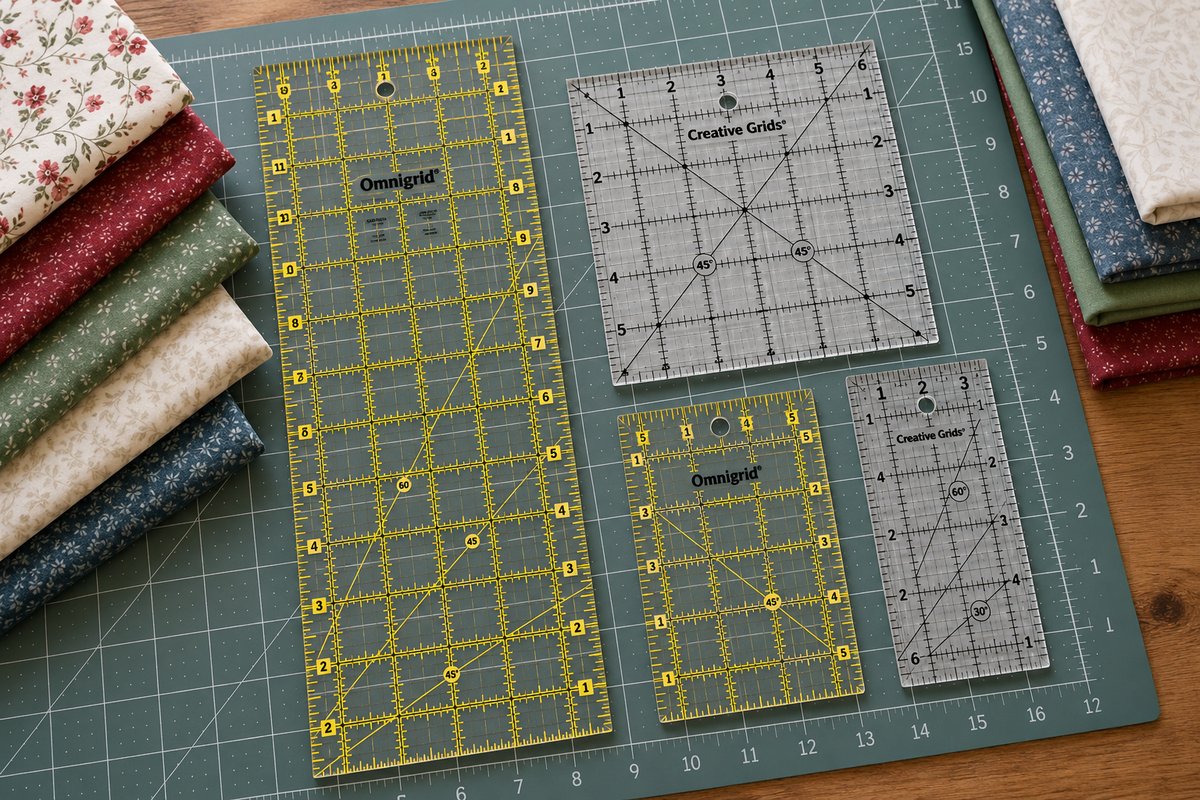
Walk into any quilt shop's ruler wall, and you'll see forty-plus shapes staring back at you: rectangles, squares, wedges, curves, something called a "Stripology" that looks like a cutting board grew a handle. New quilters see that wall and assume they need most of it. They don't. Picking the best quilting rulers for a beginner's kit isn't about owning the most tools. It's about choosing the right three and learning them well. You can buy the rest later, one project at a time, when a specific pattern calls for it.
Here's the part that trips people up before they even get to the rulers themselves: a ruler is only as accurate as the person holding it, and quilting math is unforgiving. A quarter inch off on one seam becomes a quarter inch off eight times over in a block with eight seams, and by the time you're squaring up a queen-size top, that small error has turned into a quilt that won't lie flat. Rulers exist to remove human wobble from the equation. A cheap, warped, or poorly marked one puts the wobble right back in.
Table of Contents
- Why the ruler matters (it's not just a straightedge)
- Best Quilting Rulers for Beginners: The 3 You Need
- The main ruler shapes, and what each one is for
- Material and markings matter more than the shape
- Two real options worth knowing
- Rulers, rotary cutters, and mats are a set, not separate decisions
- FAQ
Why the ruler matters (it's not just a straightedge)
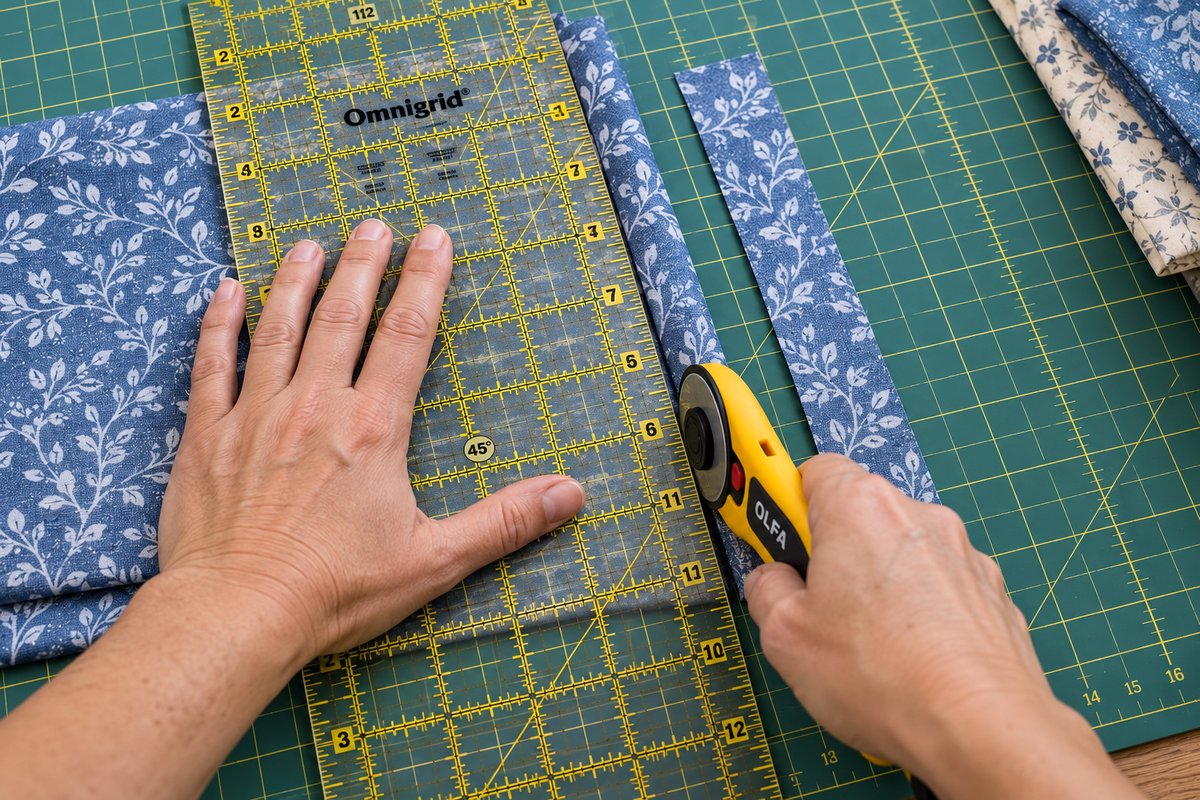
Fabric behaves differently depending on which direction you cut it. Cut along the grain and the edge holds its shape. Cut on the bias, even slightly, and that edge wants to stretch the moment you pick the fabric up. A rotary cutter paired with a good ruler keeps every cut on-grain and repeatable, because the ruler's grid lines let you square up against the fabric's actual weave instead of eyeballing it. Cut freehand with scissors, or slide a ruler that's shifted mid-cut, and you introduce bias stretch you won't notice until the block is sewn and refuses to sit flat.
Seam allowance is the other half. Quilting almost universally runs on a quarter inch, and most rulers are gridded in eighths or sixteenths specifically so you can hit that number consistently, cut after cut, block after block. A ruler with faint, unevenly spaced lines makes it easy to be a sixteenth off without realizing it. That sixteenth compounds across a block, then across a quilt, and it's the single most common reason a first quilt ends up with wavy borders and mismatched points.
Best Quilting Rulers for Beginners: The 3 You Need
Skip the twelve-piece bundles for now. Start with:
A 6" x 24" rectangle. This is the workhorse. It cuts width-of-fabric strips (the strips almost every pattern starts from), trims yardage, and squares up long edges. If you buy exactly one ruler before your first project, this is it.
A 6.5" square. Used constantly for squaring up blocks after piecing, since blocks almost never come out perfectly square on their own, even when you've sewn carefully. It also handles smaller cuts the big rectangle is awkward for.
A smaller rectangle, roughly 3.5" x 18" or similar. This fills the gap for shorter strips, half-yard cuts, and situations where the 24" ruler is more length than you need and harder to control. Some beginners substitute a second square here instead, which works fine too. It's really about having one large tool and one smaller, more maneuverable one.
That's the starting kit. Everything past those three, from curved rulers to specialty wedge templates, is a "buy it when a pattern demands it" purchase, not a day-one one. Those three, together, are the best quilting rulers to start with, in the order you will reach for them.
The main ruler shapes, and what each one is for
Rectangular rulers handle strip cutting and trimming. They come in a range of widths and lengths, and the 6" width shows up most often because it matches the width many blocks and strip sets are built to.
Square rulers exist mainly to square up. After you piece a block, its edges are rarely dead straight, and a square ruler lets you trim all four sides back to a true, consistent size before joining it to the next block. Squares from about 4.5" to 12.5" cover most quilt-block sizing.
Specialty rulers (curves, wedges, Dresden-plate templates, triangle rulers) are pattern-specific tools. A curved ruler that lets you cut clean drunkard's-path arcs is fantastic the day you're making a drunkard's-path quilt and dead weight every other day. Buy these as patterns require them rather than stocking up in advance.
Material and markings matter more than the shape
Every one of the best quilting rulers on the market is clear acrylic, thick enough (about 1/8 inch) not to flex or wobble under a rotary cutter, with laser-cut edges so the blade doesn't catch or skip. Beyond that baseline, two things separate a good ruler from a frustrating one:
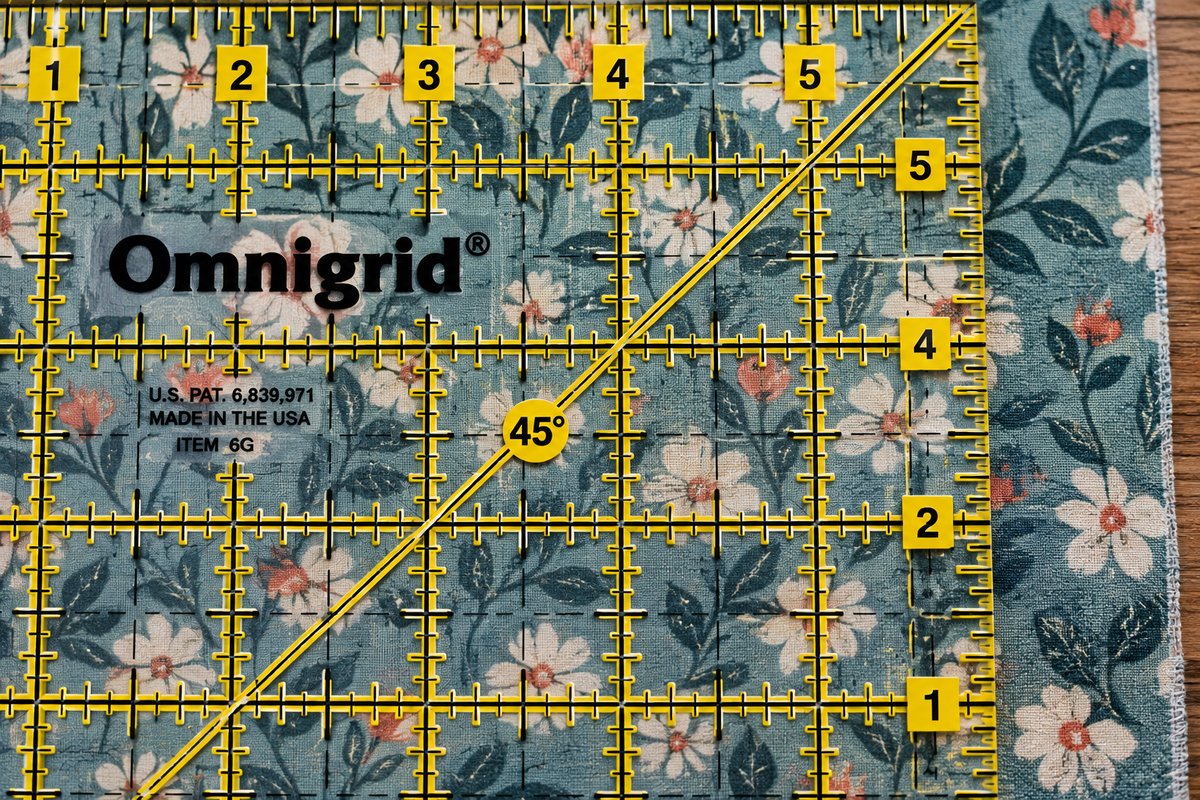
Double-sight lines. Better rulers print their grid in both black and a lighter color (often yellow or white) specifically so the lines stay visible against dark fabric. A ruler with only black markings essentially disappears the moment you set it on navy or black fabric, which is exactly when you most need to see it clearly.
Grip. Acrylic on cotton wants to slide, especially once your cutting mat has wax buildup. Some rulers add a non-slip coating or backing ring. Others rely on you pressing down evenly and keeping your cutting hand steady. If you've ever had a ruler creep half a millimeter mid-cut and ruin a strip, grip stops being a nice-to-have.
Two real options worth knowing
Here are two of the best quilting rulers on the market right now, both fact-checked against live listings today rather than pulled from an old spec sheet.
Omnigrid Ruler Set, Squares. A three-piece set (1" x 6", 4" x 4", and 6" x 6") with a 4.8-star average across roughly 900 ratings and an Amazon's Choice badge as of this writing. It's a straightforward, budget-friendly way to get a small rectangle and two of the most-used square sizes in one purchase, and it's a fine starting point if you want to try quilting before committing to a bigger kit.
Creative Grids rulers. Creative Grids sells individually rather than as one universal beginner bundle, and quilters tend to build their own set from the line's non-slip acrylic rulers, which carry a raised grip texture molded into the acrylic itself instead of a stuck-on coating that can peel. Their 6.5" x 12.5" rectangle is the brand's single most-reviewed ruler, currently sitting at 4.9 stars across roughly 1,100 ratings. A pre-bundled six-piece Creative Grids square set (2.5" through 7.5") is also available and costs about five times as much as the Omnigrid option, which is the tradeoff: better grip and a loyal following among longtime quilters, at a real price jump if you buy the whole line at once.
Fons & Porter and Quilters Select both make well-regarded non-slip rulers too, and you'll see either recommended often in quilting forums. Specific pricing on those shifts by retailer and bundle more than the two above, so check a current listing before assuming a number you read somewhere is still accurate. Either way, both are worth comparing against the two options above before you settle on which of the best quilting rulers suits your budget and grip preference.
None of this needs to be an either/or decision on day one. Many quilters start with a set budget, figure out which sizes they reach for most, and upgrade only those rulers to a non-slip version later. That's a perfectly reasonable way to spend less money up front while you're still confirming quilting is a hobby you want to keep doing.
Creative Grids publishes its full line, with sizes and uses for each ruler, on the Creative Grids USA website. It is a handy way to compare shapes before you buy, and several of its rulers show up on lists of the best quilting rulers for beginners.
If you are building a kit from scratch, buy in this order: the 6" x 24" rectangle first, then the 6.5" square, then the smaller rectangle. That order matches how often each one gets used, and it is the most practical way to collect the best quilting rulers without buying tools you will not use yet. The same order works whether you pick Omnigrid, Creative Grids, or another brand.
Add specialty rulers only when a pattern calls for one, so the best quilting rulers you own stay in regular use instead of in a drawer. Start there, and you will have the best quilting rulers for most beginner patterns covered. Many of the best quilting rulers from other brands follow the same sizes, so the order still works if you switch brands later.
Rulers, rotary cutters, and mats are a set, not separate decisions
A great ruler paired with a dull rotary cutter still gives you ragged, uneven cuts, and a great ruler used on a warped or undersized cutting mat still lets fabric shift mid-cut. If you haven't settled on the other two pieces of this toolkit yet, it's worth reading up on choosing a rotary cutter for quilting and picking the right cutting mat before you finalize a ruler purchase, since the three genuinely work as a system. The best quilting rulers in the world won't save a cut made with a dull blade or a warped mat.
FAQ
How many quilting rulers does a beginner need?
Three: a 6" x 24" rectangle, a 6.5" square, and one smaller rectangle. That covers strip cutting, squaring blocks, and shorter cuts. Everything beyond that is pattern-specific, not a starter requirement.
Do I need a non-slip ruler, or is a basic acrylic one fine?
A basic acrylic ruler works for most beginners, especially paired with a sandpaper dot or two stuck to the underside for grip. Some of the best quilting rulers on the market do add non-slip backing as a genuine upgrade, not a gimmick, but it's not mandatory to get started.
What size ruler is best for cutting fat quarters?
A 6" or smaller rectangle, since fat quarters are only 18" by 22" and a 24" ruler runs off the edge of the fabric more than it helps. Many quilters keep a shorter rectangle specifically for fat-quarter work.
Can I use a regular sewing or craft ruler instead of a quilting ruler?
Not really. Quilting rulers are thicker acrylic designed to resist a rotary cutter's blade and are gridded specifically for seam allowances and common block sizes. A thin craft ruler will get nicked by the blade and doesn't have the same markings.
What are the best quilting rulers for a first-time buyer on a budget?
A budget-friendly three-piece set like the Omnigrid Ruler Set, Squares covers the essentials without a high up-front cost, and it's a reasonable way to confirm you'll stick with quilting before spending more on a non-slip line like Creative Grids.
2 thoughts on “Best Quilting Rulers for Beginners: What You Really Need”