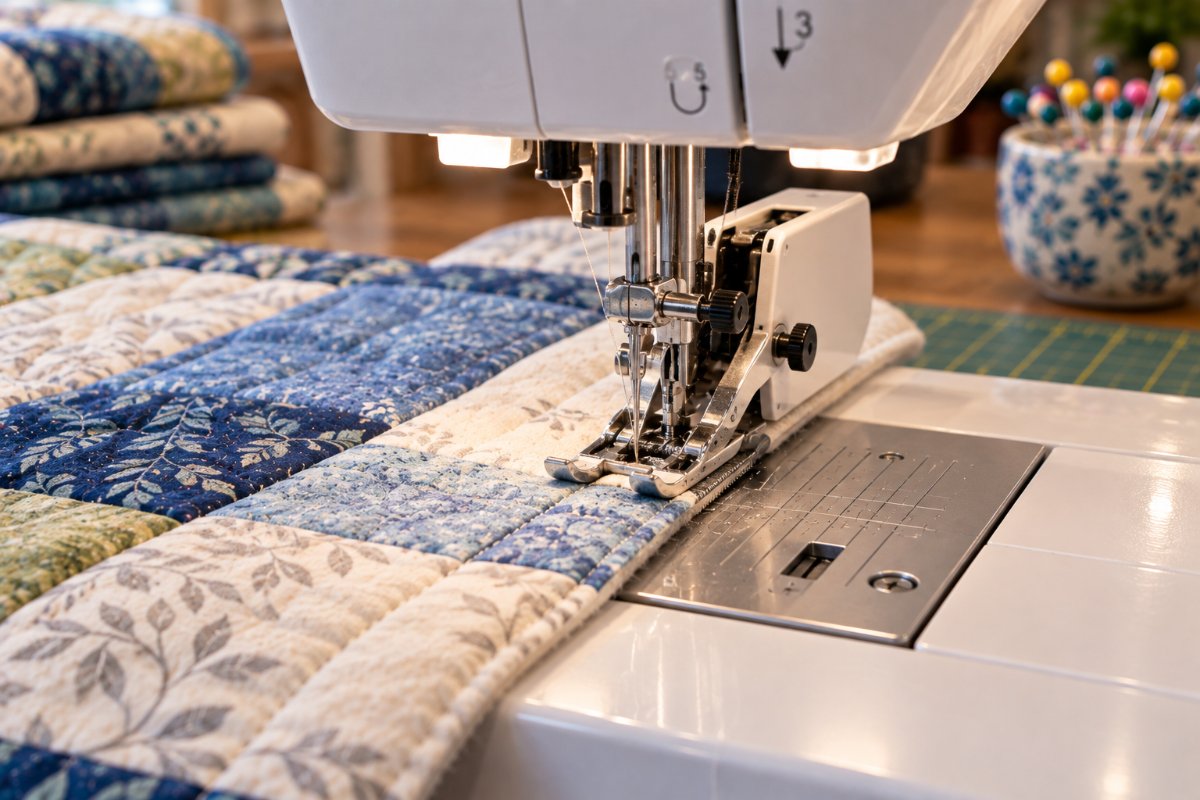
A walking foot for quilting is the single accessory most likely to fix the puckering, shifting, and uneven stitches you get when machine quilting a layered quilt sandwich on a regular sewing machine. It adds a second set of feed dogs on top of the fabric, so the top layer moves at the same rate as the layers underneath instead of dragging or bunching. Whether you are stitching in the ditch, quilting straight lines, or attaching binding, the right walking foot makes the job noticeably easier, and the wrong one (or none at all) is one of the most common reasons a home quilter gets frustrated with straight-line work.
Table of Contents
What Matters When Buying a Walking Foot for Quilting
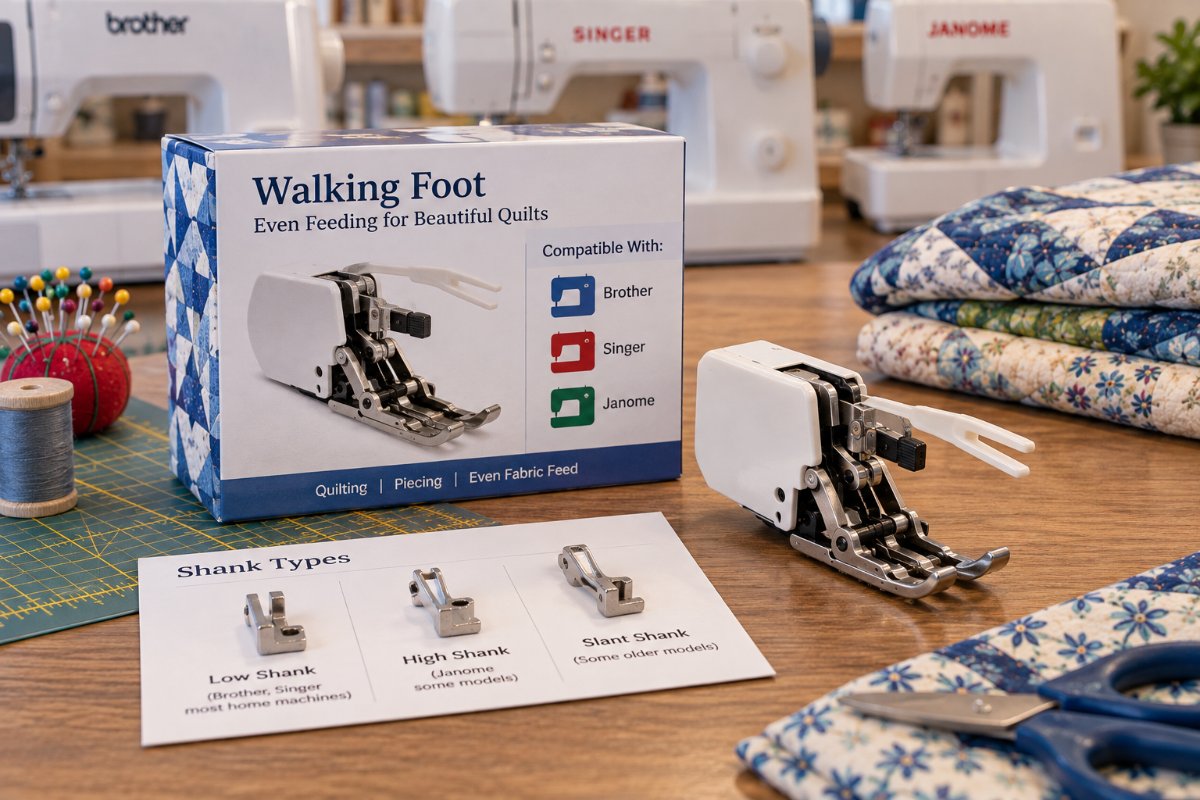
Walking feet are not one-size-fits-all, and the biggest mistake buyers make when shopping for a walking foot for quilting is ordering one without checking these details first.
- Shank type. Low-shank, high-shank, and slant-shank machines all take different walking feet. Most modern Brother, Singer, and Janome domestic machines are low-shank, but check your machine's manual or measure the shank height before ordering a generic one.
- Brand-specific vs. universal. A universal walking foot with interchangeable snap-on adapters fits more machines, but a brand-specific OEM foot (Janome, Singer, Bernina) usually attaches more securely and feeds a little more smoothly on that brand's machine.
- Open toe vs. closed toe. An open-toe walking foot gives you a clearer view of your stitching line, which matters for stitch-in-the-ditch work. A closed or standard toe is fine for straight-line quilting where you are following a marked line or a guide bar.
- Built-in quilting guide bar. A guide bar (sometimes included, sometimes sold separately) lets you space evenly parallel quilting lines without marking every single one, which speeds up cross-hatch and channel quilting considerably.
- Dual-feed vs. walking foot. Some newer machines have a built-in dual-feed system that does the same job internally. If your machine already has this, you likely don't need a separate walking foot. Check your machine's accessory list first.
Best Walking Feet for Quilting
Best Budget Pick: HONEYSEW Open Toe Walking Foot
The HONEYSEW Open Toe Walking Foot has a 4.4-star rating across roughly 1,100 reviews and an "Overall Pick" badge on the listing as of this writing. It is built for low-shank Brother machines specifically, and the open-toe design makes it easy to see your stitching line for stitch-in-the-ditch work. As the least expensive pick here, it is a low-risk way to find out whether a walking foot solves your puckering problem before spending more on a brand-name option.
Best Universal Option: Madam Sew Open Toe Walking Foot
The Madam Sew Open Toe Walking Foot has a 4.4-star rating across roughly 1,400 reviews. Madam Sew is one of the more established third-party presser foot brands among home quilters, and this foot fits low-shank Brother, Singer, Janome, and Babylock machines. If you are not sure which brand-specific foot to buy, or you sew on more than one low-shank machine, this is the safer universal choice over the cheapest no-name options.
Best for Singer Machines: SINGER Even Feed Walking Presser Foot
The SINGER Even Feed Walking Presser Foot has a 4.7-star rating across roughly 1,000 reviews. As an OEM Singer accessory built specifically for Singer's CA, CB, EA, MA, and MB series machines, it attaches more securely than a universal adapter foot and is a good choice if you sew primarily on a Singer machine and want a guaranteed fit.
Best for Janome Machines: Janome Even Feed Foot with Quilting Guide
The Janome Even Feed Foot with Quilting Guide has a 4.5-star rating across roughly 690 reviews. It is built specifically for Janome's horizontal rotary hook machine models and ships with a quilting guide bar included, which the budget and universal options above typically sell separately. The higher price reflects genuine OEM fit and the included guide rather than added gimmicks, and it is the pick worth the extra cost if you quilt often on a compatible Janome machine.
How to Use a Walking Foot for Machine Quilting
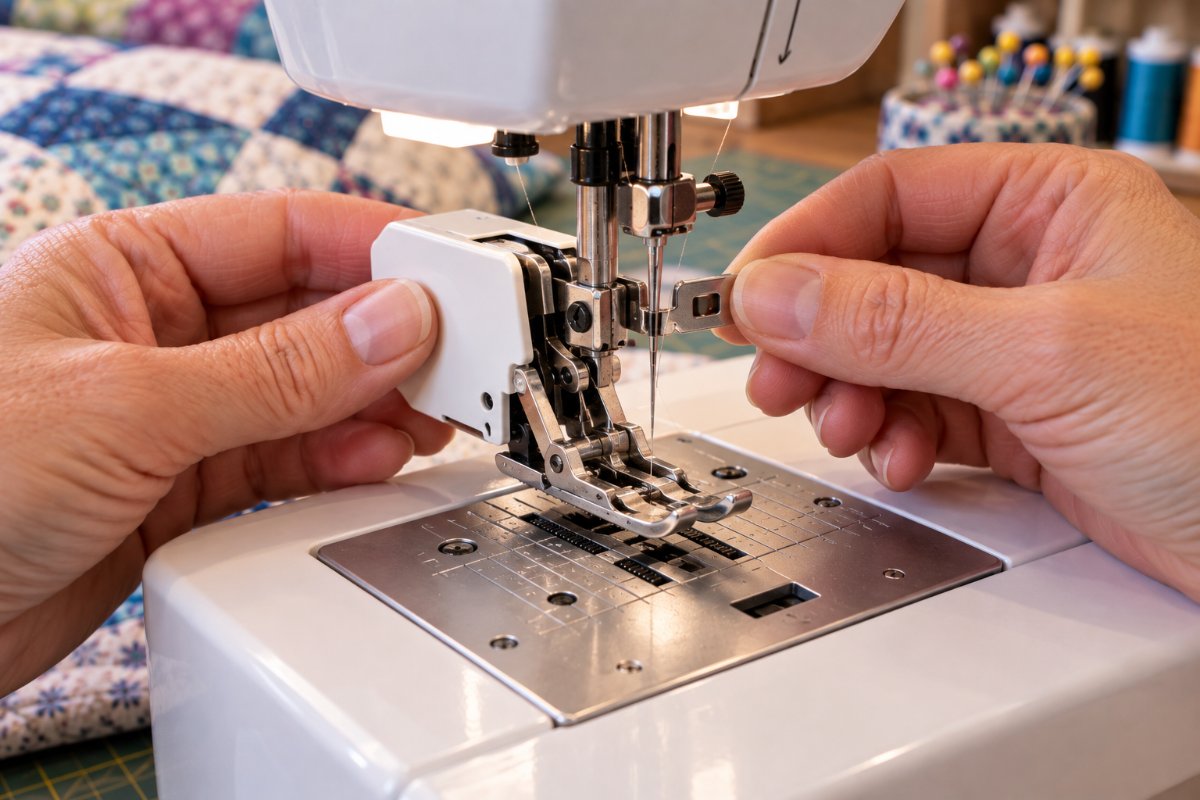
Attach the foot according to your machine's instructions, since some walking feet clip on like a standard presser foot while others need a fork or bar that hooks over the needle clamp screw. Baste your quilt sandwich first, whether with spray adhesive or basting pins, so the layers cannot shift once you start stitching. Keep your feed dogs up rather than dropped. A walking foot is meant to work together with them, unlike free-motion quilting where the feed dogs are dropped.
Sew at a slow, steady speed and let the walking foot's built-in feed dogs move the top layer, rather than pulling or pushing the fabric yourself. If your quilt is large, support the bulk on a table or your lap so its weight doesn't drag against the feed as you sew with a walking foot. Diary of a Quilter has a detailed walkthrough of straight-line quilting with a walking foot that is worth a look if you are quilting your first full-size project.
If you run into skipped stitches partway through a quilting session, the cause is more often the needle or tension than the foot itself. See our guide to how to fix skipped stitches when free motion quilting for the most common causes, several of which apply just as much to a walking foot for quilting as they do to free-motion work.
A walking foot works even better on a well-basted quilt. See our guide to the best basting spray for quilting for a quick way to hold the layers flat.
Frequently Asked Questions
Do you need a walking foot for quilting?
Not strictly, but it makes straight-line quilting on a home sewing machine significantly easier and more consistent. Without one, the top layer of your quilt sandwich tends to shift or bunch relative to the batting and backing, especially over pieced seams. A walking foot is considered close to essential for stitch-in-the-ditch and straight-line quilting specifically. It is not used for free-motion quilting, where the feed dogs are dropped instead.
What is the difference between a quilting foot and a walking foot?
"Quilting foot" is often used loosely to mean either a walking foot or a free-motion (darning) foot, depending on context. A walking foot has its own feed dogs and is used with the machine's feed dogs engaged for straight-line work. A free-motion or darning foot is used with the feed dogs dropped, letting you move the fabric by hand in any direction. If you are choosing a sewing machine for free motion quilting specifically, the feed-dog drop and darning foot matter more than the walking foot.
What tension should I use for quilting with a walking foot?
When you sew with a walking foot for quilting, start with your machine's normal piecing tension and test on a scrap quilt sandwich made from the same fabric, batting, and thread as your actual project. Thicker batting or a denser quilting design sometimes needs slightly looser top tension so the stitches lie flat on both sides rather than pulling the backing fabric up into small dots.
When should you not use a walking foot?
Skip the walking foot for free-motion quilting, since it is designed to work with the feed dogs engaged and will fight against hand-guided fabric movement. It is also unnecessary for piecing quilt blocks, where a standard or quarter-inch foot gives a cleaner, more accurate seam allowance. Save a walking foot for quilting straight lines, stitch-in-the-ditch work, and attaching binding instead.
Bottom Line
A walking foot for quilting solves a specific, common problem: keeping quilt layers feeding evenly during straight-line quilting so you avoid puckers, shifting, and uneven stitches. The HONEYSEW open-toe foot is a low-cost way to try a walking foot for quilting on a Brother machine, the Madam Sew is the safer universal pick if you are unsure which brand to buy for, and the SINGER and Janome OEM options are worth the extra cost if you sew primarily on one of those machines and want a guaranteed, secure fit.
Whichever you choose, match it to your machine's shank type first. That single check prevents most of the return requests and fit complaints seen in product reviews. For notions and tools that pair well with a walking foot for quilting, see our guide to the best rotary cutter for quilting.
2 thoughts on “Best Walking Foot for Quilting in 2026”