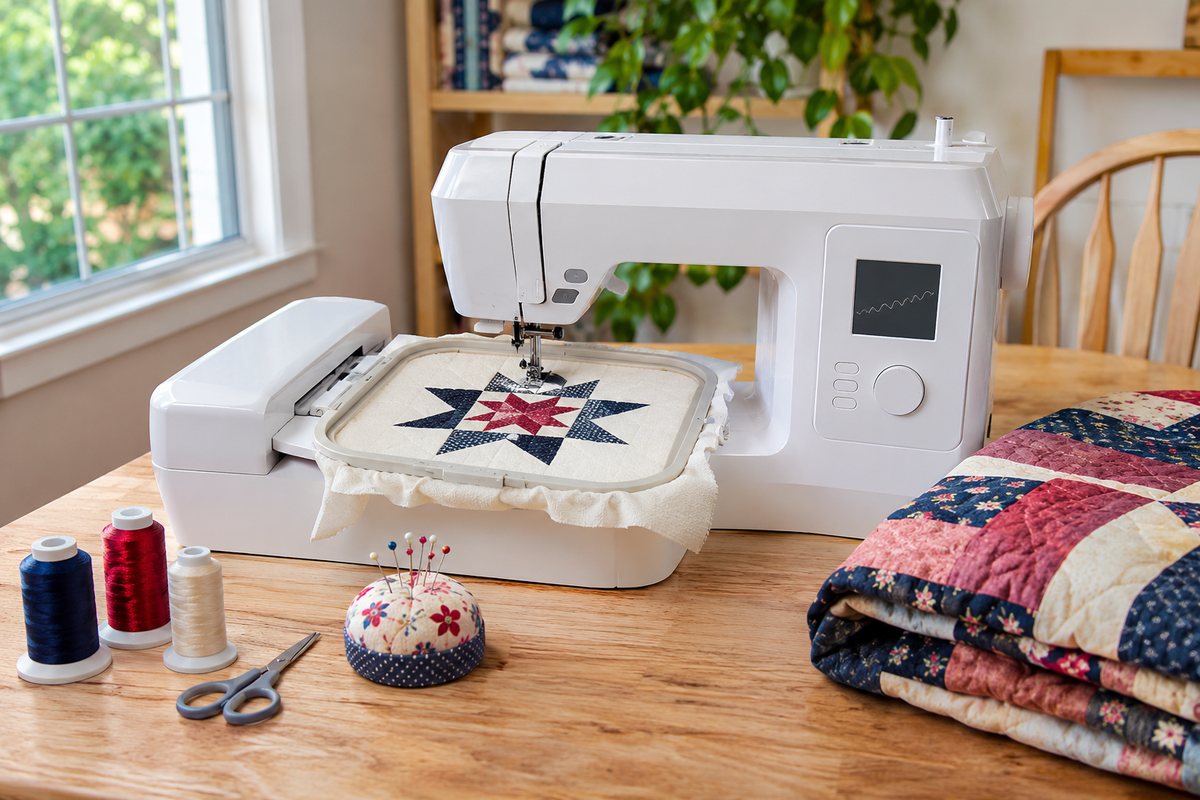
The best sewing machine for quilting and embroidery for most people is the Brother SE2000. It has the sewing features most quilters need for piecing and quilting, and its 5-by-7-inch embroidery field fits quilt labels and small embroidered blocks in one hooping. A combo machine like this lets you piece, quilt, and stitch embroidery designs on one machine instead of owning two.
QuiltGearHQ is a participant in the Amazon Services LLC Associates Program, an affiliate advertising program designed to provide a means for sites to earn advertising fees by advertising and linking to Amazon.com.
The short answers
The right pick depends on two things: how big your embroidery designs are, and how big your quilts are.
- Best for most quilters: Brother SE2000
- Best budget pick for quilt labels: Brother SE700
- Best value for a longer field: Singer SE9180
- Best for bigger designs at a mid-range price: Janome Horizon Memory Craft 9850
- Most room for quilting: Bernette 79
- Best premium pick: Brother Innov-is NQ3550W
Table of Contents
Our picks at a glance
The embroidery field is the largest design the machine can stitch in one hooping. Needle-to-arm space is the room to the right of the needle, where the rolled-up quilt has to fit. Select a machine name to check the current price on Amazon.
| Machine | Embroidery field (largest design) | Included hoops | Needle-to-arm space | Drop feed | Walking foot or dual feed | Design transfer | Biggest drawback |
|---|---|---|---|---|---|---|---|
| Brother SE2000 | 5 x 7 in | 1 (5 x 7 in) | 7.4 in | Yes (switch). Foot sold separately | None listed by Brother | Wi-Fi | Largest design 5 x 7 in |
| Brother SE700 | 4 x 4 in | 1 (4 x 4 in) | 6.4 inwork area | Yes (switch). Foot sold separately | Optional (SA140) | Wi-Fi, USB drive | Smallest field and room |
| Singer SE9180 | About 6.7 x 3.9 in170 x 100 mm | 1 (170 x 100 mm) | 6.5 in | Yes. Darning foot included | Not included | USB and Wi-Fiper Singer's manual | Only about 3.9 in tall |
| Janome Horizon Memory Craft 9850 | 6.7 x 7.9 in | 2 (US box) | 8.1 inworkspace | Yes | No built-in upper feed | USB | No Wi-Fi or knee lifter |
| Bernette 79 | 10.2 x 6.3 in | 3 | 9 in | Yes (lever) | Built-in dual feed | USB | Second-highest cost |
| Brother Innov-is NQ3550W | 6 x 10 in | 1 (6 x 10 in)Amazon listing | 8.3 inworkspace | Yesretailer listings | Not listed by Brother | Wi-Fi | Highest cost |
What a combo machine does for a quilter
A combo machine is a computerized sewing machine with an embroidery unit that attaches to it. To embroider, you attach the unit, hoop your fabric with stabilizer, pick a design, and the machine stitches it, pausing when it is time to change thread colors. To sew, you take the unit off and use it like a regular machine.
For quilters, that opens up a few things a sewing-only machine can't do:
- Quilt labels. Stitch your name, the date, and who the quilt is for, in thread instead of fabric marker.
- Embroidered blocks. Stitch a design into a block, then piece it into the quilt like any other block.
- Machine appliqué. The machine stitches the placement line, the tack-down line, and the satin edge for you.
- In-the-hoop projects. The machine pieces and quilts small items, like mug rugs and coasters, inside the hoop.
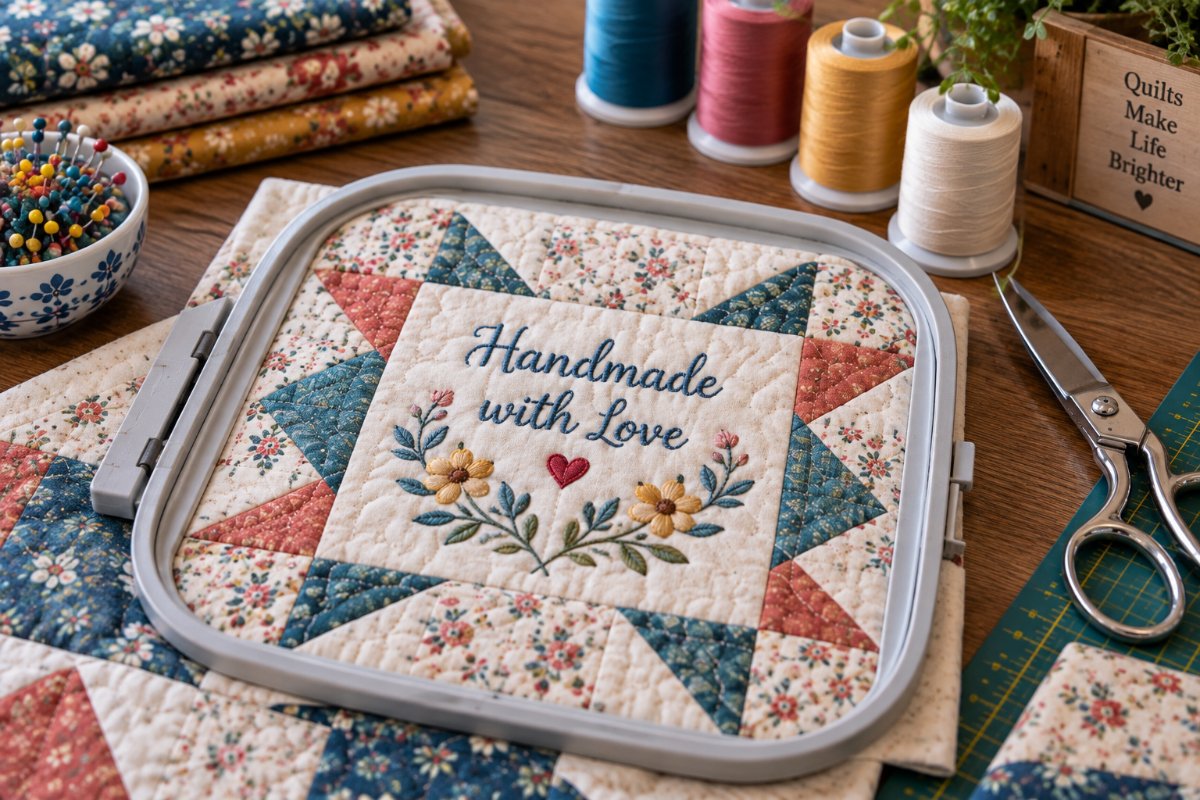
Switching between sewing and embroidery. On every machine here, embroidery means attaching the embroidery unit, and the Brother and Bernette manuals walk you through attaching and removing it. On the MC9850, Janome's US manual switches back to regular sewing with a mode key, and Janome Australia states that you can sew without removing the unit. Allow a few minutes for each switch, and set up your machine where the unit can stay attached on embroidery days.
Learning curve. For ordinary sewing tasks, these machines operate much like other computerized sewing machines. Embroidery adds new steps: choosing stabilizer, hooping fabric evenly, loading designs, and changing thread colors. Machines with Wi-Fi save the step of copying designs to a USB drive, but every machine on this list needs some practice on scrap fabric before your first label goes on a finished quilt.
If you only want to embroider, our guide to the best embroidery machine for beginners compares embroidery-only machines, which often give you a bigger field for the money.
Hoop size and embroidery field: what fits
Two terms are often confused. The hoop is the frame that holds your fabric. The embroidery field is the largest design the machine can stitch inside that hoop. Makers often name a hoop by its field (a "5 x 7 hoop"), but the field is the true limit, so it is the number to compare.
4 x 4 in
Labels, monograms
5 x 7 in
Many blocks up to about 5 in
6 x 10 in
6 in blocks, large appliqué, borders
1 inch
| Machine | Largest embroidery field | Hoops in the box | What fits |
|---|---|---|---|
| Brother SE700 | 4 x 4 in | One 4 x 4 in frame | Quilt labels, monograms, small appliqué motifs |
| Singer SE9180 | About 6.7 x 3.9 in (170 x 100 mm) | One 170 x 100 mm hoop | Labels, names, longer monograms and border motifs |
| Brother SE2000 | 5 x 7 in | One 5 x 7 in frame | Many block designs up to about 5 in square, medium appliqué |
| Janome MC9850 | 6.7 x 7.9 in (170 x 200 mm) | Two in the US box: 6.7 x 7.9 in and 5.5 x 5.5 in | 6 in blocks and other nearly square designs |
| Brother NQ3550W | 6 x 10 in | One 6 x 10 in frame (Amazon listing)SewingMachinesPlus and QualitySewing also list a 5 x 7 in frame | Large appliqué, long border designs, wall-hanging centers |
| Bernette 79 | 10.2 x 6.3 in (260 x 160 mm) | Three: 10.2 x 6.3 in, 7.1 x 4.7 in, and 2.8 x 2 in | Everything above, plus the longest single designs here |
Embroidered quilt-block designs come in several sizes, often 5 inches, 6 inches, and larger. A 5-by-7-inch field fits many block designs up to about 5 inches square, but only when the design's actual stitch area fits inside the field. Some 5-inch designs stitch right to the block edge or include placement lines that make them larger, so check the design's stitch dimensions, not just its block size. A 6-inch block, a bigger block, or a design that runs along a border needs one of the larger fields at the bottom of the table.
The sewing side: what quilters need
Quilters should evaluate sewing performance as carefully as embroidery features. These are the sewing features that matter most:
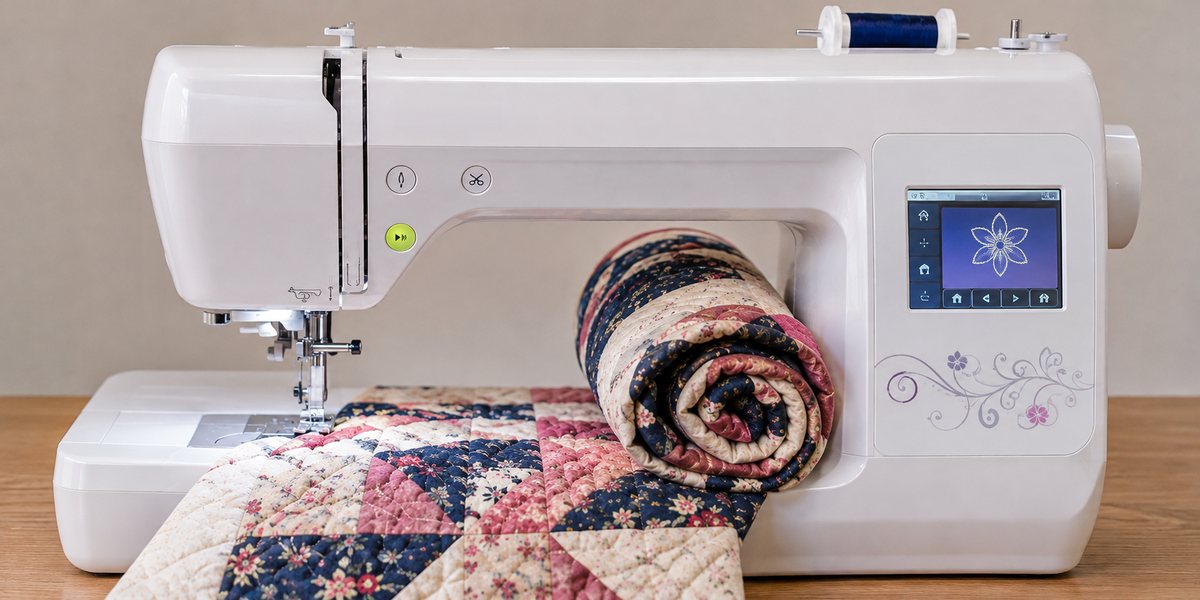
- Needle-to-arm space. This is the distance from the needle to the machine's body. When you quilt, the rolled part of the quilt sits in that space. On our list, this space runs from about 6.4 inches on the SE700 to 9 inches on the Bernette 79. As a rough guide, baby and lap quilts are manageable on any of these machines, while twin-size quilts and larger are much easier with 8 inches or more. Our quilt size chart lists standard dimensions.
- Drop feed. The feed dogs are the small teeth under the needle that move fabric forward. Lowering them lets you move the quilt in any direction for free-motion quilting. You also need a free-motion or darning foot, which some machines include and others sell separately.
- Walking foot or dual feed. A walking foot feeds the top layer of the quilt sandwich at the same speed the feed dogs move the bottom layer, so the top, batting, and backing don't shift during straight-line quilting. The Bernette 79 builds this in. The others need an add-on walking foot, where the maker lists one that fits.
- Knee lifter. This is a bar you press with your knee to raise the presser foot, so both hands stay on the quilt. The SE2000 has one. The SE700 doesn't.
- Extension table. This is a clear table that widens the flat sewing area and supports the quilt's weight. Most combo machines sell it separately, and our guide to the best extension tables for quilting covers the options.
What comes in the box and what you may add
Accessories change the total cost. This table separates what each maker lists in the box from what you may need to add for quilting.
| Machine | In the box (per the maker) | You may need to add | Check before you buy |
|---|---|---|---|
| Brother SE2000 | One 5 x 7 in frame, knee lifter, 8 feet (no quilting foot) | Free-motion quilting foot (Brother lists SA187 as fitting), an extension table | No walking foot is included, and Brother lists none as compatible (its SA140, SA188, and SA101 pages leave out the SE2000). Ask a Brother dealer before you buy one |
| Brother SE700 | One 4 x 4 in frame | Quilting foot for free-motion work, SA140 walking foot, an extension table | No knee lifter is offered |
| Singer SE9180 | One 170 x 100 mm hoop, embroidery and darning foot | A walking foot, an extension table | No walking foot, table, or knee lifter is listed in the box |
| Janome MC9850 | Two hoops (US) | An even feed (walking) foot, an extension table | Janome lists it as a non-AcuFeed model, so there is no built-in upper feed. No knee lifter is offered |
| Bernette 79 | Knee lifter, slide-on extension table, three hoops, and 10 presser feet including the free-motion embroidery foot (per bernette's manual and feature sheet) | A walking foot is not needed (built-in dual feed) | The Amazon listing does not list box contents. Confirm with the seller that it is a new US machine with the standard accessories |
| Brother NQ3550W | Not listed in detail by Brother. The Amazon listing's component list shows a 6 x 10 in frame, knee lifter, and free-motion open-toe quilting foot | Possibly a walking foot (none is listed for this model) | SewingMachinesPlus and QualitySewing also list a 5 x 7 in frame. Compare what each listing includes |
We don't list prices, because they change often. As a rule, a walking foot, a free-motion foot, and an extension table together can add a noticeable amount to the cost of a budget machine, so compare bundles that already include them.
Which machine fits your quilts and projects
Labels and small motifs
You mainly want to sign your quilts and add small monograms, and you quilt baby or lap quilts.
Start with: Brother SE700 or Brother SE2000
Embroidered blocks
You want embroidered blocks inside your quilt tops. Many block designs up to about 5 inches fit a 5-by-7-inch field, if their stitch area fits. Blocks of 6 inches need a larger field.
Start with: Brother SE2000 for 5-inch blocks, Janome MC9850 for 6-inch blocks
Long names and borders on a budget
You want longer lettering and border motifs but don't need tall designs.
Start with: Singer SE9180
Twin, full, and queen quilts
You quilt bed-size quilts on your home machine and want the most room under the arm.
Start with: Bernette 79, or a dedicated large-throat machine plus a separate embroidery machine
Big appliqué and 6-by-10-inch designs
You plan to embroider often and want large designs in one hooping.
Start with: Bernette 79 or Brother NQ3550W
Easiest design transfer
You want to send designs from a computer or phone without a USB drive.
Start with: Brother SE2000, Brother SE700, or Brother NQ3550W
The 6 best sewing and embroidery machines for quilting
Each review below starts with the specs that matter for quilting and embroidery, then who should buy it, who should skip it, and how it compares with the closest alternative.
Best for most quilters: Brother SE2000
A versatile upgrade for quilters who want to create embroidered blocks as well as quilt labels, with solid sewing features for piecing and quilting lap-size quilts.
- 5 x 7 in field
- 7.4 in needle-to-arm
- Wi-Fi transfer

- Embroidery field and hoops
- 5 x 7 in. One 5 x 7 in frame included
- Needle-to-arm space
- 7.4 in
- Feed dogs
- Lower with a switch. Free-motion foot sold separately (Brother lists SA187)
- Walking foot
- Not included. Brother lists none as compatible with the SE2000
- Design transfer
- Wi-Fi
Buy it ifYou want one machine for piecing, quilting lap quilts, labels, and many embroidered block designs up to about 5 inches square.
Skip it ifYou already know you want 6-inch blocks or large appliqué designs, or you quilt big bed quilts often.
Advantages
- Field fits labels and many smaller block designs in one hooping
- Knee lifter keeps both hands on the quilt
- Trims jump stitches, the loose threads between parts of a design, on its own
- Wi-Fi design transfer
Limitations
- No designs larger than 5 by 7 inches
- No walking foot or free-motion foot in the box
- 7.4 inches of room suits lap quilts but is tight for a queen-size quilt
Largest trade-offThe 5-by-7-inch field. It covers most quilt labels and many 5-inch block designs, but 6-inch blocks won't fit.
Value: It costs noticeably more than the SE700, and the extra cost buys a larger field, more room, a knee lifter, and jump-stitch trimming, features that help with quilting.
How it compares: Against the Janome MC9850, which costs about the same, the SE2000 gives you Wi-Fi and a knee lifter, while the Janome gives you a bigger 6.7-by-7.9-inch field and faster sewing.
More specs: 193 designs, 13 fonts, 241 stitches. Up to 850 stitches per minute sewing, 650 embroidering. Knee lifter, automatic thread cutter, and jump stitch trimming. 1-, 2-, and 25-year limited warranty, per Brother
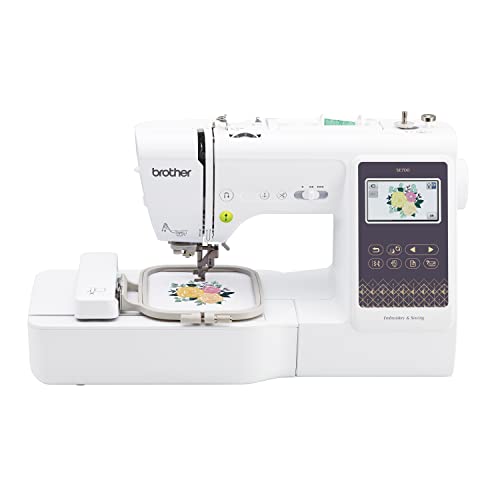
Check Price on AmazonBest budget pick for quilt labels: Brother SE700
The most affordable option in this comparison for quilt labels and small motifs. Its sewing features are more limited than those of higher-end models.
- 4 x 4 in field
- 6.4 in work area
- Wi-Fi or USB
- Embroidery field and hoops
- 4 x 4 in. One 4 x 4 in frame included
- Needle-to-arm space
- 6.4 x 4.0 in work area
- Feed dogs
- Lower with the feed dog position switch. Quilting foot sold separately
- Walking foot
- Brother SA140 fits (sold separately)
- Design transfer
- Wi-Fi or USB drive
Buy it ifYour embroidery is mostly labels and monograms, you piece more than you quilt, and you want to spend as little as possible.
Skip it ifYou regularly need embroidery designs larger than 4 by 4 inches, or plan to quilt large bed-size projects on this machine.
Advantages
- Lowest cost on our list
- Wi-Fi design transfer
- Feed dogs lower for free-motion quilting
- Brother lists a walking foot that fits
Limitations
- 4-by-4-inch embroidery field, the smallest here
- Smallest work area on our list
- No knee lifter
- Brother's manual has no step-by-step free-motion section
Largest trade-offSize. Both the embroidery field and the work area are the smallest here.
Value: It is the least expensive pick, but adding a quilting foot and a walking foot narrows the gap to the SE9180 and the SE2000.
How it compares: Against the Singer SE9180, the SE700 costs less and uses Brother's design library, while the Singer gives you a longer field and includes an embroidery and darning foot for a moderate step up in cost.
More specs: 135 designs, 10 fonts, 103 stitches. Up to 710 stitches per minute sewing, 400 embroidering. Automatic thread cutter, no knee lifter. 1-, 2-, and 25-year limited warranty, per Brother
Check Price on AmazonBest value for a longer field: Singer SE9180
A longer embroidery field than the SE700 for a moderate step up in cost, with an embroidery and darning foot in the box.
- About 6.7 x 3.9 in field
- 6.5 in needle-to-arm
- USB and Wi-Fi

- Embroidery field and hoops
- 170 x 100 mm (about 6.7 x 3.9 in). One hoop included
- Needle-to-arm space
- 6.5 in, needle to tower
- Feed dogs
- Lower for free-motion sewing. Embroidery and darning foot included (works for free-motion)
- Walking foot
- Not included
- Design transfer
- USB and Wi-Fi, per Singer's manual (see the note below)
Buy it ifYou want longer names, borders, and wider labels than a 4-by-4-inch field allows, on a budget.
Skip it ifYou want square block designs of 5 inches or more, or you need a walking foot in the box.
Advantages
- Longer field than the SE700
- Embroidery and darning foot included
- Drop feed and a metal interior
- More than 250 sewing stitches
Limitations
- The field is only about 3.9 inches tall, so it won't fit a square 5-inch design
- No walking foot, table, or knee lifter listed in the box
- One Singer FAQ answer contradicts its Wi-Fi spec
Largest trade-offShape. The field is long but not tall, which suits lettering and borders more than blocks.
Value: It sits between the SE700 and the SE2000 in cost, and the embroidery and darning foot in the box saves one add-on purchase.
How it compares: Against the Brother SE2000, the Singer gives you a field that is longer but not as tall, for less money, while the Brother fits many 5-inch block designs and adds a knee lifter and more room.
More specs: 150 designs, 10 fonts, more than 250 stitches. Up to 800 stitches per minute sewing, 450 embroidering. Metal interior. 90-day, 2-year, and 25-year warranty, per Singer
Check Price on AmazonA note on the SE9180 and Wi-Fi: Singer's SE9180 manual says the machine has Wi-Fi for Singer's mySewnet (now CREATIVATE) services, including wireless firmware updates, and the product page's spec list agrees. One FAQ answer on the same page says it is not Wi-Fi enabled, which contradicts the manual. You can also load designs from a USB stick. The same FAQ gives the embroidery area as 7 by 4.7 inches, but Singer's spec list says the included hoop stitches up to 170 by 100 millimeters, so we use the smaller figure.
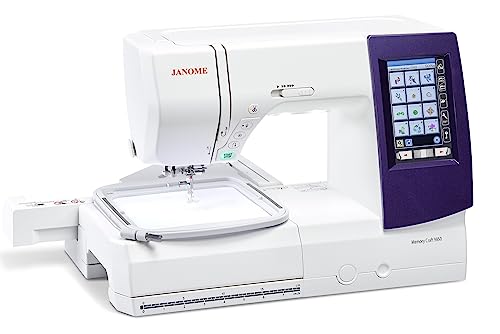
Best for bigger designs at a mid-range price: Janome Horizon Memory Craft 9850
A much larger, nearly square embroidery field than the Brother SE models offer, plus fast sewing, for about the same cost as the SE2000.
- 6.7 x 7.9 in field
- 8.1 in workspace
- USB only
- Embroidery field and hoops
- 6.7 x 7.9 in (170 x 200 mm). Two hoops in the US box: 6.7 x 7.9 in and 5.5 x 5.5 in
- Needle-to-arm space
- 8.1 x 4.7 in workspace
- Feed dogs
- Drop feed
- Walking foot
- No built-in upper feed (non-AcuFeed)
- Design transfer
- USB only
Buy it ifYou want 6-inch blocks and other nearly square designs, plus a fast machine for piecing.
Skip it ifYou want Wi-Fi, a knee lifter, or a built-in upper feed for straight-line quilting.
Advantages
- Fits 6-inch blocks in one hooping
- Two hoops in the US box
- Sews up to 1,000 stitches per minute
- You can switch back to regular sewing without removing the embroidery unit
Limitations
- No Wi-Fi
- No knee lifter (none in Janome's US accessory list)
- No built-in upper feed (non-AcuFeed)
- Only 2 built-in fonts
Largest trade-offConvenience. You get a bigger field, but you give up Wi-Fi and a knee lifter.
Value: The extra field size is the main reason to choose it over the SE2000.
How it compares: Against the Brother SE2000, the Janome fits 6-inch blocks and sews faster, while the Brother adds Wi-Fi, a knee lifter, and Brother's larger built-in lettering library.
More specs: 175 designs, 200 stitches, 2 fonts. Up to 1,000 stitches per minute sewing, 800 embroidering. Automatic thread cutter and programmable jump thread trimming. 22.9 lb
Check Price on AmazonMost room for quilting: Bernette 79
The most room for quilting and the largest embroidery field on our list, with built-in dual feed for even layers.
- 10.2 x 6.3 in field
- 9 in right of needle
- Built-in dual feed

- Embroidery field and hoops
- 10.2 x 6.3 in (260 x 160 mm). Three hoops: 10.2 x 6.3 in, 7.1 x 4.7 in, and 2.8 x 2 in
- Needle-to-arm space
- 9 in to the right of the needle
- Feed dogs
- Lower with a lever. Free-motion embroidery foot included, per bernette
- Walking foot
- Built-in dual feed
- Design transfer
- USB
Buy it ifYou quilt larger quilts on your own machine and want the largest designs here in one hooping.
Skip it ifYou want Wi-Fi, or your budget stops at the Brother SE models.
Advantages
- 9 inches of room, the most on our list
- Built-in dual feed does a walking foot's job
- Largest field, with three hoops
- Large stitch library, with 500 stitches
Limitations
- Costs more than every pick except the NQ3550W
- No Wi-Fi
- The Amazon listing does not list box contents, so confirm the standard accessories with the seller
Largest trade-offCost. It is the second-most-expensive machine here.
Value: It costs more than the SE2000 or MC9850, and in return you get the room, dual feed, and field size that matter most when you quilt larger quilts.
How it compares: Against the Brother NQ3550W, the Bernette has more room, a larger field, and built-in dual feed for less money, while the Brother adds Wi-Fi and Brother's software.
More specs: 208 designs, 500 stitches. Up to 1,000 stitches per minute sewing, 850 embroidering
Check Price on AmazonBest premium pick: Brother Innov-is NQ3550W
The premium Brother option in this comparison, with a 6-by-10-inch field, Wi-Fi, and 8.3 inches of workspace.
- 6 x 10 in field
- 8.3 in workspace
- Wi-Fi transfer

- Embroidery field and hoops
- 6 x 10 in. The Amazon listing shows a 6 x 10 in frame. SewingMachinesPlus and QualitySewing also list a 5 x 7 in frame
- Needle-to-arm space
- 8.3 x 4.1 in workspace
- Feed dogs
- Drop feed, per SewingMachinesPlus and QualitySewing listings. Free-motion open-toe quilting foot in the Amazon listing
- Walking foot
- Not listed by Brother
- Design transfer
- Wi-Fi
Buy it ifYou will embroider often, want large designs, and prefer Brother's software and Wi-Fi.
Skip it ifYou want the most room for big quilts, or you want every spec confirmed by the maker.
Advantages
- 6-by-10-inch field for large appliqué and borders
- Wi-Fi design transfer
- 8.3 inches of workspace
- Large built-in design and stitch library
Limitations
- Highest cost on our list
- Several specs come only from retailer listings, because Brother's page is short
- Brother's walking foot pages don't list it
Largest trade-offCost versus room. The Bernette 79 offers more room and a larger field for less.
Value: It is the most expensive pick. It makes sense mainly if Brother's Wi-Fi and software matter to you.
How it compares: Against the Brother SE2000, the NQ3550W adds a much larger field and more workspace in the same Brother system, at a much higher cost.
More specs: 258 designs, 13 fonts, 291 stitches. Up to 850 stitches per minute (SewingMachinesPlus and QualitySewing). Knee lifter in the Amazon listing's component list
Check Price on AmazonWhat you give up with a combo machine
Only the Bernette 79 on our list offers more room than a popular dedicated quilting machine. The Juki TL-2000Qi, for example, lists an arm size of about 8.5 inches and is built only for sewing and quilting. The other combo machines here have about 6.4 to 8.3 inches.
Part of the purchase price covers the embroidery unit, software, and hoops, even if you do not use them regularly. That cost is worth it if you want embroidery in your quilts. Those additional features may not justify the expense if you rarely embroider.
If you regularly quilt bed-size quilts on your own machine, a dedicated large-throat sewing machine plus a separate embroidery machine is usually the better fit. If free-motion quilting matters more to you than embroidery, see our guide to the best sewing machine for free-motion quilting.
How we chose these machines
We looked for combo machines that are still sold in the US in November 2026 and that Amazon carries new. We left out discontinued machines, like the Brother SE1900, even though older guides still recommend it.
We did not test these machines hands-on. This guide is based on research: each maker's product pages, manuals, and spec sheets, checked on 16 November 2026, plus retailer listings where a maker gives no detail. Where a figure comes only from a retailer, we say so. Where a maker's own sources disagree, as with one Singer FAQ answer about the SE9180's Wi-Fi, we go with the manual and say so.
We judged each machine on what matters to quilters: embroidery field, needle-to-arm space, drop feed, walking foot or dual feed options, included hoops and accessories, and how designs get onto the machine. We don't give star ratings or list prices, because prices change often.
Frequently asked questions
What is the best sewing machine for quilting and embroidery?
For most quilters, the Brother SE2000. Its 5-by-7-inch embroidery field fits many embroidered block designs up to about 5 inches square, as long as the design's stitch area fits the field. It has 7.4 inches from the needle to the arm, lowers its feed dogs for free-motion quilting, and trims jump stitches on its own.
What is the best budget sewing and embroidery machine for quilters?
The Brother SE700. Its 4-by-4-inch embroidery field is its main limitation, but it handles quilt labels, monograms, and small appliqué motifs. If you want a longer field for a moderate step up in cost, look at the Singer SE9180, whose included hoop stitches up to 170 by 100 millimeters (about 6.7 by 3.9 inches).
What is the difference between hoop size and embroidery field?
The hoop is the frame that holds the fabric. The embroidery field is the largest design the machine can stitch in that hoop. Makers often name hoops by their field size, but always check the maximum embroidery area in the machine's specs, because that is the true limit for a design.
What hoop size do I need for quilting?
A 4-by-4-inch field is enough for labels and small motifs. A 5-by-7-inch field fits many embroidered block designs up to about 5 inches square, as long as each design's stitch area fits the field. For 6-inch blocks and bigger, you need a larger field, and a 6-by-10-inch field or larger lets you stitch big appliqué pieces and long border designs without re-hooping.
Can the Brother SE700 do free-motion quilting?
Yes. Brother's manual shows a feed dog position switch that lowers the feed dogs for free-motion quilting. The manual also says you need to buy a quilting foot separately, and it does not include step-by-step free-motion instructions, so plan on a separate foot and some practice.
Can you quilt a whole quilt on a combo machine?
Yes, with a walking foot or dual feed for straight-line quilting, or lowered feed dogs and a free-motion foot for free-motion quilting. The limit is room. On our list, the needle-to-arm space runs from about 6.4 to 9 inches, so managing a queen-size quilt can be difficult on the smaller machines. The Bernette 79 has the most room, at 9 inches.
Do combo machines come with a walking foot?
Most don't. None of the Brother SE models or the Singer SE9180 list a walking foot in the box. Brother lists its SA140 walking foot as fitting the SE700, but its walking foot pages don't list the SE2000, so confirm fit before you buy one. The Bernette 79 has a built-in dual-feed system that does the same job by feeding the top layer.
Is a combo machine better than two separate machines?
It saves space and money if your quilting is mostly lap- and throw-size quilts and your embroidery is labels and blocks. If you often quilt large bed quilts on your own machine, a dedicated large-throat sewing machine plus a separate embroidery machine usually works better.
Which one should you buy?
If you want one machine for piecing, quilting, and many embroidered block designs up to about 5 inches square, get the Brother SE2000. If your embroidery is mostly labels and you want to spend less, the Brother SE700 is suitable for those smaller embroidery projects, and the Singer SE9180 gives you a longer field.
For 6-inch blocks and other bigger designs, the Janome Horizon Memory Craft 9850 gives you a 6.7-by-7.9-inch field and fast sewing. If you quilt larger quilts, the Bernette 79 has the most room and the largest embroidery field among these six machines. If you want Brother's Wi-Fi and software with a 6-by-10-inch field, the Brother Innov-is NQ3550W is the premium Brother option in this comparison.