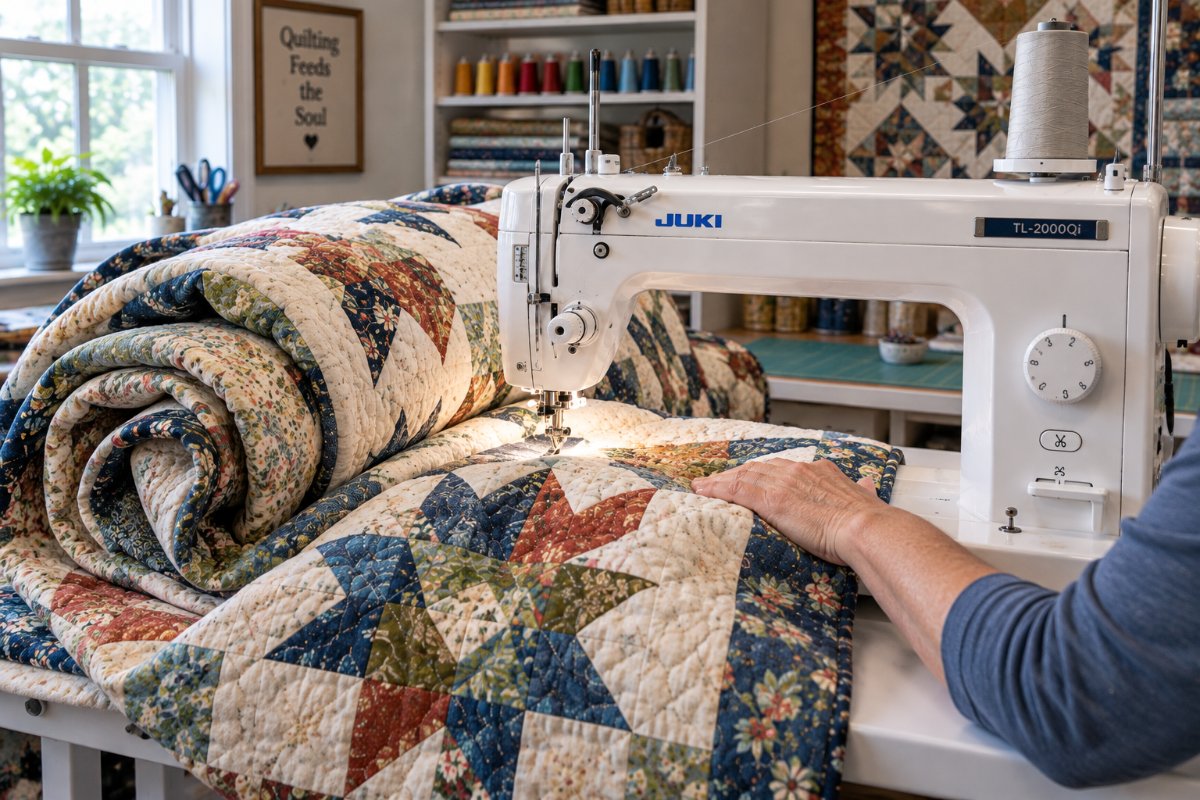
Throat space is the spec that decides whether quilting on a home machine feels like fighting the fabric or enjoyable, and the best large throat quilting machine gives you real working room without tipping into longarm territory. This guide covers what throat space buys you, the two machines worth considering first, and what you give up by staying with a domestic machine instead of moving to a frame. If you're just starting out and don't need the extra room yet, our sewing machine for quilting beginners guide covers smaller, cheaper machines that still quilt well.
Table of contents
- What "throat space" means, and why it matters
- How much throat space do you need?
- Best large throat quilting machine: 2 picks
- What to check before you buy
- Step-up machines and what they add
- Do you need to go bigger than a domestic machine?
- Frequently asked questions
- The bottom line
What "throat space" means, and why it matters
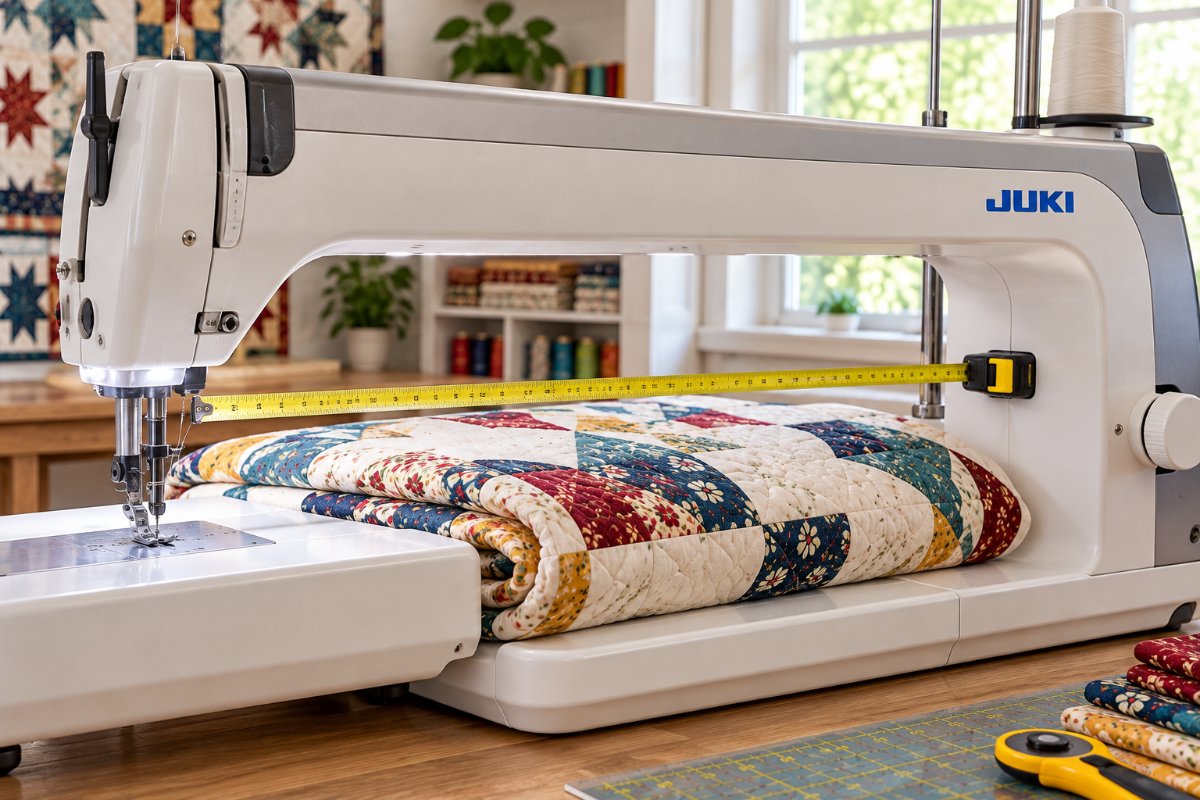
Throat space (also called harp space or needle-to-arm space) is the distance between the needle and the body of the machine, measured to the right. A standard domestic sewing machine gives you around 6 to 6.5 inches. That's fine for piecing blocks and garment sewing, but once you're trying to maneuver a bulky quilt sandwich under the needle for free-motion quilting, every extra inch of room means less bunching, less wrestling, and less risk of the fabric dragging the needle off its line.
A large throat quilting machine typically gives you 8 to 9 inches of that space. It's not a longarm (those run 12 feet or more of open frame), but it's a meaningful step up from a standard machine, and it's the practical ceiling for what a home sewing table and a normal budget can support.
How much throat space do you need?
For a domestic machine, 8 to 9 inches is the realistic ceiling. Nothing goes much bigger without crossing into semi-industrial or longarm territory, which costs far more and takes up far more room. That ceiling is exactly why the best large throat quilting machine means something specific rather than a vague upgrade: it's the most throat space a home sewing table can hold.
If you're quilting table runners, baby quilts, or anything that stays under a lap-quilt size, a standard 6.5-inch throat is still fine, and there's no reason to spend more. The extra throat space earns its price specifically when you're quilting queen- or king-size tops on a domestic machine and tired of rolling and re-rolling the quilt to get it under the needle.
Best large throat quilting machine: 2 picks
For most home quilters, two machines stand out as the best large throat quilting machine options, and both deliver real large-throat space without jumping to a frame. Both are straight-stitch-only machines built for speed and heavy use, not machines with decorative stitches or embroidery, which is the tradeoff that keeps them in the mid-range.
Juki TL-2000Qi
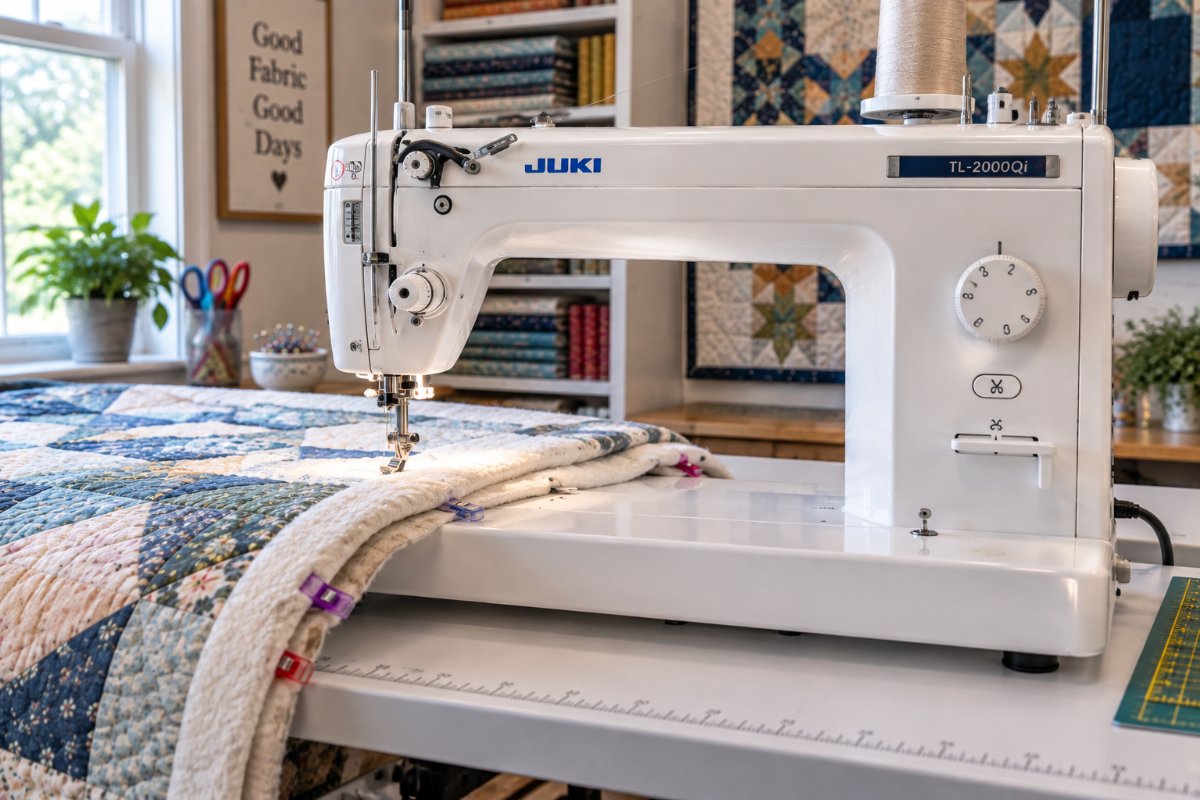
The Juki TL-2000Qi is sold and marketed specifically as a "9-inch long-arm" sewing and quilting machine, and that 9 inches of throat space is the real draw. It's a single-stitch, straight-stitch-only machine that sews up to 1,500 stitches per minute, with an aluminum die-cast arm and bed that keeps vibration low at speed, an automatic needle threader, and an extension table included for extra work surface. For many quilters, it is the best large throat quilting machine they can fit on a normal sewing table.
It holds a 4.6-star average across 913 Amazon ratings, and reviewers consistently describe it as a genuine workhorse that sews through multiple layers of denim or batting without skipping stitches. It also tends to sell well below Juki's list price. Our full Juki TL-2000Qi review goes deeper.
Brother PQ1600S
The Brother PQ1600S (the current model, replacing the discontinued PQ1500SL) gives you a 5.7 by 8.7 inch needle-to-arm space, sews up to 1,500 stitches per minute, and includes an 11.1 by 23.3 inch wide extension table plus a knee lifter for hands-free presser-foot control while quilting. It has a pin-feed mechanism (swapping the feed dogs for a single pin) that's useful for feeding multiple layers evenly without leaving feed-dog marks. It holds a 4.4-star average across 47 Amazon ratings, and our Brother PQ1600S review covers it in more depth.
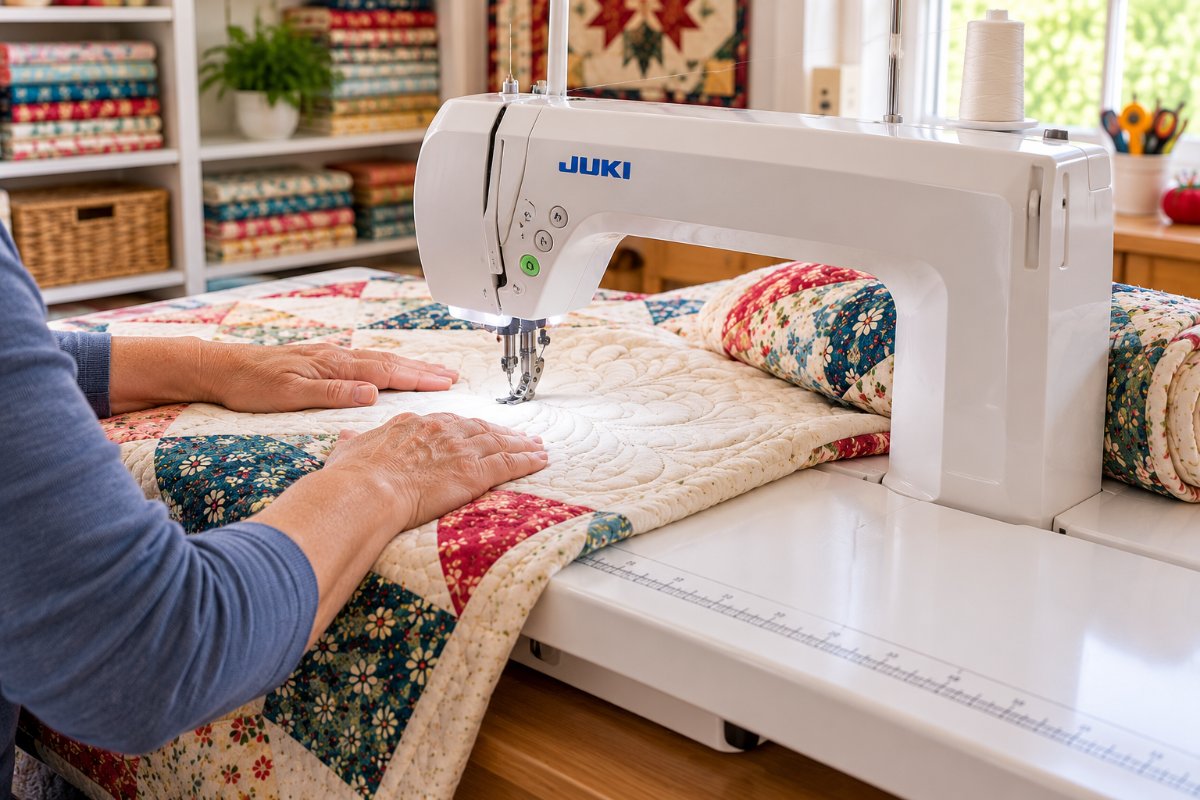
Between the two, the Juki has the larger throat (9 inches versus roughly 8.7) and a much larger review base to judge it by. The Brother's knee lifter and pin-feed system are the kind of details that matter once you're quilting for hours at a time. Either is a reasonable pick for the best large throat quilting machine in a home sewing room, and the right one comes down more to which feature set matters to your specific projects than any real gap in quality between them.
What to check before you buy
Throat width is the headline number, but a few other details decide whether the best large throat quilting machine for you is pleasant to use every day. Check these before you order.
- Throat height, not just width. A tall throat lets a rolled quilt pass under the arm without crushing it. The Brother PQ1600S lists 5.7 inches of height, which matters as much as its 8.7 inches of width.
- Table space around the needle. Extra throat room helps less if the quilt drags off the edge of the table. Look for a wide extension table in the box, or plan to set the machine into a sewing cabinet.
- Feed dog drop. Free-motion quilting needs the feed dogs lowered or covered. Both picks here drop their feed dogs, but check this on any machine you compare.
- Presser foot lift. A knee lifter or high foot lift makes it easier to slide thick quilt layers in and out without stopping to adjust.
- Local service. Semi-industrial machines last for years with basic care, but a nearby dealer who services the brand makes timing or tension problems far easier to fix.
Step-up machines and what they add
Being upfront about the tradeoff: several well-regarded large-throat machines sit one tier above these two, and it's worth knowing what you'd get by spending more. The Janome HD8, the Juki TL-2010Q (the step up from the TL-2000Qi), and the Janome HD9 professional line all cost noticeably more.
All three add speed, durability upgrades, or bobbin capacity over the two picks above, but none of them meaningfully increase throat space beyond what the best large throat quilting machine picks already offer. In other words, spending more at this tier buys you a sturdier or faster machine, not more room to quilt under the needle.
Do you need to go bigger than a domestic machine?
If you're consistently quilting queen- or king-size tops and 9 inches of throat still feels tight, the honest next step isn't a pricier domestic machine. It's a mid-arm or longarm setup on its own frame. Our longarm quilting machine guide covers that jump in detail, including the real cost and space tradeoffs. For most home quilters, though, the best large throat quilting machine on a domestic setup, with an 8 to 9-inch throat, covers the gap between "cramped" and "needs a dedicated frame room," which is exactly why this class of machine exists.
Frequently asked questions
What is the best large throat quilting machine?
For most home quilters, the Juki TL-2000Qi and the Brother PQ1600S are the two best options, both offering 8.7 to 9 inches of throat space. The Juki has the larger throat and a much bigger track record among reviewers. The Brother's knee lifter and pin-feed system appeal to quilters who want more hands-free control.
How much throat space do I need for quilting a queen-size quilt?
8 to 9 inches is the realistic ceiling for a domestic machine and is workable for queen-size quilts with practice rolling and re-rolling the quilt as you go, which is exactly the space the best large throat quilting machine provides. If you quilt king-size and larger tops often, a mid-arm or longarm frame starts to make more sense than any domestic machine, regardless of throat size.
Is a large throat quilting machine worth it for a beginner?
Not usually. Both machines that qualify as the best large throat quilting machine picks here are straight-stitch-only, industrial-style machines without decorative stitches, which makes them a poor first machine if you're still doing general sewing alongside quilting. They're worth it once you know quilting is what you're doing most and a standard machine's 6 to 6.5 inch throat has become the bottleneck in your projects.
What's the difference between a large throat machine and a longarm?
A large-throat domestic machine still sits on a normal sewing table, and you move the fabric under a stationary needle, just with more room to do it. A longarm mounts the machine on a 10- to 12-foot rolling frame, and you move the machine over a quilt that stays stretched in place, which is a fundamentally different (and far more expensive) setup.
The bottom line
The best large throat quilting machine for most home quilters comes down to the Juki TL-2000Qi or the Brother PQ1600S, both landing at 8.7 to 9 inches of throat space, with no meaningfully larger domestic option. Spend more, and you're buying speed or durability, not more room. Spend less, and a standard 6.5-inch machine is fine unless big quilts are already the bottleneck in your workflow.
5 thoughts on “Best Large Throat Quilting Machine for Home Quilters”