
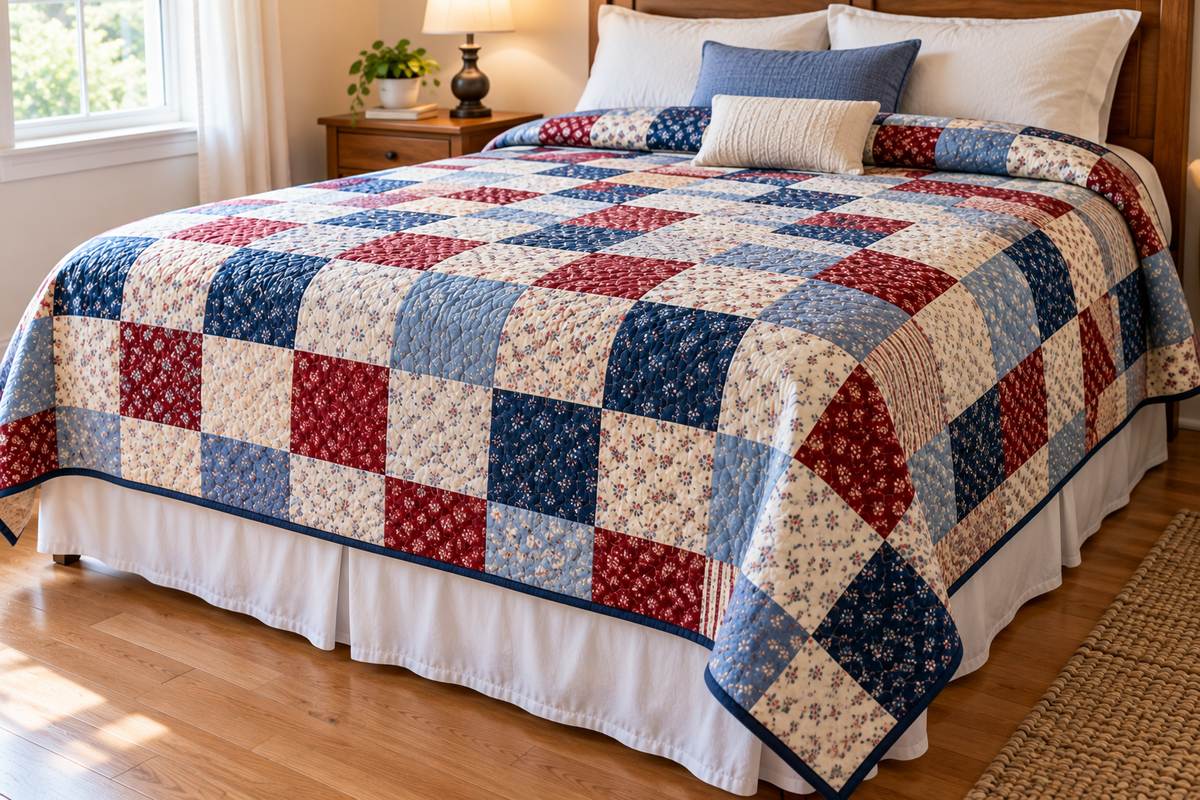
A queen quilt is usually about 90 x 95 inches, a twin is about 70 x 90, and a king is about 108 x 95. Those are the sizes most patterns use, but no one official quilt size exists. Each one is just a mattress size plus how far the quilt hangs over the sides and the foot.
QuiltGearHQ is a participant in the Amazon Services LLC Associates Program, an affiliate advertising program designed to provide a means for sites to earn advertising fees by advertising and linking to Amazon.com.
This page has the full quilt size chart, from baby quilts to California king. It also has a free planner that works from your own mattress, and charts for the batting, backing, and binding each size needs. Bookmark it for your next project.
Table of Contents
Quilt Size Chart
These are the common finished sizes for bed quilts. The "with pillow tuck" column adds 10 inches to the length so the quilt can tuck under and over the pillows.
| Quilt size | Mattress (in) | Finished quilt (in) | With pillow tuck (in) |
|---|---|---|---|
| Baby or crib | About 28 x 52 | 36 x 52 | Not used |
| Lap | No bed | 50 x 65 | Not used |
| Throw | No bed | 60 x 72 | Not used |
| Twin | 38 x 75 | 70 x 90 | 70 x 100 |
| Twin XL | 38 x 80 | 70 x 95 | 70 x 105 |
| Full or double | 54 x 75 | 84 x 90 | 84 x 100 |
| Queen | 60 x 80 | 90 x 95 | 90 x 105 |
| King | 76 x 80 | 108 x 95 | 108 x 105 |
| California king | 72 x 84 | 102 x 100 | 102 x 110 |
You will often see a queen listed as 90 x 108 instead of 90 x 95. Both are correct. The longer size covers the pillows and hangs lower at the foot. The shorter one stops at the head of the mattress. Before you pick a size, decide if you want a pillow tuck.
Lap and throw sizes vary more than bed sizes, because they only need to fit a person on a couch. Lap quilts run from about 36 x 48 to 50 x 65 inches, and throws from about 50 x 60 to 60 x 72 inches.
Quilt Size Planner
A chart assumes an average mattress. If your mattress is extra deep or you want the quilt to reach the floor, use the planner. It shows the quilt top size to make, the batting package to buy, and how much backing and binding fabric you need.
Quilt Size Planner
Pick the bed, measure the mattress, and choose how far the quilt should hang. The planner gives you the finished quilt size, the batting package to buy, and how much backing and binding fabric you need.
Measure from the top of the mattress to its bottom edge.
Cover the mattress adds 3 in below the mattress. Cover the box spring too adds 10 in.
Cotton batting often shrinks about 3 percent.
Quilt Size Planner by QuiltGearHQ.com. Sizes are rounded up to the nearest inch. Always measure your own bed before you cut.
How Quilt Sizes Are Figured
Every bed quilt size comes from the same simple math. Measure the top of the mattress, then add the drop, which is how far the quilt hangs over the edge.
- Width = mattress width + drop on the left + drop on the right
- Length = mattress length + drop at the foot + pillow tuck (if you want one)
There is no drop at the head of the bed, because that end sits against the headboard or wall.
Here is a queen example. The mattress is 60 x 80 inches and 12 inches deep. A 15-inch drop covers the mattress sides with 3 inches to spare. The width is 60 + 15 + 15 = 90 inches. The length is 80 + 15 = 95 inches. That is the 90 x 95 queen in the chart. Add a 10-inch pillow tuck and the length becomes 105 inches.
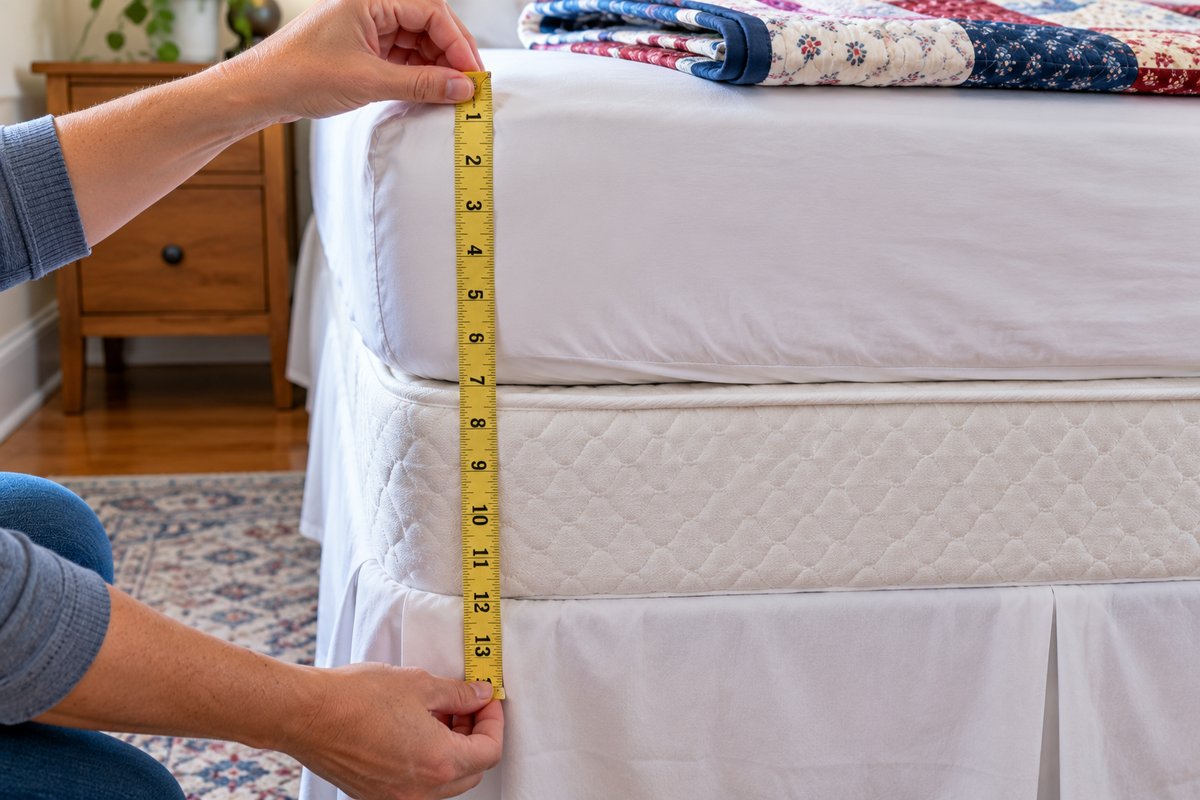
To measure the drop on your own bed, put the sheets and mattress pad on first. Measure from the top edge of the mattress straight down to where you want the quilt to stop. With a long quilter's tape measure, you can do this by yourself.
Mattress Sizes
Quilt sizes start with the mattress. These are the standard US mattress sizes from the Sleep Foundation. Brands can be off by an inch, so measure yours if the fit matters.
| Mattress | Width x length (in) |
|---|---|
| Crib | About 28 x 52 |
| Twin | 38 x 75 |
| Twin XL | 38 x 80 |
| Full or double | 54 x 75 |
| Queen | 60 x 80 |
| King | 76 x 80 |
| California king | 72 x 84 |
Federal safety rules set crib mattress sizes. Under the federal crib mattress standard (16 CFR 1241), a full-size crib mattress must be at least 27 1/4 x 51 5/8 inches. The crib itself is about 28 x 52 3/8 inches inside, according to the Consumer Product Safety Commission.
A California king is narrower and longer than a regular king. A king quilt is too wide and a little short, so use the California king size.
Quilt Size by Mattress Depth
Mattress depth is the number most charts leave out. Many mattresses are about 8 to 14 inches deep, and pillow-top or deep mattresses can be 16 inches or more. A deeper mattress needs a bigger drop, so the quilt has to be wider and longer.
This chart uses a drop of the mattress depth plus 3 inches, so the quilt covers the mattress sides. It does not include a pillow tuck.
| Bed | 8 in deep mattress | 12 in deep mattress | 16 in deep mattress |
|---|---|---|---|
| Twin | 60 x 86 | 68 x 90 | 76 x 94 |
| Twin XL | 60 x 91 | 68 x 95 | 76 x 99 |
| Full | 76 x 86 | 84 x 90 | 92 x 94 |
| Queen | 82 x 91 | 90 x 95 | 98 x 99 |
| King | 98 x 91 | 106 x 95 | 114 x 99 |
| California king | 94 x 95 | 102 x 99 | 110 x 103 |
Notice how much the size changes. A queen quilt for a 16-inch pillow-top mattress needs to be 98 x 99 inches, while the same quilt for an 8-inch mattress is 82 x 91. The 12-inch sizes are within 2 inches of the standard sizes in the main chart, which is why those sizes fit most beds.
Coverlet, Comforter or Bedspread: How Far Should It Hang?
The drop is a style choice. Here are the usual ranges for each look.
| Style | Typical drop | What it covers |
|---|---|---|
| Coverlet | 8 to 12 in | The top of the bed and part of the mattress sides. Often used with a bed skirt. |
| Comforter style | 12 to 16 in | The full mattress sides on most beds. |
| Bedspread | 18 to 25 in | The mattress and box spring, down to the floor or close to it. |
For a floor-length quilt, measure from the top of the mattress to the floor, then subtract about 1 inch so the edge doesn't drag. Bedspread-size quilts are very large. A floor-length queen can be over 100 x 100 inches, so plan the batting and backing early.
What Size Batting to Buy
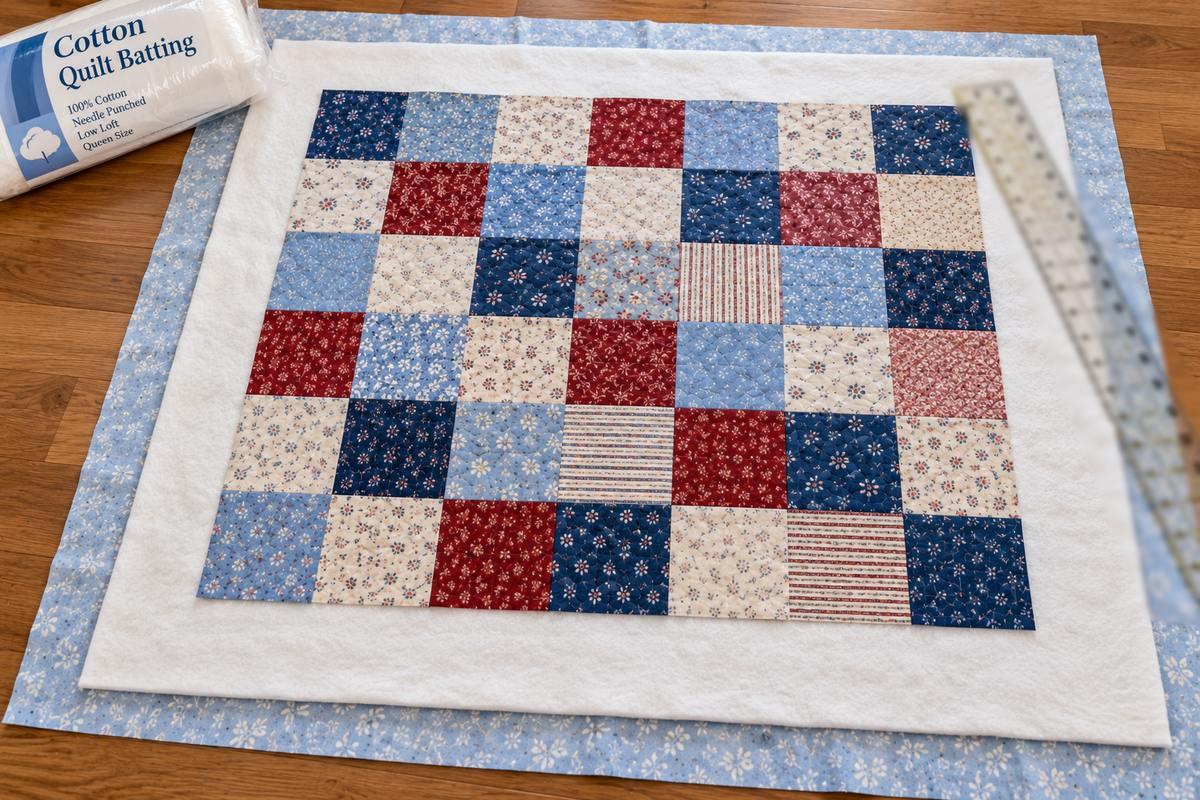
Batting should be bigger than the quilt top. Longarm quilters usually ask for at least 4 inches extra on every side, and the same margin works well on a home machine. The extra gives you room to hold the quilt and covers the small amount the quilt pulls in as you stitch.
One thing to watch for: packaged batting is named for the quilt size, not the quilt size plus extra. A queen package from Warm and Natural is 90 x 108 inches, which is exactly the size of a large queen quilt. If your queen top is 90 inches wide, a queen package leaves no extra, so you need a king package.
| Package | Warm and Natural (in) | Hobbs Heirloom 80/20 (in) |
|---|---|---|
| Crib | 45 x 60 | 45 x 60 |
| Twin | 72 x 90 | 72 x 90 |
| Full | 90 x 96 | 81 x 96 |
| Queen | 90 x 108 | 90 x 108 |
| King | 120 x 124 | 120 x 120 |
This chart shows which package to buy for each quilt size, with 4 inches extra on every side.
| Quilt size (in) | Batting needed (in) | Smallest package that fits |
|---|---|---|
| Baby 36 x 52 | 44 x 60 | Crib |
| Lap 50 x 65 | 58 x 73 | Twin |
| Throw 60 x 72 | 68 x 80 | Twin |
| Twin 70 x 90 | 78 x 98 | Queen |
| Twin XL 70 x 95 | 78 x 103 | Queen |
| Full 84 x 90 | 92 x 98 | King |
| Queen 90 x 95 | 98 x 103 | King |
| King 108 x 95 | 116 x 103 | King |
| California king 102 x 100 | 110 x 108 | King |
So a twin quilt usually needs a queen package, and a full or queen quilt needs a king. You can trim the leftover batting and use it for pillows or table runners. For more on choosing batting, see our guides on quilt batting types and the best quilt batting.
Batting and Tools for Sizing a Quilt
These picks come from brands quilters use widely. We checked package sizes and Amazon prices in October 2026. We have not tested them ourselves.
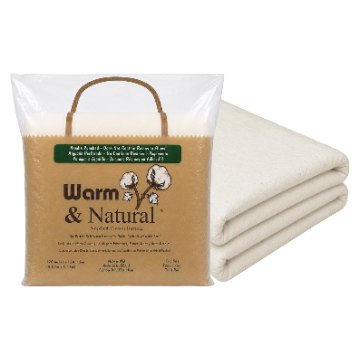
A needled cotton batting from The Warm Company in a 120 x 124 inch package.
- Big enough for a full, queen or king quilt with 4 in extra on every side
- One of the most popular batting packages sold
- The maker says it shrinks about 3% in a cold wash and up to 5% in warm
- Can be stitched up to 10 in apart
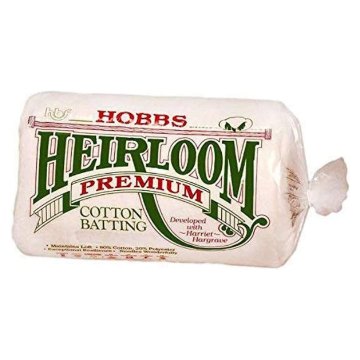
An 80 percent cotton, 20 percent polyester blend in a 120 x 120 inch package.
- Costs less than Warm and Natural king at the time we checked
- The polyester makes it a little lighter
- Listings give 3 to 5% shrinkage
- Listings say to stitch no more than 4 in apart, closer than Warm and Natural
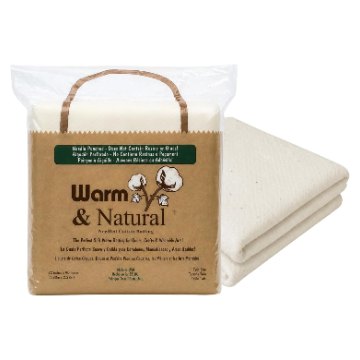
The same needled cotton batting in a 72 x 90 inch package.
- Covers lap and throw quilts with extra on every side
- Leftover strips work for small projects
- Too small for a twin bed quilt once you add 4 in per side
- Same shrinkage as the king size
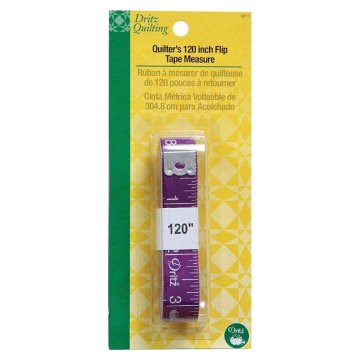
A 120 inch tape measure that is long enough to measure a king bed and drop in one pull.
- Long enough to measure across a king quilt
- Cheap enough to keep one in the sewing room
- Cloth tapes can stretch over time. This one is fiberglass, but check it against a ruler now and then.
- Measure a finished quilt through the middle, not along the edges
Backing and Binding for Each Size
The backing should match the batting, so it's 4 inches bigger than the quilt top on every side. This chart shows how much fabric to buy for each standard size, using the same math as our quilt backing calculator. Binding is calculated using 2 1/2-inch strips, as in our guide on how to bind a quilt.
| Quilt size (in) | Backing size (in) | Regular cotton backing | 108 in wide backing | Binding |
|---|---|---|---|---|
| Baby 36 x 52 | 44 x 60 | 2 1/2 yd | Not needed | 5 strips, 3/8 yd |
| Lap 50 x 65 | 58 x 73 | 3 1/4 yd | 1 5/8 yd | 7 strips, 1/2 yd |
| Throw 60 x 72 | 68 x 80 | 4 1/2 yd | 2 yd | 7 strips, 1/2 yd |
| Twin 70 x 90 | 78 x 98 | 5 1/2 yd | 2 1/4 yd | 9 strips, 5/8 yd |
| Twin XL 70 x 95 | 78 x 103 | 5 3/4 yd | 2 1/4 yd | 9 strips, 5/8 yd |
| Full 84 x 90 | 92 x 98 | 7 3/4 yd | 2 5/8 yd | 9 strips, 5/8 yd |
| Queen 90 x 95 | 98 x 103 | 8 1/4 yd | 2 3/4 yd | 10 strips, 3/4 yd |
| King 108 x 95 | 116 x 103 | 8 5/8 yd | 3 1/4 yd | 11 strips, 7/8 yd |
| California king 102 x 100 | 110 x 108 | 9 yd | 3 yd of 118 in wide | 11 strips, 7/8 yd |
For any quilt twin size or larger, wide backing usually means less fabric and no seams. Our backing calculator compares both costs.
Plan for Shrinkage
Most quilts get smaller after the first wash. Cotton batting shrinks, pulling the quilt in. The Warm Company says Warm and Natural shrinks about 3 percent in a cold wash and up to 5 percent in warm water. Retailer listings for Hobbs Heirloom 80/20 give 3 to 5 percent.
On a 90 x 95 inch queen, 3 percent is close to 3 inches each way. Quilting itself also draws the quilt in a little, often 1 to 3 inches on a large quilt. If you want the quilt to fit a certain bed after washing, add about 3 percent to the quilt top. The planner above does this for you.
Polyester batting shrinks very little. If you want the crinkled, vintage look that comes from shrinkage, cotton is the better choice.
Baby and Crib Quilts: A Safety Note
A crib quilt is a classic gift, but it should not go in the crib while a baby sleeps. The American Academy of Pediatrics says babies should sleep on their backs without blankets, pillows or other soft bedding for the first year. The CPSC also recommends keeping quilts and comforters out of the crib.
Use a baby quilt for tummy time on the floor, as a play mat, in the stroller while you watch, or as a wall hanging in the nursery. A 36 x 52 inch quilt works well for all of these. Our guide to the best batting for baby quilts covers the batting choices.
Wall Quilts and Table Runners
Wall quilts and runners have no standard size, because they fit a wall or a table, not a mattress. Wall quilts often range from about 24 x 36 inches to 48 x 60 inches. Table runners are usually 13 to 16 inches wide.
For a runner, measure the table length, decide how far the runner should hang off each end, and add that to both ends. For a wall quilt, measure the wall space first, then leave some bare wall on each side so it doesn't look crowded.
Quilt Size Questions
What are the standard quilt sizes?
Common finished sizes are baby 36 x 52, lap 50 x 65, throw 60 x 72, twin 70 x 90, full 84 x 90, queen 90 x 95, king 108 x 95, and California king 102 x 100 inches. Add about 10 inches to the length for a pillow tuck.
What size is a queen quilt?
A queen quilt is usually 90 x 95 inches. Many patterns make it 90 x 108 inches, so it covers the pillows and hangs lower at the foot.
What size quilt do I need for a king bed?
A king mattress is 76 x 80 inches, so a king quilt is usually about 108 x 95 inches. For a California king, use about 102 x 100 inches.
How big is a throw quilt?
Throw quilts usually range from about 50 x 60 to 60 x 72 inches. A 60 x 72 inch throw covers an adult on a couch.
What size batting do I need for a queen quilt?
Buy batting at least 4 inches larger than the quilt top on all sides. For a 90 x 95 inch queen, that is 98 x 103 inches, so you need a king size package. A queen package is 90 x 108 inches and is too narrow.
How much do quilts shrink after washing?
Quilts with cotton batting often shrink about 3 percent in the first wash. The Warm Company says its cotton batting shrinks about 3 percent in cold water and up to 5 percent in warm.
Can a baby sleep under a crib quilt?
No. The American Academy of Pediatrics says babies should sleep without blankets, quilts, or other soft bedding for the first year. Use a baby quilt for supervised play or tummy time instead.
Bottom Line
For most beds, the standard sizes work: twin 70 x 90, full 84 x 90, queen 90 x 95, and king 108 x 95 inches. Add 10 inches to the length for a pillow tuck. If your mattress is extra deep, or you want the quilt to reach the floor, measure your bed and use the planner. Buy batting and backing at least 4 inches larger than the top on all sides, and allow about 3 percent for shrinkage if you use cotton batting.
This guide is based on standard mattress sizes, published quilt size charts, and the batting makers' own size and shrinkage figures. We calculated the depth, batting, and backing charts ourselves using the same math as the planner.