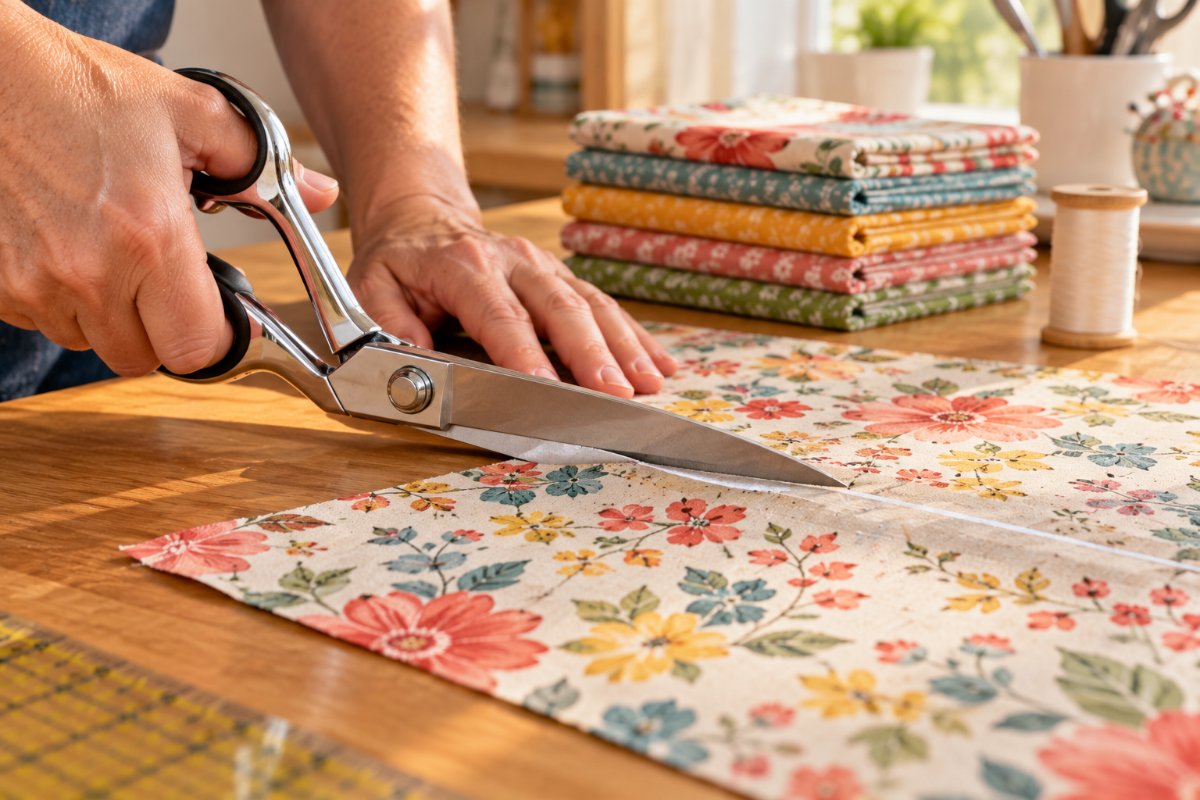
The best fabric scissors for most quilters are an 8-inch pair of bent-handle dressmaker shears with a knife edge, plus a small pair of snips for threads. Start with the Kai 5210: sharp, light, and inexpensive. If you want shears that last a lifetime and can be resharpened again and again, the all-metal Gingher 8-inch is the classic. And if slippery fabrics and fussy cuts are your daily work, a micro-serrated pair like the Karen Kay Buckley Perfect Scissors grips where a smooth blade slides.
This guide to the best fabric scissors covers six picks. It also explains the things most roundups skip: what the steel and edge type mean for how long a pair stays sharp, a 30-second sharpness test, how to fix scissors that fold fabric instead of cutting it, and why the old rule about never cutting paper is true.
Table of Contents
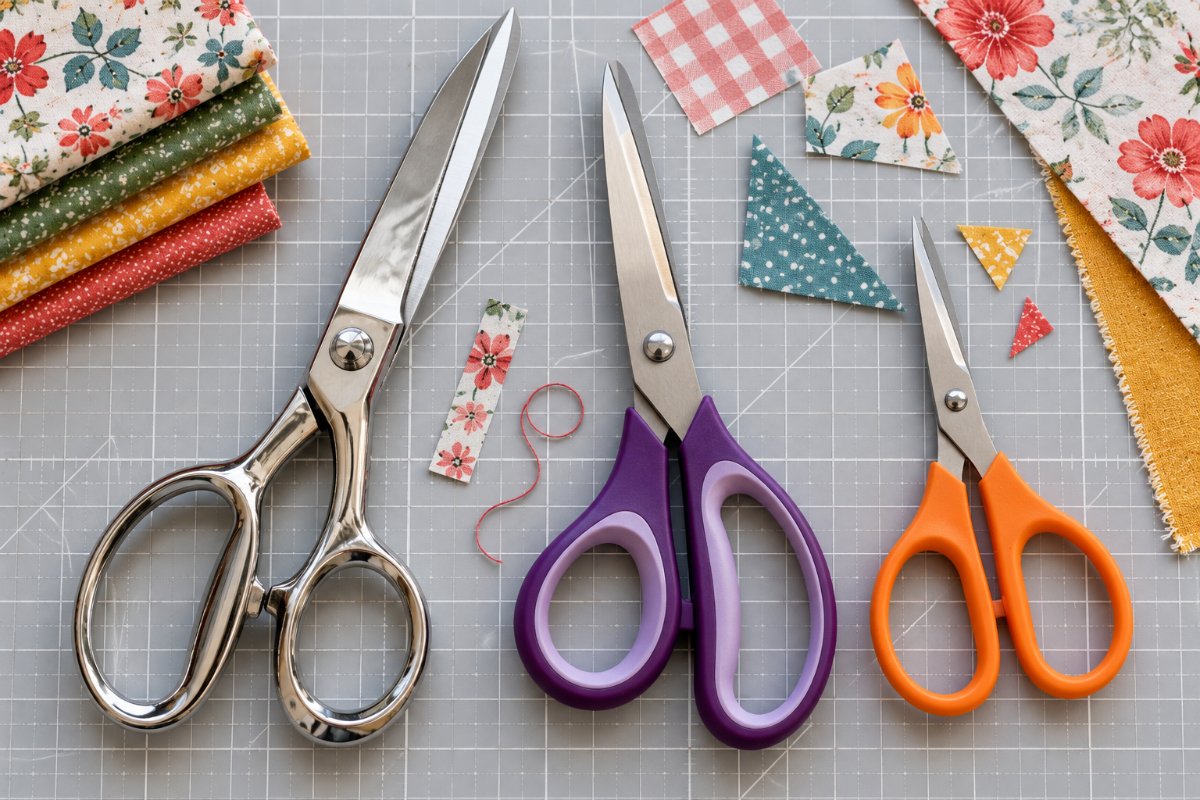
Best fabric scissors at a glance
Prices are approximate Amazon prices at the time of writing and change often.
| Scissors | Length and edge | Best for |
|---|---|---|
| Kai 5210 Dressmaking Shears | 8 in, knife edge, bent handle | Best value for most quilters |
| Gingher 8-Inch Dressmaker Shears | 8 in, knife edge, all metal | Lifetime shears you resharpen |
| Kai 7205 Professional Shears | 8 in, knife edge, full tang | Hardest steel, heavy use |
| Fiskars RazorEdge Softgrip | 8 in, knife edge, soft grip | Comfort on a budget |
| Karen Kay Buckley Perfect Scissors | 7.5 in, micro-serrated | Slippery fabric, fussy cutting, layers |
| Fiskars Easy Action Micro-Tip | 6 in, spring-assisted | Threads, notches, tight spots |
What makes good fabric scissors
Shears vs scissors
Strictly speaking, shears have blades longer than about 6 inches and handles with one small loop for the thumb and one larger loop for several fingers. Most dressmaker shears also have a bent handle, which lets the lower blade lie flat on the table as you cut. That keeps the fabric from lifting, so your cut follows the line instead of wandering. For cutting yardage and backing, bent-handle shears are the tool you want.
Blade length
Eight inches suits most quilters. It's long enough to cut across a fat quarter (a precut fabric piece about 18 by 22 inches) in a few strokes and short enough to control around curves and appliqué shapes. Ten-inch shears move faster through long, straight cuts but get heavy in smaller hands. Anything under 6 inches is a pair of snips or detail scissors, not your main cutting tool.
Knife edge vs micro-serrated
This is the choice that matters most when you shop for the best fabric scissors, and most guides gloss over it. A knife edge is a smooth, finely honed blade. It gives the cleanest cut on cotton and can be resharpened many times by a professional. A micro-serrated edge has tiny teeth along one blade that grip the fabric so it can't slide away. That's a big help on silk, minky, satin, and stacked layers, but most home and many shop sharpeners can't restore those teeth properly once they wear.
So the trade is simple. Knife-edge shears are the long-term tool you sharpen. Micro-serrated scissors are the specialist you reach for when fabric misbehaves.
Steel and hardness
Harder steel holds an edge longer before it needs sharpening. Most makers don't publish a hardness number, but Kai does for its 7000 series: AUS8A stainless steel hardened to about 60.5 HRC (a Rockwell hardness rating, where a higher number means harder steel). The blades are full-tang, running through the handles, with a locking fastener that stops the pivot screw from working loose. That's in the range of a good kitchen knife, which is why the 7000 series stays sharp through heavy daily use.
Handles and weight
All-metal shears like the Gingher feel solid and are easy to resharpen and adjust, but they weigh more and can press into your knuckles during long cutting sessions. Plastic or rubber-covered handles are lighter and kinder to sore hands. If you cut for hours at a time or have arthritis, comfort matters more than steel. Left-handed quilters should look for truly left-handed blades, not just ambidextrous handles. Kai makes a left-handed version of the 5210.
The best fabric scissors for quilting
Kai 5210 8-Inch Dressmaking Shears: best value
The Kai 5210 is the pair most quilters should buy first. It's a bent-handle, 8-inch dressmaking shear with a knife edge, light plastic handles and a reputation for coming sharp out of the box. It's one of the most popular fabric scissors, and it's inexpensive. That low price also means you won't panic if someone in the house borrows it for cardboard.
- Good for: everyday cutting, yardage, backing, trimming blocks.
- Watch for: plastic handles don't feel as solid as all-metal shears. The 5000 series doesn't publish a hardness rating as the 7000 series does.
Gingher 8-Inch Dressmaker Shears: the lifetime classic
Gingher's chrome-plated, all-metal dressmaker shears have been a sewing room standard for decades. The knife edge cuts cleanly to the tip, the bent handle keeps the lower blade flat, and the screw can be adjusted as the pair wears in. They're heavy, and the metal handles aren't padded, but they can be sharpened and tuned for years.
- Good for: quilters who want one pair of shears for life and will send them out for sharpening.
- Watch for: weight and hard handles on long cutting days. Make sure you buy the right-hand or left-hand version you need.
Kai 7205 8-Inch Professional Shears: hardest steel
The 7000 series is Kai's professional line. The 7205 is the 8-inch dressmaking size, with AUS8A steel at about 60.5 HRC, full-tang construction and a fastener designed not to loosen. It holds an edge longer than softer shears, which matters if you cut a lot of batting or heavy fabric.
- Good for: heavy use, long quilting sessions, cutting batting and denim.
- Watch for: it costs more than twice as much as the 5210 for a difference you'll only notice if you cut a lot.
Fiskars RazorEdge Softgrip 8-Inch Shears: comfort on a budget
Fiskars' RazorEdge shears pair a honed stainless steel knife edge with soft, cushioned handles. Fiskars says its advanced pivot design gives its smoothest cut yet, and the listing calls out fabrics like silk and oilcloth. It's the comfortable middle ground between the Kai 5210 and the premium pairs.
- Good for: quilters with tired or sore hands who still want a full-size pair.
- Watch for: the soft handles are larger than Kai's, which some smaller hands find bulky.
Karen Kay Buckley 7.5-Inch Perfect Scissors: best for slippery fabric
These are the quilters' favorite for appliqué and fussy cutting. The micro-serrated blade grips fabric so it doesn't slide, and the listing says it cuts up to eight layers. They come with a protective blade cover. They're the pick for detail work.
- Good for: appliqué shapes, fussy cutting, minky and other slippery fabrics, stacked layers.
- Watch for: micro-serrated edges are hard to resharpen. Use these as a specialist pair, not your only shears.
Fiskars Easy Action Micro-Tip 6-Inch Scissors: best small pair
Full-size shears are too big for thread work, so every quilter needs a small pair next to the machine for threads, notches and tight corners. Fiskars' Micro-Tip scissors have fine, pointed stainless blades that cut right to the tip and a spring-assisted handle that opens after each cut. That's easier on your hand when you're snipping hundreds of threads.
- Good for: trimming threads, clipping curves, snipping dog ears.
- Watch for: they're for detail work, so don't use them for long cuts through yardage.
How we chose these fabric scissors
We didn't pick these from a single bestseller list. Every pair here had to meet four tests. We wanted a maker with a long record in sewing tools, a strong record of owner reviews, a clear use case in a quilter's sewing room, and published specs we could check, such as length, edge type, and steel. Where a maker publishes harder numbers, like Kai's steel hardness, we used them.
Fabric scissors vs a rotary cutter
Most piecing (sewing small fabric pieces together into a quilt top) today is done with a rotary cutter, a ruler and a cutting mat, because they're faster and more accurate for straight strips and squares. That doesn't make fabric scissors obsolete. Shears are still better for curves and appliqué shapes, trimming batting and backing after quilting, cutting yardage off the bolt at home, and any cut where a mat isn't handy. Most quilters use both every day.
Which fabric scissors for which job
Most quilters end up with three pairs. Here's how the work splits between them.
| Job | Best tool | Why |
|---|---|---|
| Cutting yardage and backing | 8-inch knife-edge shears | Long blades and a bent handle keep long cuts straight |
| Strips, squares and triangles | Rotary cutter and ruler | Faster and more accurate than any scissors |
| Appliqué shapes and fussy cutting | Micro-serrated 6 to 7.5 inch scissors | Grips fabric so small shapes stay put |
| Trimming batting after quilting | Long shears you keep for batting | Batting is hard on edges, so keep your best pair off it |
| Threads, dog ears and notches | Small snips or micro-tip scissors | Fine points reach tight spots by the machine |
| Finishing seam allowances | Pinking shears | The zigzag edge slows fraying |
Specialty scissors quilters use
Beyond everyday shears, a few specialty pairs are worth owning.
- Appliqué scissors with a wide, flat "duckbill" lower blade let you trim close to a stitched edge without nicking the fabric underneath.
- Curved snips trim threads flat against a quilt top without poking into it, which is why longarm quilters keep a pair on the frame.
- Batting scissors are long, lightweight shears kept just for batting, so the fibers and scrim (a thin web that holds some battings together) don't dull your good pair.
- Pinking shears finish raw seam allowances on bags and garments where the inside shows.
A 30-second test for sharp scissors
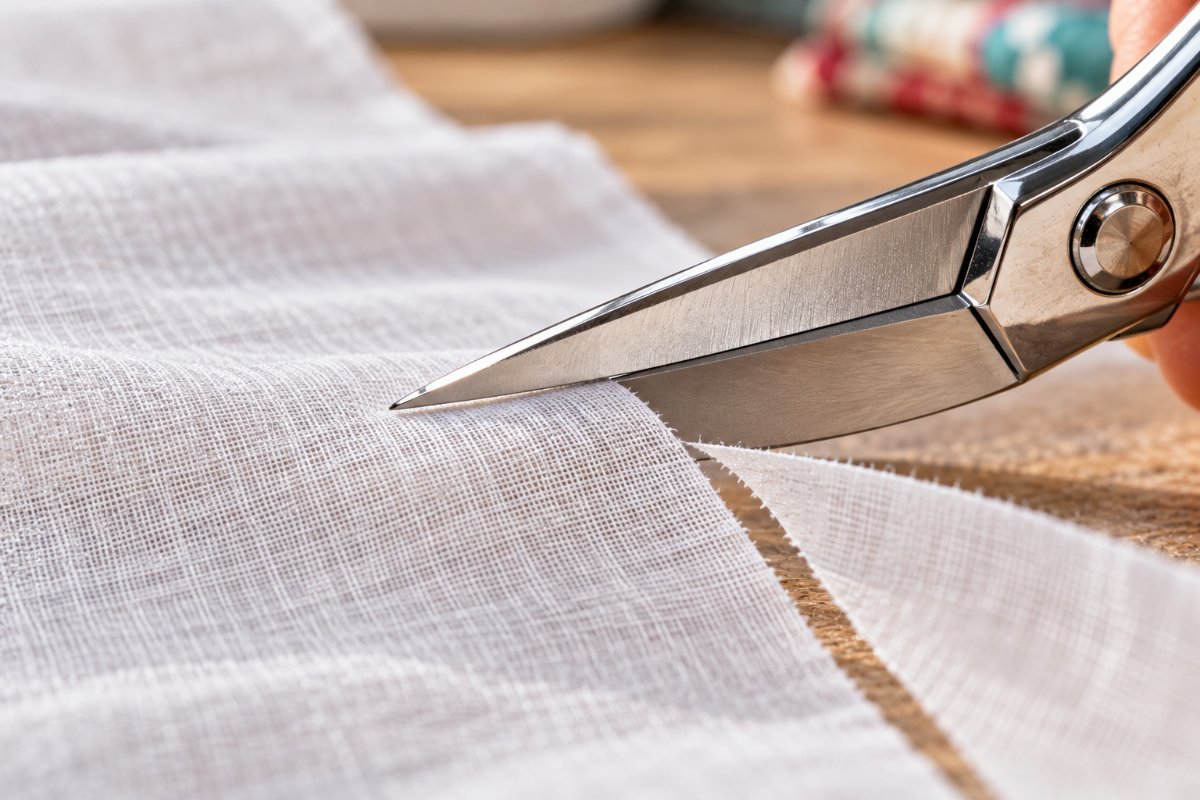
- Take a scrap of thin, lightweight cotton or lawn, a single layer.
- Cut slowly using only the last inch of the blades, right at the tips.
- A sharp pair cuts cleanly all the way to the point. A dull pair chews, folds the fabric into the gap between the blades, or leaves a ragged edge near the tip.
- Repeat near the pivot. If the pair cuts well at the pivot but not at the tips, the tips are dull, or the blades have lost tension.
Run this test when you buy a pair, and every few months after. It tells you whether you need a sharpening or just a tension adjustment.
Why scissors fold fabric instead of cutting it
When fabric slides into the gap between the blades and folds over, the blades aren't meeting tightly enough. On shears with an adjustable screw, like the Gingher, tighten it a fraction of a turn and test again. Too tight and the shears get stiff and wear faster, so make small changes. If the blades still don't meet at the tips, the pair needs professional sharpening and setting. Don't force shears with a locked or riveted pivot. Take them to a sharpener.
Care and sharpening
- Cut fabric and thread only. Paper often contains mineral fillers such as clay that wear an edge down faster than cloth does. Pins and staples nick the blades.
- Wipe lint and fusible residue off the blades after each project. Fusible web gums up blades quickly.
- Put a drop of sewing machine oil on the pivot now and then, open and close the shears a few times, and wipe off the excess.
- Store them closed, with a blade cover if they came with one, and never drop them point first. A bent tip is hard to fix.
- Send knife-edge shears to a professional sharpener when the 30-second test fails. Avoid pull-through kitchen sharpeners, which grind the wrong angle on sewing shears.
Pinking shears are a separate tool with their own care needs. Our pinking shears guide covers those.
Frequently asked questions
What are the best fabric scissors for quilting?
For most quilters, an 8-inch pair of bent-handle, knife-edge dressmaker shears plus a small pair of snips. The Kai 5210 is the best value, the Gingher 8-inch is the classic all-metal pair, and the Karen Kay Buckley Perfect Scissors are best for slippery fabric and appliqué.
Are Gingher or Kai scissors better?
Both are excellent. Gingher shears are heavy, all-metal and easy to adjust and resharpen. Kai shears are lighter, with plastic handles, and the professional 7000 series uses AUS8A steel hardened to about 60.5 HRC for long edge life.
Why should you not cut paper with fabric scissors?
Paper often contains mineral fillers such as clay that wear down a sharp edge faster than fabric does. Over time that dulls the blades, especially at the tips, which is where precise fabric cuts happen.
Can micro-serrated scissors be sharpened?
They are hard to resharpen. Many sharpeners cannot restore the tiny teeth properly. Use micro-serrated scissors as a specialist pair for slippery fabric and keep knife-edge shears as your main pair to sharpen.
How often should fabric scissors be sharpened?
When they fail a simple test: cutting a single layer of thin cotton cleanly at the tips. With fabric-only use, good shears can go a long time between sharpenings.
Which one to buy
The best fabric scissors are the ones that stay sharp because you use them only on fabric. Start with a Kai 5210 for everyday cutting and a small pair of snips by the machine. Add a micro-serrated pair for appliqué and slippery fabric. If you want one pair to keep for decades, buy Gingher or Kai 7000 shears and have them sharpened when the tip test says so.