
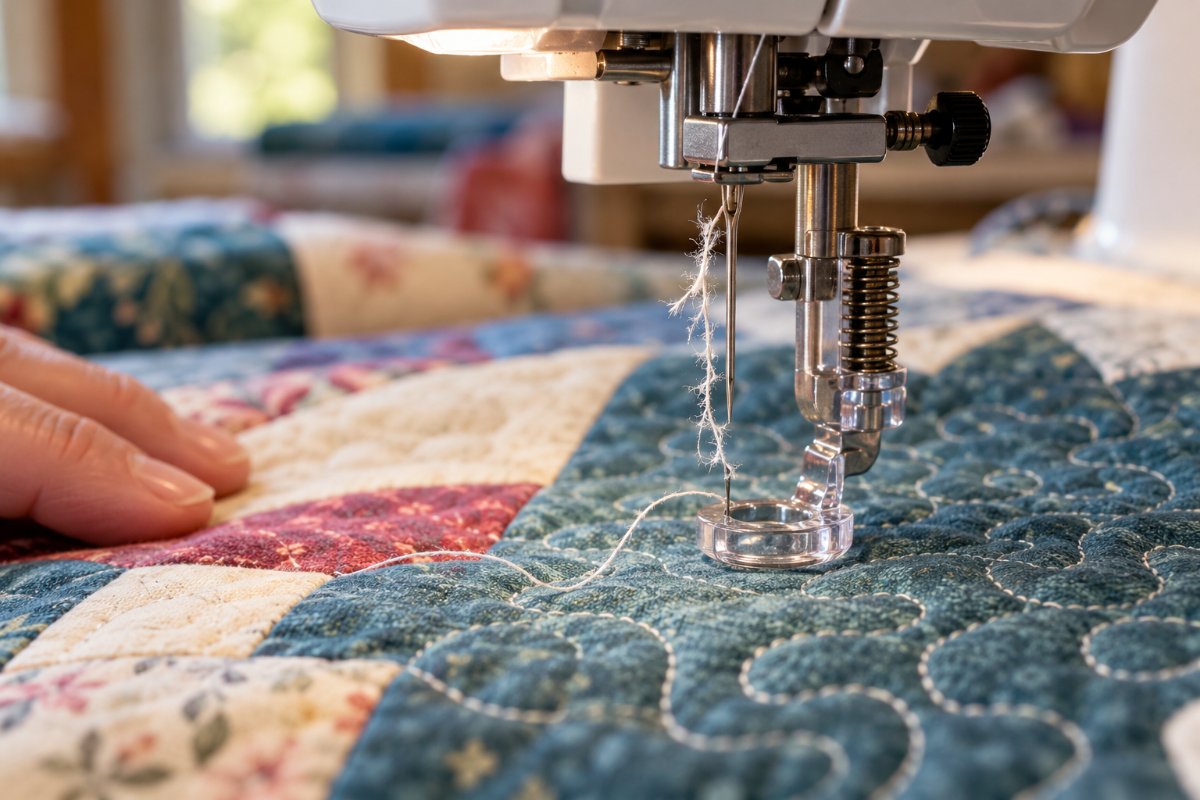
Your thread keeps breaking when quilting, usually halfway across a row of feathers often with the needle buried in the quilt sandwich (the top, batting and backing stacked together). The break itself is a clue. Where the thread snapped, and what the broken end looks like, points to the needle, the tension, the spool, or the thread path long before you need a repair shop.
This guide works through the causes in the order worth checking, cheapest and fastest first. Most of the time the answer is a needle swap or a tension dial turned down a step or two.
Table of Contents
Start with where the thread breaks
Before you change anything, pull out the broken tail and look at it. Superior Threads tells quilters to find the point of origin first, because thread that shreds at the needle and thread that snaps up near the spool have different causes. Use this table as a starting map.
| Where it breaks and what the end looks like | Most likely cause | Try this first |
|---|---|---|
| Frayed, fuzzy end right at the needle | Needle eye too small for the thread, or a burr in the eye | A fresh needle one size up, or a Topstitch needle |
| Clean snap somewhere above the needle | Top tension too tight, or thread caught on the spool or a guide | Rethread with the presser foot up, then lower the top tension |
| Twists or kinks just above the needle | Thread twisting as it unwinds off the end of the spool | Move a straight wound spool to a vertical pin or a thread stand |
| Random breaks, and the thread snaps easily by hand | Old, dry, or poor-quality thread | Test a second spool of the same thread |
| Breaks only when you move in one direction | Needle hitting the thread, or a burr on the foot or needle plate | Slow down and check the foot and plate for nicks |
| The bobbin thread breaks | Lint, a burr on the bobbin case, or a bobbin seated the wrong way | Clean the bobbin area and reseat the bobbin |
If your thread breaks in more than one of these ways, work down the sections below in order. Change one thing at a time so you know which fix worked.
Check the needle first
A needle eye that is too small for the thread is the most common reason top thread shreds and breaks at the needle, according to Superior Threads. The thread rubs the edges of the eye on every stitch until it frays apart. Quilting thread is often heavier than the 50 weight thread used for piecing (sewing small fabric pieces together into a quilt top), so the 80/12 needle left in from your last piecing session may simply be too small.
Go up one size. When the trouble is at the needle, move from an 80/12 to a 90/14: a 90/14 for 40-weight thread, and a 100/16 for 30-weight and heavier threads. A Topstitch needle helps too, since it has one of the largest eyes you can get for a home machine. Our guide to the best needles for quilting covers specific picks by thread weight.
Don't trust a needle just because it's new. A needle picks up a tiny burr the first time it clips a pin, and the odd one comes out of the pack with a flaw. Try a second new needle, even if the first was fresh. If the broken end looks fuzzy rather than cleanly cut, suspect the needle first.
Loosen the top tension for quilting thread
Most home machines come set up for fine 50 weight polyester thread. Thicker quilting threads need less tension. When the tension discs grip too hard, the thread snaps cleanly somewhere between the discs and the needle, often with no fraying at all. If every break has a clean, sharp end, tension is the likely reason.
The factory preset on most machines is around 5, and settings between 2.5 and 4 suit most threads. Metallic thread goes down to about 1. Lower the dial one small step at a time, stitch on a practice sandwich made from the same fabric and batting (the soft middle layer of a quilt) as your quilt, and stop when the stitches look even on both sides.
Leave the bobbin (the small spool that holds the lower thread) alone at first, since bobbin tension tends to be the more reliable of the two. If you do adjust it, mark the screw position with a permanent marker and turn it a quarter turn at a time. Our guide to fixing uneven tension on a quilting machine walks through balancing top and bobbin together.
Fix how the thread comes off the spool
Twisted or kinked thread is the next suspect, especially if the break lands just above the needle. It sounds too small to matter. It isn't.
Spools and cones are wound differently. Most spools are straight-wound, with the thread laid in neat parallel rows, and they feed best from the side on a vertical spool pin so the spool turns as the thread leaves it. Cones are cross-wound and are meant to sit still on a thread stand while the thread lifts up and off the top. Put a straight-wound spool on a horizontal pin, and the thread comes off the end, picking up a twist with every wrap. That twist can cause trouble with more delicate threads.
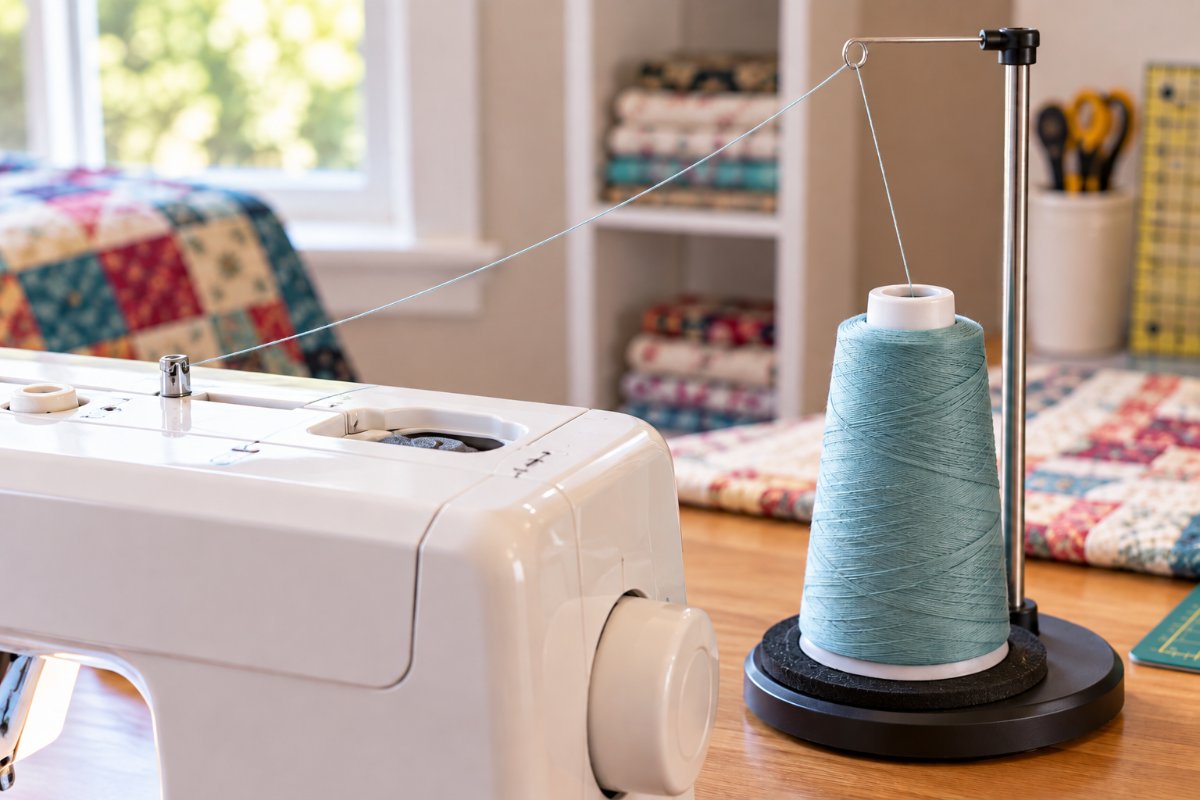
A few smaller things catch people out. Many spools have a notch on one end to hold the thread tail, and the thread can snag on it, so on a thread stand, set the notched end at the bottom. If thread slides down and pools around the base of a cone, a thread net holds it in place. On a longarm (a large quilting machine that rides on a frame), Handi Quilter lists a thread mast that isn't centered over the cone as one cause of shredding.
Rule out the thread itself
Thread ages. Cotton and cotton blend thread can dry out and turn brittle after years on a shelf, and brittle thread breaks with very little pull. Snap a length between your hands. If it gives way easily, retire the spool, no matter how much is left.
Superior Threads suggests a simple test to tell a thread problem from a machine problem. Put on a second spool of the exact same thread (same brand, type, and weight, though the color can differ) and stitch again without changing anything else. If the second spool runs fine, the first one is probably bad. If the thread keeps breaking with the new spool too, the cause is somewhere in the machine setup.
Check the label for the word glazed, too. Glazed cotton is made for hand quilting, and both Superior Threads and YLI say not to run it through a sewing machine, because the coating rubs off in the tension discs and gums up the thread path. For threads that run well on home machines, see our roundup of the best thread for machine quilting.
One less obvious link: some high sheen threads don't get along with adhesive sprays. If the breaks started after you spray-basted, test that combination on a scrap. Our basting spray guide covers the sprays quilters use most.
Look for snags along the thread path
Thread can slip out of a guide or catch on something rough on its way to the needle. Rethread the whole machine with the presser foot (the part that holds fabric flat under the needle) raised, so the tension discs are open and the thread seats between them, and make sure it runs through the take-up lever.
Then look for burrs. A needle strike can leave a nick in the needle plate, the bobbin case, or the hook, and that rough spot shaves the thread every time it passes. Run a fingernail around the needle hole in the plate and along the edge of the bobbin case. Anything that catches your nail will catch thread.
Lint does its damage quietly. A packed bobbin area, or lint lodged in the tension discs, adds drag. If your thread breaks at random, with no pattern you can spot, lint is a good bet. Brush it out before you start a big quilt, and oil the machine if the manual calls for it. Our sewing machine oil guide covers the cleaning and oiling routine.
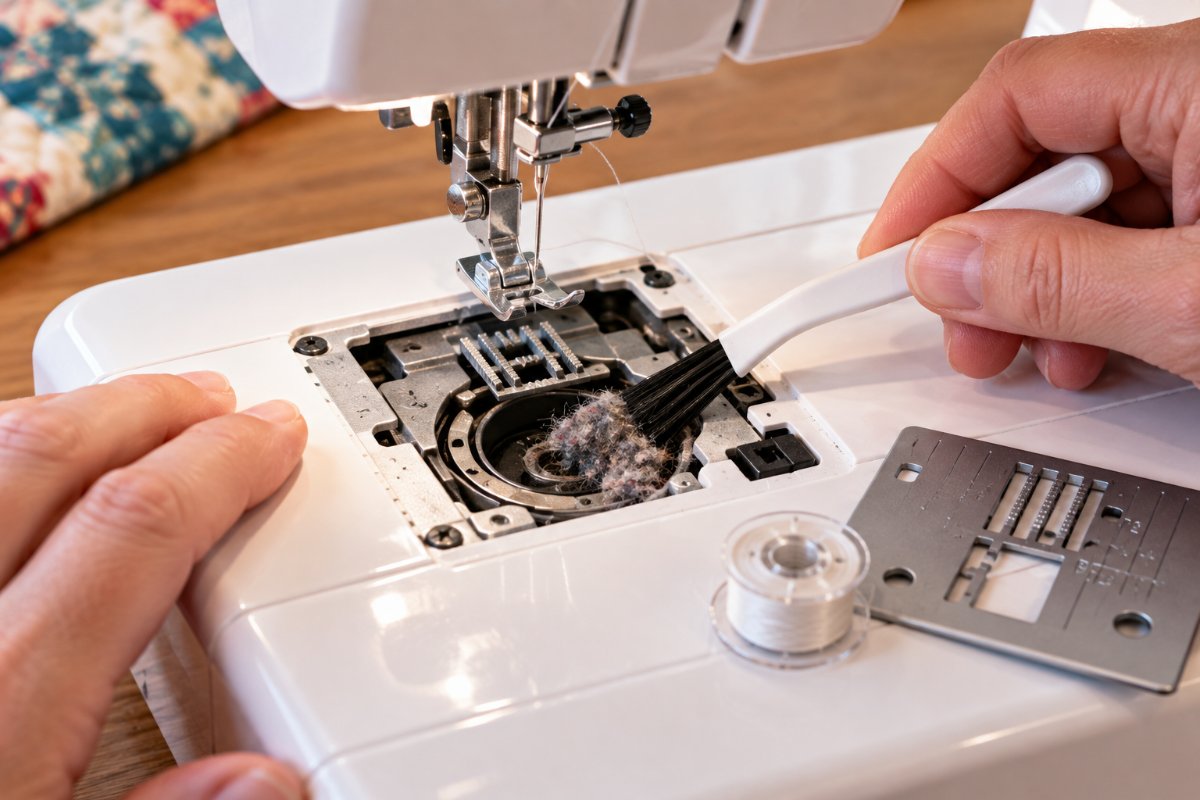
If the bobbin thread breaks, check that the bobbin sits in the case as your manual shows, that it isn't wound too full, and that the case has no nicks along its edge.
Why thread breaks more during free motion quilting
Free motion work is harder on thread than straight line quilting. The feed dogs are down, your hands set the stitch length, and the quilt moves in every direction. That's why many quilters find their thread breaks during free motion work, even though piecing on the same machine goes fine.
Change your speed first. Slowing down often solves breakage on its own, and a mismatch between how fast you move the quilt and how fast the needle runs adds drag on every stitch.
If the thread only breaks when you move the quilt one way, the needle may be coming down on the thread itself. Handi Quilter's support pages describe this on longarms: pushing or pulling the thread under the needle lets the point pierce it. A burr on one side of the foot or plate can cause the same one-direction pattern. Try quilting that section from another angle, and check the foot and plate. If your machine lets you adjust the free-motion foot height, lower it so it just clears the quilt top.
Skipped stitches often turn up alongside breaks, and the fixes overlap. If you're getting both, read our guide to fixing skipped stitches when free motion quilting. If you're shopping for a machine built for this kind of work, see our guide to the best sewing machine for free motion quilting.
When the machine needs a dealer
Say you've fitted a new needle one size up, lowered the top tension, tried a fresh spool of good thread, fixed the thread delivery, cleaned out the bobbin area, and slowed down, and the thread still breaks. At that point, the machine may be out of time. Handi Quilter tells longarm owners in that spot to have a dealer retime the machine, and the same goes for home machines. Timing isn't a kitchen table repair for most quilters.
A quick fix list, in order
- Look at the broken end and note where it broke.
- Rethread the top thread with the presser foot up, and reseat the bobbin.
- Put in a new needle one size larger, or a Topstitch needle.
- Lower the top tension one step at a time and test on a scrap sandwich.
- Move a straight wound spool to a vertical pin, or put a cone on a thread stand.
- Test a second spool of the same thread.
- Brush out lint from the bobbin area and feel for burrs on the plate and bobbin case.
- Slow down, and notice whether breaks happen in one direction only.
- If nothing works, book a service visit.
Frequently asked questions
Why does my thread keep breaking when free motion quilting?
Common causes include a needle that is too small for the thread, top tension set too tight, and moving the quilt at a speed that doesn't match the needle. Go up one needle size, lower the top tension a step, and slow down. If breaks happen only in one direction, check the foot and needle plate for burrs.
What size needle stops quilting thread from breaking?
Match the needle to the thread weight. Superior Threads recommends a 90/14 for 40 weight thread and a 100/16 for 30 weight and heavier threads. If thread shreds at the needle, go up one size, for example from 80/12 to 90/14, or switch to a Topstitch needle with a larger eye.
Can old thread cause breaking?
Yes. Cotton and cotton blend thread can dry out and turn brittle with age. Pull a length between your hands, and if it snaps with little effort, replace the spool.
Should I adjust top tension or bobbin tension first?
Start with the top tension. Bobbin tension is usually more reliable. If you do change the bobbin, mark the screw position first and turn it a quarter turn at a time.
Can I use hand quilting thread in my sewing machine?
Not if it is glazed. Glazed hand quilting thread has a coating that rubs off in the tension discs and thread path. Thread labeled for machine quilting is unglazed and works for both machine and hand quilting.
Summary
When your thread keeps breaking, read the broken end before you touch a dial. Frayed at the needle points to the needle. A clean snap points to tension or a snag. Kinks point to the spool. Sort those three out, and most breaks stop without a trip to the dealer.